
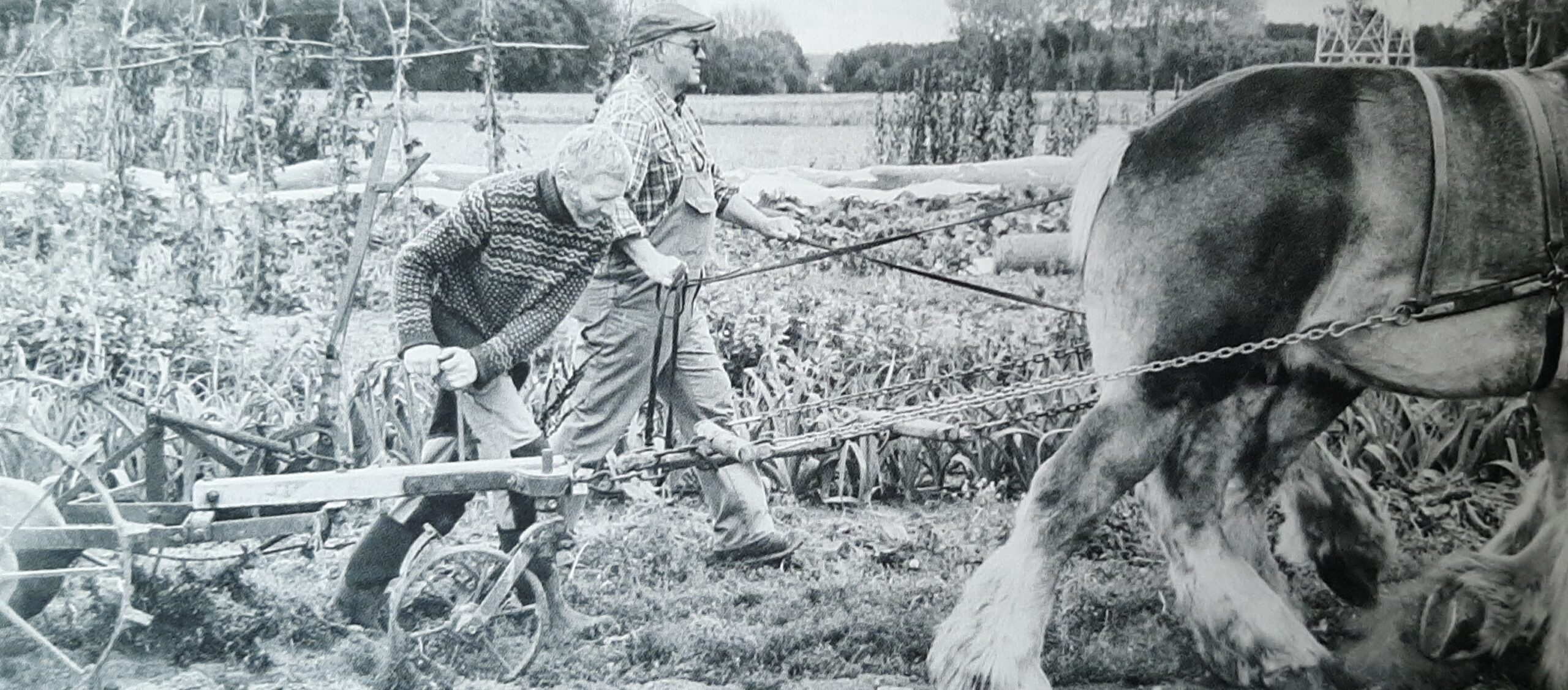
“That’s me,” smiles Frans Van Laerhoven, pointing to a photo in a book of a young boy steering a plough pulled by a massive Brabant draft horse. “The picture was taken on my parents’ witloof farm,” he says.
I’ve come to visit Frans and his partner Anja in Nederokkerzeel, a Flemish green-belt village 25km north-east of Brussels, to learn more about the gentle giant of the Belgian equine scene.
They invite me to join them over a drink, together with Frans’s brother Louis and his wife Ingrid, at a table in the barn-cum-bar that stands next to their attractive L-shaped farmhouse.
The couple, who have seven draft horses and an eighth on the way (one of their mares is expecting), are busy preparing for an open day at their base, where visitors can see the powerful horses up close and learn about the history of the breed.
Their love of the draft horse is immediately obvious. “Come with me,” says Anja, leading the way into their kitchen and lounge. The rooms are a veritable shrine to the breed. Practically every wall, nook and cranny is adorned with paintings, photographs and drawings of their horses. There’s even a handwritten poem dedicated to the mighty steed, and the weathervane on their rooftop depicts...well, you can guess.
Returning to the barn, I can’t but notice that half the space is taken up by a jumble of various horse carriages. “Tell him how many you have,” says Anja. Frans starts counting on one hand. Anja shakes her head, giving him a withering look. “Er, it’s 10,” he confesses. A line of rosettes on one of the walls attests to Frans’s success in equestrian competitions, both as a solo rider or carriage team driver.
While his ever-expanding carriage collection might be a sore point, the draft horses are most definitely a shared passion.
“We see it as our duty to share our knowledge about the breed,” says Anja. “We want to inspire new generations to continue what we’re doing in the future.”
But, before we go on, a quick word on terminology.
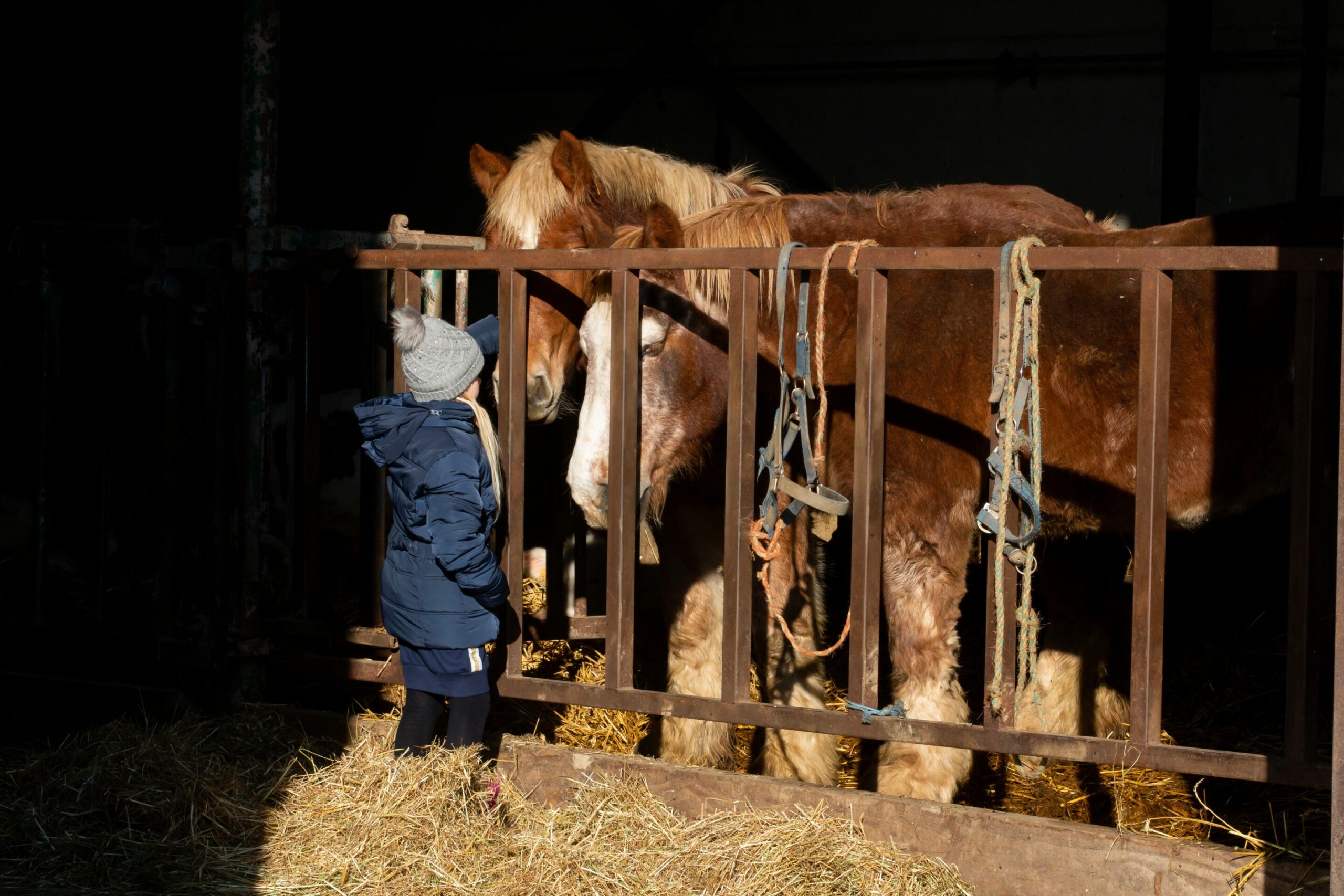
A chold carresses a Belgian draft horse during the 13th edition of the 'Day of the crafts', at the 'Ferme de la bosse jauque' in Gilbecq, Sunday 17 November 2019. Credit: Belga / Nicolas Maeterlinck
The Brabant and Belgian draft horse are essentially the same animal – the Brabant was selectively bred after the Second World War to be thicker bodied and heavier. Both strains are known as ‘Brabander’.
Draft is sometimes spelt draught and some refer to them as dray horses, especially in the brewing trade. In Flemish, the breed is known as the Brabants (or Belgische) Trekpaard and, in French, Cheval de Trait belge.
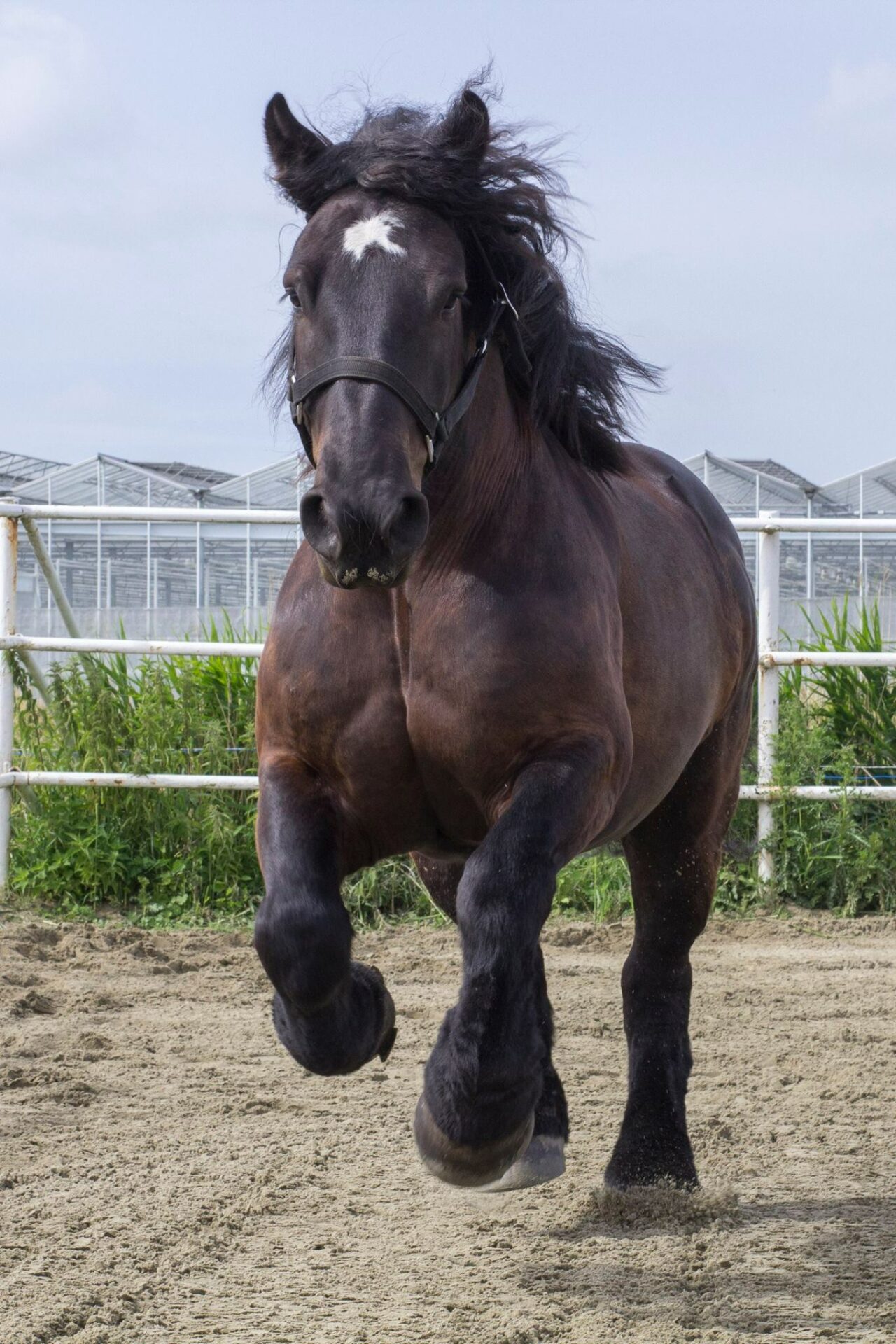
Renowned for their strength and placid nature, the horses can weigh 1,000kg or more and reach up to 1.7 metres at the ‘withers’, the top of the back.
While tractors and trucks gradually began to displace the working horse on Belgian farms from the 1950s, Frans’s parents continued using them until the end of the 1970s on their farm in the nearby, improbably named village of Erps-Kwerps.
Born among horses
One of six children, Frans opted to leave farming and instead trained as a pilot. He flew long-haul for Belgium’s former national carrier Sabena and later for supply chain company DHL. But he never lost his enthusiasm for the horses he’s loved since he was a child. Now retired, 66-year-old Frans has more time to dedicate to his Brabander.
Anja, 53, a relative novice by comparison, has a mere 15 years’ experience with the breed, although she is not surprised her life took an equine direction. “I was born among horses in Vilvoorde,” she explains, the town famed for its horse fair and Rik Poot’s magnificent farmhorse bronze (‘Het Boerenpaard’) which stands in front of the gothic Church of Our Lady and Good Hope (Onze-Lieve-Vrouw van Goede Hoopker) in the town centre.
The locals in Vilvoorde are known in Belgium as the ‘Pjeirefretters’ (horse-eaters) due to their keen taste for the meat delicacy. While it is taboo in the US and many other countries, horse meat is much leaner than beef and my hosts are regulars at the town’s renowned De Kuiper restaurant, which specialises in ‘chevaline’.
Despite a full-time job working for an association that supports people with chronic illnesses and mental disabilities, Anja puts in endless hours helping Frans to look after their horses, which are kept in fields up the road, as well as a menagerie of other animals at their farm including chickens (see article on Mechelse koekoek), geese and two Jack Russell terriers.
The horses, in particular, seem like exhausting work – and none too cheap to look after. “It is a hobby and, let's say, quite an expensive hobby,” she says. “It's not a business: our drive stems from our love for the horses.”
Their horses all have names. “The oldest is Isa, who is 13, then it’s Elske, who’s expecting, Gust, Youri, Jean, Nestor and Nieke. They all have their own unique character and they’re super intelligent,” Anja says. “Isa is our alpha-mare. With her, it’s ‘get out of my way, I'm the boss here’. Elske can come across as a bit stupid, but she’s not. She pretends not to understand what you’re asking her to do, then does it. Gust is very easy-going and unstressed. His attitude is ‘if it’s not happening today then it will tomorrow’. Youri is the opposite. It’s ‘yes, where and when’?”
And the others? “Jean is very affectionate, but also impatient. He was a very big foal and I had to sleep next to him for two weeks, making sure he put his head under his mother to feed. Nestor and Nieke are our youngest, both two years old. While Nestor is very friendly, Nieke has a character which is more like Isa’s.”
Horse bureaucracy
Every Brabant draft horse has a kind of birth certificate, which provides their breeding details and full name, which includes the place and region where they were born. For Nestor, his full name is Nestor van den Mussenhoek (the name of their farm) van Vlaams Brabant. “Each horse has an identification chip in the left shoulder and, when they are born, you must declare if they are intended for pleasure or for eating,” explains Frans.
The region pays a premium for every foal, but this barely makes a dent in the cost of feed or vet’s bills.
In theory, the horses eat grass in the summer and hay in the winter, supplemented with pellets, carrots and beets. But the hot weeks during the summer left the horses’ pastures with barely a blade of grass so the couple had to provide replacement feed.
Draft horses are generally very approachable and calm – unless they have recently foaled. “If we go into the field, there’s no problem in that situation because they know us,” Frans says. “The relationship is based on trust. But they’re very protective. If you went into the field, you’d probably get chased.”
Elske was mated with a stallion at a stud farm at Vollezele in the Pajottenland, southwest of Brussels. She is due to produce her foal next spring. “Genetic diversity is very important for the future of the breed,” Frans continues.
“You have to be careful to avoid, ahem, incest,” his other half adds helpfully.
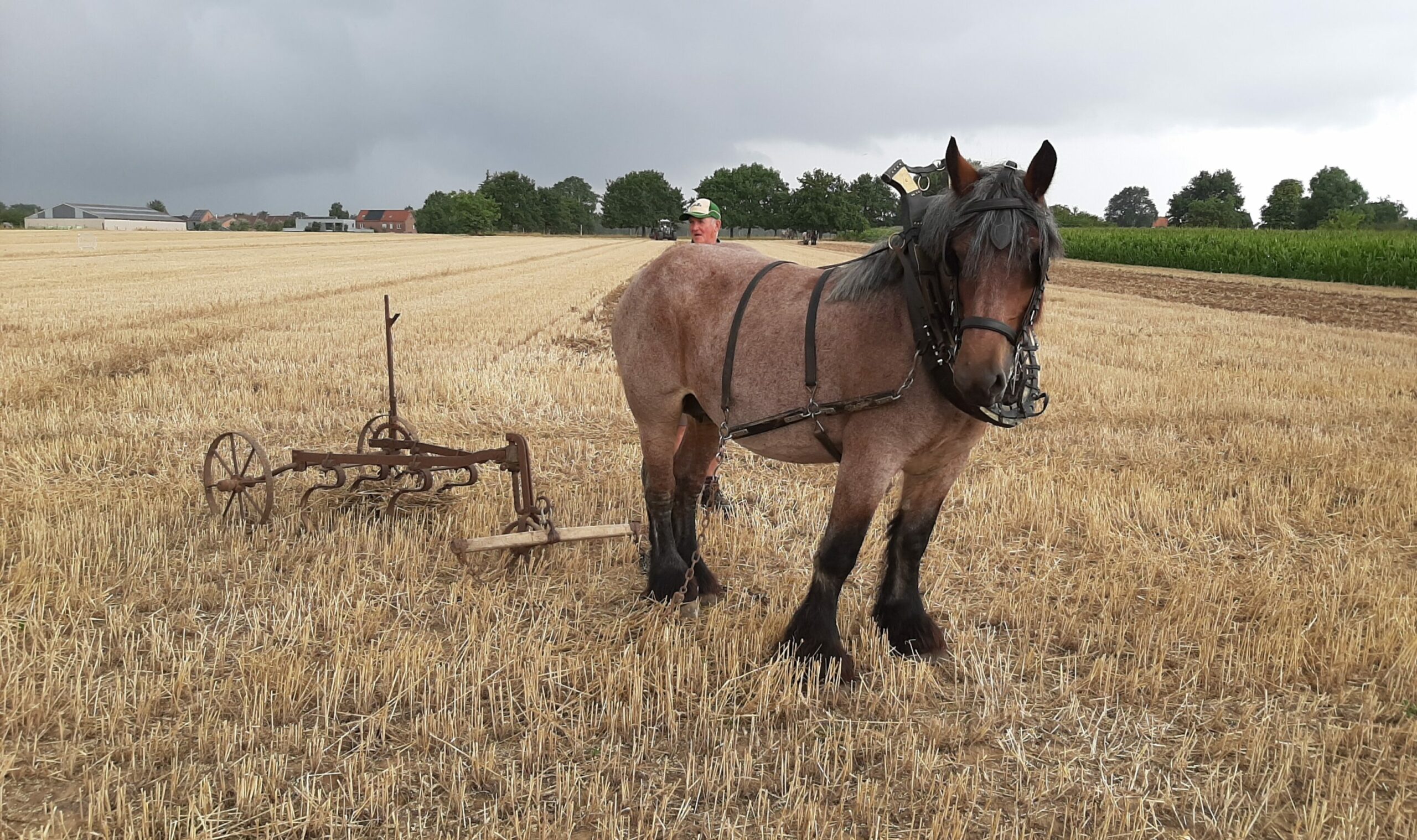
Draft horse can still do field work
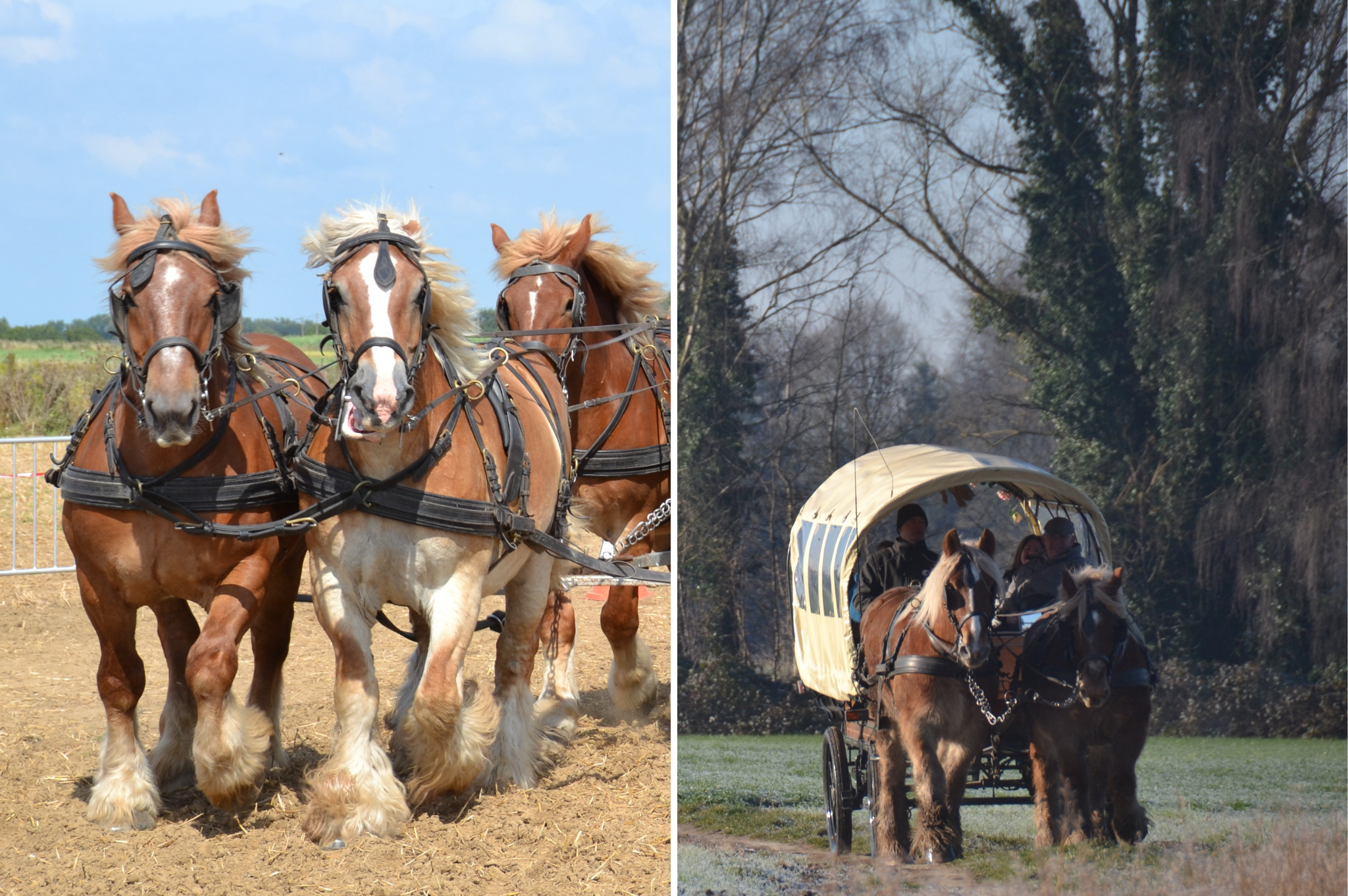
A few days later, I return for the open day at their farm. As well as their own herd, other enthusiasts have brought horses, too. There are around 20 and they make a magnificent sight. Several are pulling ploughs in the field behind their farm (the horses move more briskly than you might think), while others are giving rides or taking groups in covered carriages.
A popular attraction is the “flying carpet” with a pair of horses pulling excited little ones on a rug behind them. Unfortunately, the weather suddenly turns and we are caught in a torrential storm. Nearly everyone makes a dash for cover, including a few of the handlers.
One finds space next to me and gently tries to coax her horse towards us. He’s having none of it and pulls her back into the teeming rain. He must be a good 900kg, so it’s no contest.
They say you can lead a horse to water but shouldn’t expect him to drink. This one could be an exception. He is thoroughly enjoying himself as he splashes his hooves up and down in the water gathering on the surface of the field.
As we huddle for shelter from the downpour, the friendly giant looks at us and shakes his head. It’s as if he’s trying to tell us something.
I don’t know horse-speak but I’ve an idea that it could be “you lightweights”.
Bonus: What is the history?
Descendant of the medieval ‘Great Horse’, the Belgian draft horse was a frequent sight in towns and villages in the 19th century after the industrial revolution drove demand for horses capable of pulling heavy machinery.
The first studbook, a genealogical register, was created with the founding of the Société Nationale du Cheval de trait Belge in 1866.
In 1878, a stallion called Brillant from the Haras de Vollezele – his statue stands outside a museum dedicated to the draft horse – won a top prize at the Exposition Universelle (World's Fair) in Paris, followed by a string of championship victories across Europe. Brillant’s success made Vollezele a global hub for the trade in heavy horses. In the early 20th century, Belgian draft horses were exported throughout Europe, Asia and the United States.
In the First World War, the horses were often used to haul heavy artillery guns or pull supply wagons on the battlefields of Flanders and northern France. In 1919, the national association became the Société Royale Le Cheval de Trait Belge (Koninklijke Maatschappij het Belgisch Trekpaard in Flemish).
While the Belgian/Brabant is still used as a traditional working horse, notably in forest management and by coastal shrimp fishers at Oostduinkerke (my colleague Angela Dansby wrote about them in the previous issue), the breed is more often seen today in recreational roles.
Covered wagon rides are a popular attraction in the green belt around Brussels and draft horses are also used as a form of therapy to help adults and children improve their physical and mental abilities.
Today, the draft horse is regarded as a Belgian cultural icon: in 2018, the horse was added to the Flanders Inventory of Intangible Cultural Heritage. Projects linked to the breed have received funding via the EU Rural Development Programme, aimed at translating agricultural techniques from the past into new uses. For example, the Hof Ten Dormaal brewery in Tildonk used draft horses to help in the cultivation of hops for its excellent beers.
Bonus: Hilse’s tribute
Belgian filmmaker Hilse De Groote has spent the past five months criss-crossing the country with her Brabant draft horse, Elixir, for a documentary she plans to make about the breed.
Her trek, backed by crowdfunding and volunteers, was also a tribute to her late grandfather, Philippe van Dixhoorn, who owned a stud farm in Vollezelle and founded the Belgian Draft Horse Museum 25 years ago.
“The draft horse has been incredibly important in our history – it put us on the world map,” she says. “My grandfather is no longer here, but he’s the reason I had the idea to make the journey. I wanted to learn more about what fascinated him and filled his heart.”
Hilse, 38, and Elixir covered 10 to 15km a day and received a VIP welcome in the towns and villages they passed through. “The reactions have been fantastic,” she adds. Elixir, who started the trip weighing 850kg, has also benefited from receiving extra treats. “I think she’s even put on a little weight,” she laughs.
The Belgian Draft Horse Museum, located in the former town hall of Vollezele, will be the focus of activities during the Brabant Draft Horse Day (Dag van het Brabants trekpaard), which is on October 19.
