
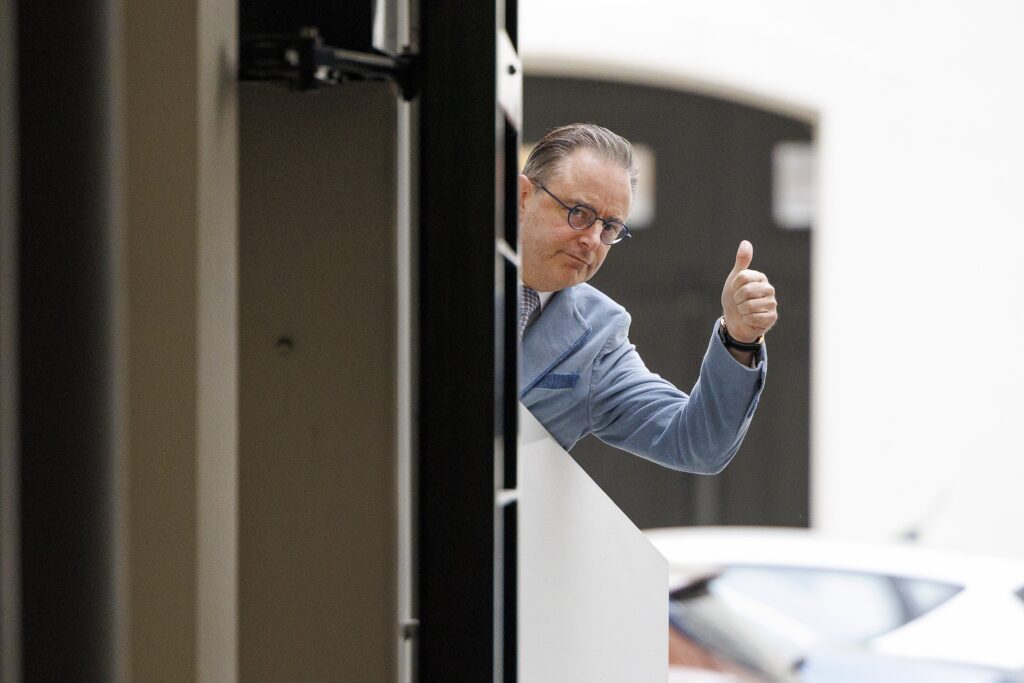
Belgian Prime Minister Bart De Wever (N-VA) was forced to delay his 'State of the Union' speech in the Federal Parliament on Tuesday after his government failed to agree on its federal budget in time.
After fruitless weekend talks, the cabinet meeting on Monday morning also ended without a result as the so-called Arizona coalition (N-VA, MR, Les Engagés, CD&V and Vooruit) tries to agree on both its 2026 budget and the multi-annual budgets.
"The budget is not a piece of paper," Prime Minister Bart De Wever commented to the Belga News Agency after the meeting of the select committee failed to deliver his government's budget.
"We will continue to work over the next few days to reach an agreement on the 2026 budget and beyond if possible," added Deputy Prime Minister David Clarinval (MR).
Public anger
In recent weeks, the Prime Minister has found himself isolated among his government coalition after calling for further spending cuts to plug more budgetary holes, particularly after proposing freezing automatic wage indexations and harmonising VAT rates.
With tens of thousands of trade unionists taking part in Tuesday’s national strike, Belgium's Federal Government is facing considerable protests over its pension and labour market reforms, which it justified as necessary in order to bring down the country’s public debt.

Members of the trade unions gather for a demonstration in Brussels against the Arizona government's measures, on Wednesday 25 June 2025 in Brussels. Credit: Belga
Many sectors are angry about the pension reform: even the Belgian army's unions made a rare appearance in national demonstrations this year due to how the reforms affect their sector.
Since last week, Belgium's maritime pilots are currently blocking around 100 ships carrying goods from docking at Belgian ports (as younger pilots face having to sign up to pensions which are around 50% lower than their older counterparts).
The country's judiciary has also stressed the need for investment as it deals with chronic prison overcrowding as well as skyrocketing organised crime and drug trafficking levels. In April, Belgium's public prosecutors launched an unprecedented protest against the pension reforms.
Deficit not improving despite reforms
Tuesday’s mobilisation had been planned to coincide with De Wever's 'State of the Union' speech, but the failed talks show that his government's task is not simple. The Prime Minister has even called finding these savings as being "the most difficult exercise of this century".
Under its plans, the Federal Government wants to reduce the budget deficit by around €10 billion by 2029. Belgium is under added pressure from the European Union, which placed it under an excessive deficit procedure (EDP) after it failed to meet the requirement that urges all Member States to lower their deficits to 3% of GDP.
Related News
- National strike: What trade unions say about Belgium’s budget woes
- Special report: Brussels Region allegedly misused EU funds to pay off debt
- Behind Brussels’ finances: is the city's debt worse than it appears?
- Foreign Minister warns of tense political climate, does not rule out Government collapse
- Report reveals Brussels generates wealth it does not get to keep
- Brussels appoints new Budget Minister
- More Belgians opting for early retirement despite government push to extend careers
But there is still much at play. Despite the widespread labour market and pension reforms, the deficit and debt under the De Wever government are still not improving as much as the Arizona partners had hoped.
In particular, the budget monitoring committee's predictions have left the Federal Government reeling. By the end of this year, the federal budget deficit is projected to reach €26.2 billion, equivalent to 4.1% of GDP, according to an estimate in July.

Vice-Prime Minister and Budget Minister Vincent Van Peteghem arrives at a 'Kern' meeting gathering selected Ministers of the Federal Government, Monday 13 October 2025 in Brussels. Credit: Belga
Last month, the latest bulletin from the monitoring committee predicted that the budget deficit will rise to €39 billion in 2029 if current policies remain unchanged, €1.7 billion more than estimated in July.
The deficit for Entity I – which includes federal authority and social security — is expected to remain stable at 4.2% of GDP (€26.6 billion) in 2026, before rising to 5.8% of GDP (€40.1 billion) by 2030.
These figures include additional defence spending outlined in the Easter budget agreement to meet NATO’s standard of 2% of GDP dedicated to military expenses.
In its latest forecast, the Federal Planning Office says that for the coming year, Belgium’s budget deficit will be just under €36 billion.
Many economists, particularly in Flanders, agree that the Federal Government's sweeping cuts are necessary.
"The demographics are clear: there are fewer and fewer people paying for more and more. So the current system must be reformed or it will disappear. We are heading for a brick wall," UGent's economist Koen Schoors told VRT earlier this year.
Cuts or no cuts
With the Arizona coalition seeking to save between €8 and €10 billion by 2029 to meet EU deficit targets, the Flemish nationalist Prime Minister has argued for further public spending cuts in order to make more savings.
Last week, De Wever was given a cold shower by all of his coalition partners, including their main government allies, the French-speaking liberals MR, for having suggested a freeze on automatic wage indexations as a solution.
Belgium has a long-standing system of automatic wage indexation, meaning wages rise in line with inflation, giving workers extra protection when it comes to purchasing power and the cost of living.
Freezing wage indexations would impact the purchasing power of most Belgian households. This made other government partners nervous at a time of ongoing tensions about the pension and labour market reforms.
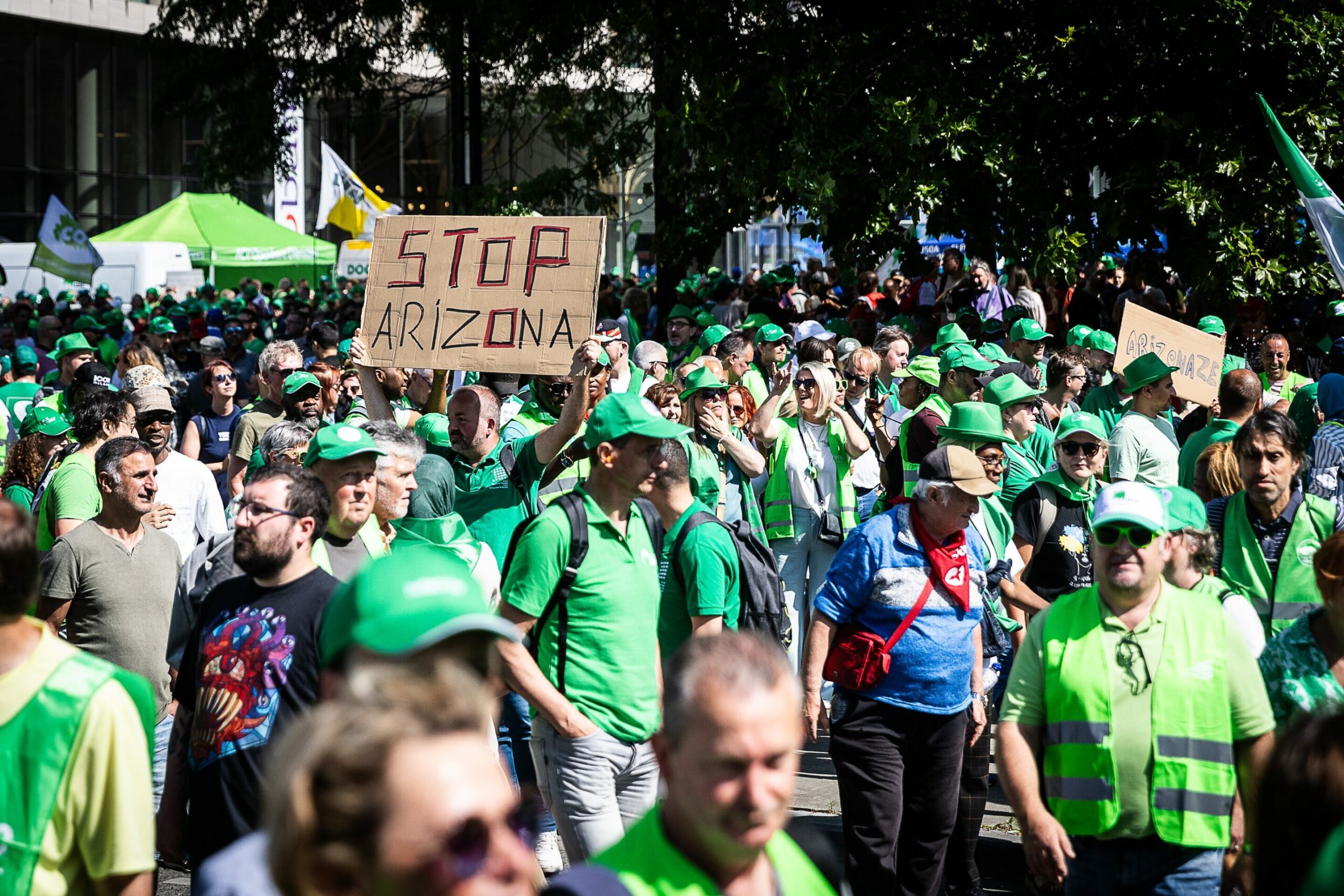
Members of the trade unions gather for a demonstration in Brussels against the Arizona government's measures, on Wednesday 25 June 2025 in Brussels. Credit: Belga / James Arthur Gekiere
Indeed, some say the move would alienate trade unions further, while straining relations between employers and workers. Many SMEs are reporting that their workers are struggling with the cost of living, and despite the economic temptation of an indexation freeze for employers, there are worries that it would risk doing more harm than good.
This was argued by Pierre-Frédéric Nyst, President of the Union of the Middle Classes, which represents self-employed people and French-speaking SMEs in social consultation bodies, in an interview with L’Echo last weekend. He nonetheless praised the efforts of the Federal Government in helping SMEs.
Another proposal by De Wever in recent weeks has been the harmonisation of lower VAT rates. This would consolidate the 6% and 12% rates into a standard 9%.
This measure would hit low-income families the hardest, according to the Belgian Central Economic Council (CEC), which represents both trade unions and employers. It also warned that raising VAT could result in the loss of thousands of jobs while generating only limited budgetary returns.
Tax avoidance?
Meanwhile, the Budget Minister Vincent Van Peteghem (CD&V) has recently opened the door to finding other ways of raising money beyond spending cuts.
These include taxing management companies, reducing copyright tax exemptions and flexible jobs (known as flexi-jobs) – which he says all cause the Belgian State to lose revenue.
These measures largely target tax avoidance as a way of helping the government raise more capital.
For example, with management companies, the government believes that many freelancers and companies that use these services are not paying adequate taxes, meaning the government is missing out on significant revenue.
The Budget Minister is sticking to his target of reaching 3% deficit in 2030, which he says would amount to saving €16 billion over four years.
Belgium's Foreign Minister Maxime Prévot (Les Engagés), who is also a deputy PM, fears that the target of reducing the federal budget deficit to 3% of GDP by 2030 is "excessive" and threatens to undermine the competitiveness of businesses and household spending.
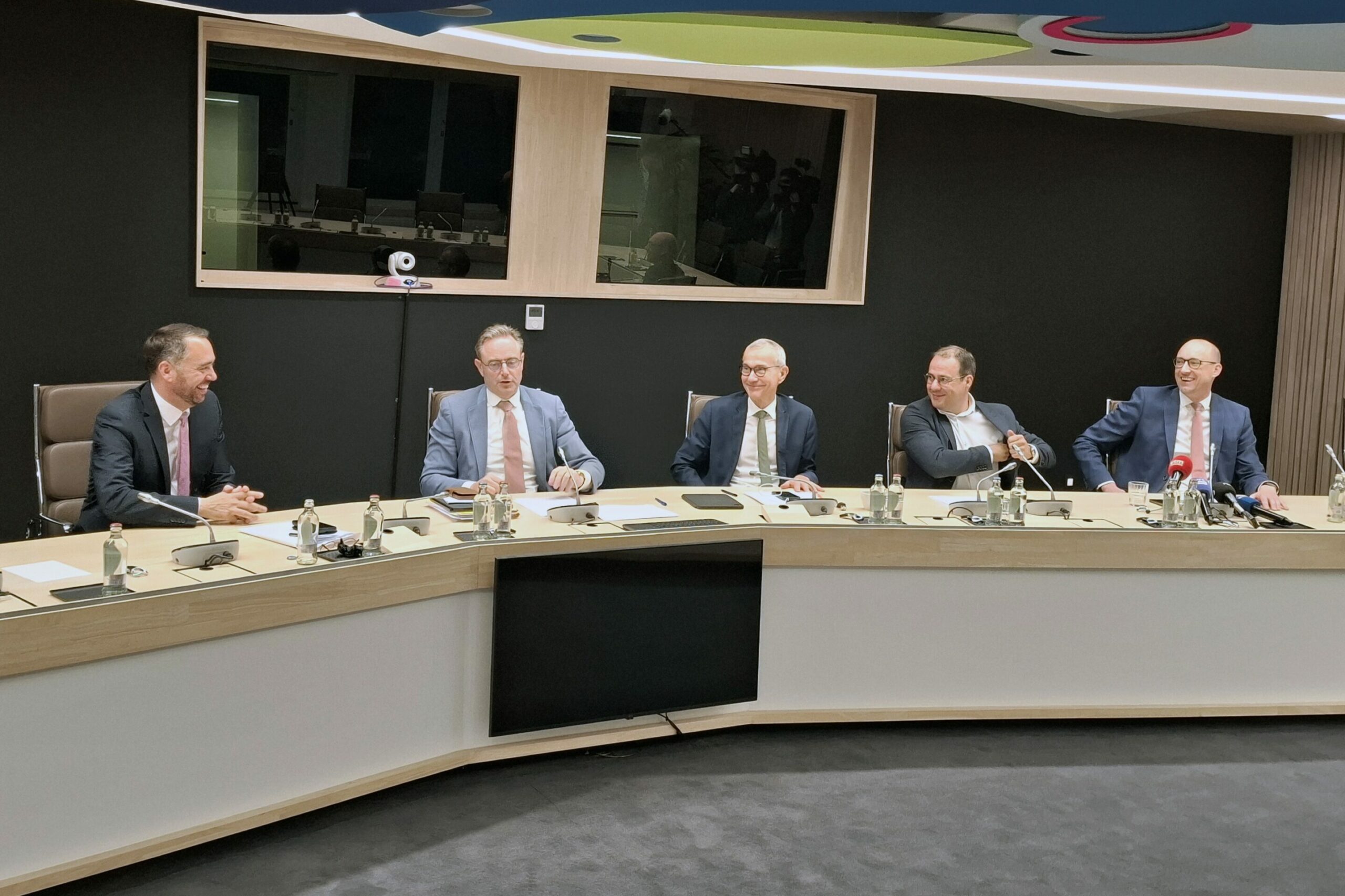
Foreign Minister Maxime Prevot, Prime Minister Bart De Wever, Health Minister Frank Vandenbroucke, Economy Minister David Clarinval and Budget Minister Vincent Van Peteghem hold a press conference, Monday 21 July 2025 in Brussels. Credit: Belga
While Van Peteghem told Le Soir that he would not touch pensions anymore when finding savings, he believes significant cuts need to be made to Belgium's healthcare system, with Health Minister Frank Vandenbroucke looking to cut around €900 million from the health budget despite the issues facing the sector.
The pressure is growing on the De Wever government to deliver on many of its promises, but even in its budget considerations, it appears to be stalling.
Furthermore, a report released in May by Belgium's Court of Auditors cautioned the Federal Government that its projected benefits from the wide-reaching labour and pension reforms may be significantly overestimated, especially concerning employment growth.
According to Le Soir, the public deficit in 2029-2030 under Arizona is expected to reach €40 billion, which will be double what it was at the end of the previous government led by Alexander De Croo in 2024.
In more positive news, on Saturday the credit rating agency Moody’s maintained Belgium's rating at Aa3, which was better than expected and also shows that it considers the credit risk to be 'very low'.
