
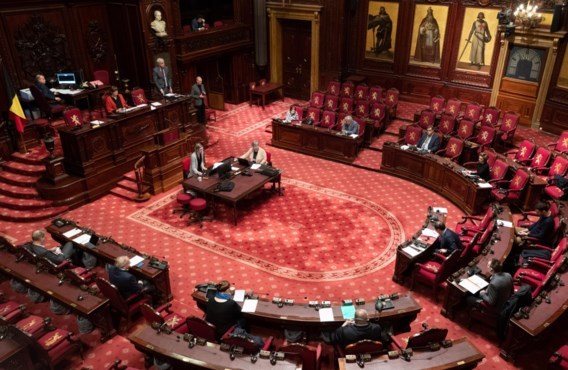
In his opening speech for the 2025-2026 parliamentary year, Senate President Vincent Blondel announced that the Senate's Institutional Affairs Committee will begin examining proposals to dissolve the institution in November.
Since its inception in 1831, the importance of the 'upper house' in Belgium's political system has been constantly debated and discussed.
For years now, a number of political parties have been calling for its abolition, arguing that its relevance is now negligible. Others, however, argue for its preservation as a forum for dialogue between the federated entities, which is considered essential in a federal structure.
From aristocratic roots to democratic reform
When Belgium declared independence in 1830, its founders looked to Great Britain for inspiration. The new kingdom adopted a bicameral parliament: a Chamber of Representatives for the people and a Senate for the elite.
Even the colour scheme mirrored Westminster, where the House of Commons (lower house) is furnished in green, while the House of Lords (upper house) is red.
In its early decades, the upper house acted as a conservative counterweight, made up of property owners and notables who met strict income thresholds. It was, quite literally, a chamber of privilege designed to temper the democratic zeal of the lower house.
That balance began to shift as Belgium gradually democratised.The first major reform came in 1893 with the introduction of universal male suffrage, tempered by plural voting. In 1921, true universal male suffrage was introduced, and women gained the vote in 1948.
The Senate became more representative, with members elected directly or indirectly, and for most of the century it shared real legislative power with the Chamber. Every major law had to pass through both.
But as Belgium evolved into a federal state, the Senate’s role was rewritten again and again. Starting in the 1970s, a series of state reforms turned it from a political heavyweight into a space for institutional dialogue. The 1993 reform, the moment Belgium officially became federal, redefined the chamber as a meeting point between the country’s federal entities, its regions and linguistic communities.
The 2014 reform further reduced its role: senators stopped being directly elected and became largely non-permanent, with 60 members drawn from regional parliaments. In the wake of this reform, the Senate no longer votes on laws or holds the government to account.
An institution that ran out of allies
If the aim was to position the Senate as a point of convergence between the federal government and the federated entities, there was not enough political will to make it work in practice. Parties, notably the N-VA, which has long advocated the Senate's abolition, did not cooperate, gradually undermining the institution's purpose. Now, its disappearance seems all but inevitable.
The possible abolition of Belgium’s Senate is raising concerns among constitutional experts. Anne-Emmanuelle Bourgaux (UMONS) told RTBF that it is a "missed chance to reinvent the institution as a citizen-participation chamber", especially since a 2024 law already allows for citizen commissions.
Writer David Van Reybrouck also envisions a citizens’ chamber to bring more diversity into politics. Bourgaux warns, however, that shifting the Senate’s role to the comité de concertation (consultation committee) composed of ministers rather than parliamentarians, would further empower the executive and weaken democratic oversight.
The Senate also serves as a key forum for dialogue between Belgium’s federated entities and for monitoring international relations - responsibilities that risk being neglected should it be dismantled. For Bourgaux, suppressing it behind closed doors would be “a poor signal for Belgian democracy”.
