

Wherever you are in Belgium, you will hear myths and legends unique to each region, based on folk tales older than the country itself.
Having originated in sparsely populated and remote regions like the Ardennes, these folk tales resurfaced in cities and towns, where they were retold, recorded and reinvented.
To get you in the mood for Halloween, The Brussels Times has compiled a list of the country's creepiest and most intriguing folk tales and urban legends below.
A child-snatching werewolf
A young girl stays out late one night in Mechelen, walking by the canal all alone. A growl from a nearby bush startles her, and the next thing she sees is an approaching red-eyed dog. The dog transforms into a tall man, who tries to snatch the little girl into the underworld as she screams in desperation. Luckily, some locals hear the scuffle and come to her rescue, scaring away the dark figure. As the man runs away, he is last seen magically transforming back into dog.

A pair of red eyes at a desolate spot on Mechelen's waterfront (staged photo). Credit: Kosmos Khoroshavin / The Brussels Times
Oude Rode Ogen (Old Red Eyes) is a demonic werewolf-like child snatcher said to be haunting the area around Mechelen at night.
The legend on which this urban myth is based says that a pitch-black shapeshifter terrorised Mechelaars for a long time. Tired of it, the inhabitants organised a manhunt on the banks of the River Dyle, finding the figure and stripping it of its glistening magical skin. They hid it in a sacred place, deep in the cellars of St. Rumbold's Cathedral, hoping to prevent the beast from using its shapeshifting abilities. However, Oude Rode Ogen is said to still wander around Mechelen looking for its stolen skin to regain its original powers.
A shapeshifter tricking people into their demise
A man stays in an Antwerp inn until late at night, drinking into the wee small hours. On his journey home, he hears footsteps behind him. As he turns back, he finds another man following him. The drunk starts running, but the other man does so too. Luckily, he arrives at his house unscathed, hiding in his bed. Later, he hears a knocking on his window. When the man peers out, a giant as tall as the surrounding houses towers over him. “If you get drunk again, I will break your neck,” he says.

The statue of the Lange Wapper at Het Steen fortress of Antwerp. Credit: Kosmos Khoroshavin/The Brussels Times
This bizarre tale is one of many stories locals of Antwerp and surrounding towns ascribe to the Lange Wapper. He is a folkloric trickster capable of acquiring different forms to fool people, with his favourite guise being that of a giant. Legends involve him tricking people into their deaths, vexing drunkards and bamboozling young children.
Sometimes, as in the above example, the story includes a moralistic element, but other times Lange Wapper is merely a mischief-maker, blurring the line between protector and tormentor. This is a classic archetype for European trickster characters, whose role was to scare people into behaving morally out of fear.
The statue of Lange Wapper can be seen at Het Steen fortress in the old city centre of Antwerp. Different districts of the city claim ownership of the trickster, with Wilrijk being particularly keen to claim the giant as their own. Wilrijk's 20th century mayor Louis Kiebooms reportedly bestowed honorary citizenship on Lange Wapper.
The eyes watching you in the Sonian Forest
Walking through the Sonian Forest, a night wanderer finds himself shrouded in a green mist. Shivers run down his spine as he feels someone watching him from the darkness. A loud, childlike laughter erupts when he sees little dark figures scattering in different directions. Suddenly, the fog disappears as mysteriously as it had appeared.
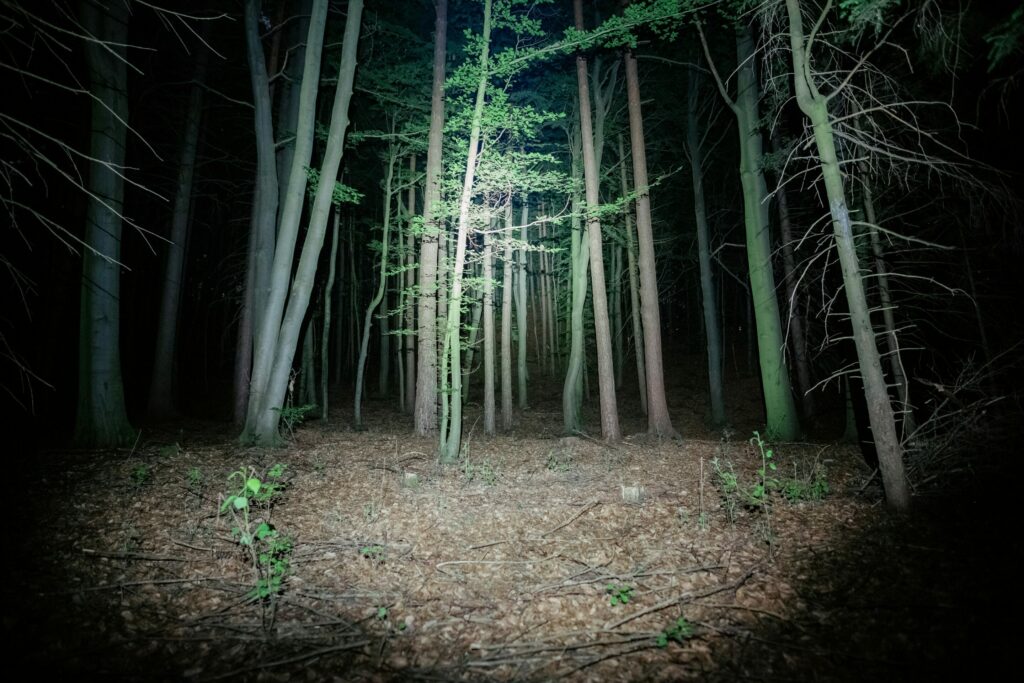
A night forest. Credit: Unsplash
De Ogen (The Eyes) is an urban legend centred around a ghost-like figure said to haunt the Sonian Forest on the edge of Brussels. After its victims feel stalked by the eyes, coloured fog appears, followed by running child-like figures. Drivers passing the forest may find bloody palm prints on the windows of their cars, which disappear later on, just like the fog.
Online sources point to the origin of the story in De Kinderen van Het Bezeten Bos ('The Children of the Possessed Forest') a book as folkloric as the tale itself. Supposedly written in 1837, it documents local nuns finding burned bodies of up to 80 children dumped in the Sonian Forest. However, without any real evidence of the book's existence, it is hard to tell if the real origin of De Ogen is anything more than a recent online fabrication or a series of pranks on late night-walkers.
The insatiable wolf
A farmer's family in East Flanders walks out of the house to find all of their sheep dead on the land. The animals appear to have been mauled to death by something, but the only traces of the creature are wolf-like paw prints on the ground. Tragic, but not unusual - at least if it wasn’t happening simultaneously across regional lines, separated by rivers and highways.
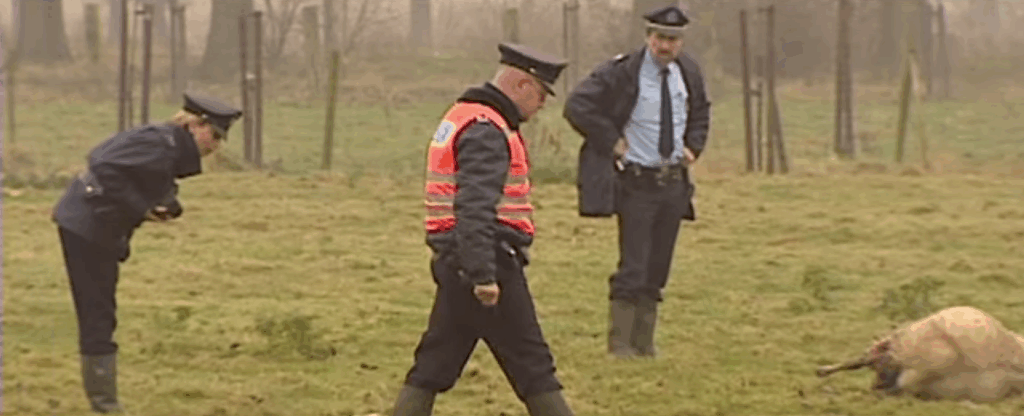
Belgian police officers inspecting what seems to be a sheep mauled by the Waasland Wolf. Credit: screengrab from Fans of Flanders YouTube channel
This is a real case turned folklore, documenting the elusive Waasland Wolf, also referred to as Isegrim. In the early 2000s, a wolf-like creature killed about 60 sheep in a short period in the Waasland region of East Flanders and north of the border in the Netherlands. The animal apparently carried out its attacks simultaneously in remote locations.
Belgian and Dutch police carried out searches for the creature - even deploying a helicopter to no avail. The Waasland Wolf was supposedly spotted as far away as Brussels and Ghent.
The attacks resonated with many locals for their resemblance to Reinaart de Vos (Reynard the Fox) – a morally ambiguous fox trickster from medieval Dutch animal epics.
The story ended as mysteriously as it started with a local hunter sending an anonymous message to Belga News Agency claiming he had killed the wolf. While no evidence for this was provided, the killings of the sheep did stop.
