
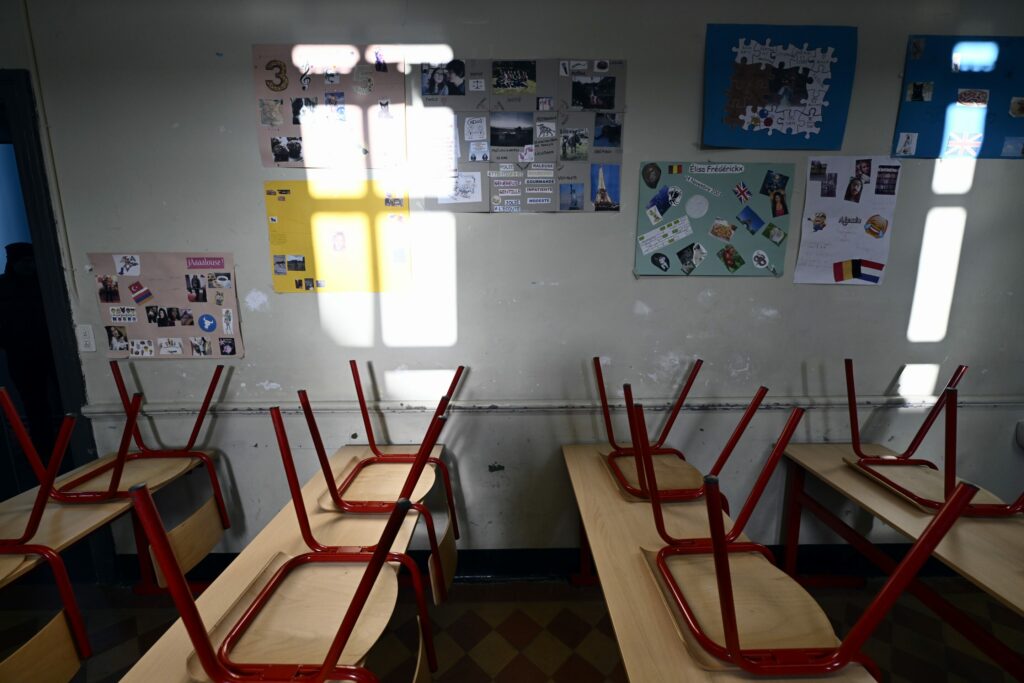
Around 120,000 teachers in Belgium's French-speaking community (Federation Wallonia-Brussels) are on strike today to protest planned austerity measures introduced by the governing 'Arizona' coalition.
The strike aims to highlight what unions describe as harsh budget cuts adversely affecting students, families, and the already difficult working conditions of educators.
Union leaders have emphasised that this mobilisation is not a day off but a day of action against the government’s austerity decisions.
Symbolic protests
Various demonstrations are planned across the region, including traditional picket lines at schools and the handing out of leaflets.
In Brussels, teacher unions will lay a wreath at Place Surlet de Chokier outside the Federation Wallonia-Brussels government headquarters in memory of deceased colleagues.
In other areas, educators have organised symbolic protests, including a “slow-drive” procession from the Lion’s Mound in Waterloo to Nivelles, a solidarity chain at Roosevelt Square in Mons, and funeral vigils in Namur and Liège to figuratively bury government reforms.
These protests follow the Federation Wallonia-Brussels government’s announcement on 10 October that €86.7 million in budget savings would be implemented in compulsory education next year.
Among the measures are a 10% increase in workloads for upper secondary school teachers without salary adjustments, reduced sick leave pay, and stricter rules on early retirement allowances.
The unions are also angered by broader reforms, such as plans to end civil servant status for new teachers in favour of fixed-term contracts.
Further strike action planned
A second day of strike action is planned for 25 November, as part of a larger, nationwide public sector protest involving three days of union action at the end of the month.
Schools are obligated to remain open during the strike and must provide childcare services for attending students.
Union officials have stated their frustration with a lack of dialogue and expressed strong dissatisfaction with the government, arguing that trust has been irreparably damaged.
Protests against the federal government's policies have been ongoing since the start of the current legislature, highlighting persistent tensions between educators and the authorities.
A significant mobilisation previously took place in November 2024, when schools saw their first strike day under this administration, followed by two strike days and a demonstration in January that drew over 30,000 participants.
In April, unions staged a week of “rolling actions” across various provinces, illustrating sustained opposition to the government’s measures.
