
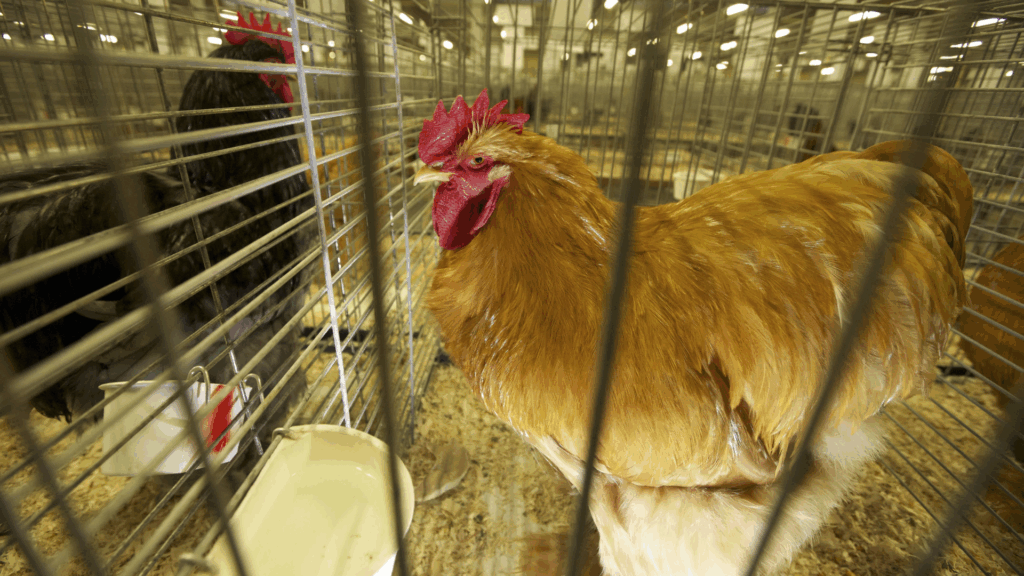
A bird flu outbreak has plagued Belgian poultry farmers this autumn, but while the situation is being monitored, health authorities advise the general public to take precautions.
Since October, cases of the highly contagious viral disease, commonly known as bird flu, have been found in eight poultry farms and in chickens belonging to one amateur breeder. Several wild birds were also infected.
The disease can affect almost any bird species, and in exceptional cases, the flu can infect mammals, although human infections in Belgium remain rare.
Symptoms of the disease in humans are similar to those of a regular seasonal flu; however, the consequences can be more severe for those with weaker immune systems, according to Hélène Bonte, spokesperson for the Federal Agency for the Safety of the Food Chain (FASFC).
Protect your pets
Speaking to The Brussels Times, Bonte said that no recalls have been issued for meat or eggs due to concerns of bird flu contamination, as the food safety agency has been able to trace potentially infected products before they hit the supermarket shelves.
According to Bonte, the FASFC is not concerned at the moment about the possibility of human infections.
Nonetheless, the health agency encourages people to thoroughly cook their meat and eggs to eliminate any risk of infections.
Additionally, Bonte noted that the disease can be transmitted to pets, including cats and dogs, if they come in contact with an infected bird.
"We had some [infected] cats in March. It was the first time in Belgium that we found two cats with bird flu who died," she said, noting that the animals in question lived on a farm where there was an outbreak.
The FASFC advises that all dogs be walked on a lead and that pet owners contact a vet if their animals appear to be ill.
The general public is further urged not to touch any dead or sick birds, and to report dead birds in the wild via the free phone number 0800/99 777.
A year-round issue?
Despite typically being a seasonal disease, avian flu or bird flu is increasingly a year-round challenge for health authorities due to the impact of climate change on birds' migration patterns, according to Bonte.
“The birds don't go to the south that often anymore, so they stick around here as long as there is enough food and the temperature is warm enough,” she told The Brussels Times.
Although the exact cause of the recent outbreak has not yet been identified, Bonte says that the fact that a large number of different bird species are being infected could explain the rapid outbreak.
Situation likely to worsen
To prevent further infections, poultry at affected sites are being culled, and protection and surveillance zones have been set up near the detected outbreaks.
Additionally, animals at commercial farms are being confined as a safety precaution.
Though Bonte says these measures have proven effective in the past, she warns that the situation is unlikely to improve any time soon.
“With these measures, we are trying to keep the virus out of farms as much as possible, but there is no such thing as zero risk. We expect, with the cold weather, that the epidemiological situation will not improve and will probably even worsen,” she said.
