
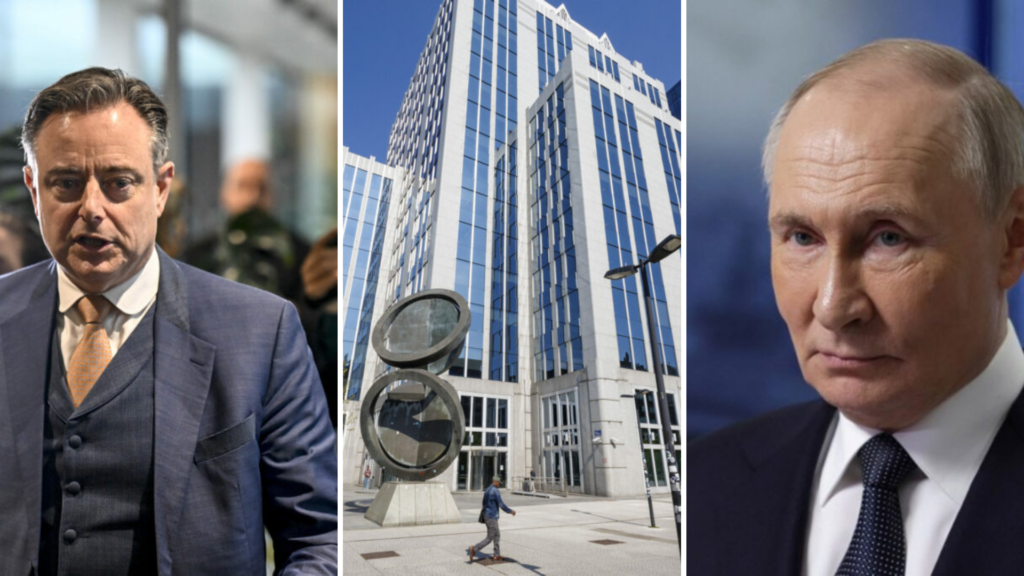
Talks over unlocking Russia’s frozen assets are set to come to a head this week, with crunch talks taking place in Brussels at a meeting of EU leaders on 18 December.
Belgium, long viewed as a “model pupil” by the EU, has found itself on the proverbial naughty step in recent months for its refusal to give the go-ahead to an EU plan to use €210 billion in frozen Russian state assets to finance Ukraine’s war with Russia.
The majority of the assets are held in Brussels-based financial clearing house Euroclear, and Belgium fears it will be held liable should Russia mount a legal challenge against the seizure of the funds.
What does the EU plan involve?
At the onset of Russia’s full-scale invasion of Ukraine in March 2022, the EU froze around €210 billion worth of Russian assets. Most of these assets (approximately €190 billion) are housed at Euroclear.
Until now, European authorities have only used the interest on frozen Russian assets to fund Ukraine. Now, the EU wants to go a step further and touch the assets themselves.
Under the plan first floated in September by EU Commission President Ursula von der Leyen, the EU would tap into €140 billion of the funds currently held at Euroclear to keep Ukraine financially and militarily afloat for the next two years.
The wheels appear to be in motion. On Thursday, EU member states agreed to freeze Russian assets indefinitely, marking a significant step towards using the assets. Prior to this agreement, sanctions against Russia had to be agreed every six months through unanimous approval by all 27 Member States.
With Thursday's move, Member States hope to prevent the loan from being jeopardised if a country such as Hungary were to block a future renewal.
The measure relies on Article 122, an emergency provision that requires only a qualified majority (ie. gaining the support of 15 countries) to pass. This is seen as a way of ensuring the funds will not have to be returned to Russia if sanctions are lifted in the future.
What is the case for seizing the assets?
There is a compelling case for tapping into the funds. Ukraine is in dire need of capital, not only to fund its defence, but to aid its reconstruction. The UN and World Bank estimate that the reconstruction of Ukraine will cost around €400 billion.
Proponents of the EU scheme say Russia should foot the bill through its frozen assets. Otherwise, they argue, European taxpayers will have to pay the €90 billion needed to meet Ukraine’s budget shortfall over the next two years – all this at a time of belt-tightening in many European capitals.
There have also been suggestions that Donald Trump is hoping to use the cash for US companies in Ukraine and Russia as part of a “joint investment vehicle” with Vladimir Putin. Those backing the EU plan say that if Europe doesn’t seize the assets, the US will.
What is Euroclear and what is its position?
Headquartered in central Brussels on Boulevard Albert II, Euroclear is a depository where central banks and investment funds place stocks, bonds and other financial products. It handles trillions of Euros worth of transactions each year.
Belgian national Valérie Urbain has been head of the organisation since May 2024. She recently told Le Monde that she learned about the EU proposal to seize Russian assets while reading the news.
Warning of terrible consequences for the entire eurozone should the EU plan come to fruition, Urbain told the French newspaper that "the most important thing for Euroclear is credibility and trust.”
Urbain claims that her organisation is being unfairly targeted in this debate, pointing to the fact that Euroclear is not the only institution holding Russian money. Russian assets are also held in the UK, France, Switzerland, the US and Japan.
"These countries remain silent," Urbain told Le Monde. "It's time to stop targeting Euroclear and Belgium."
Why is Belgium opposed to the EU plan and what is De Wever’s position?
Belgian Prime Minister Bart De Wever has made his scepticism over the EU proposals abundantly clear.
De Wever believes that if a peace deal with Russia were agreed and Moscow claimed back its money, Belgium would be on the hook to repay the sum. He has said the plan could bankrupt Belgium. He also argues that seizing the assets would deprive the EU of leverage against Moscow in any future peace negotiations.
Speaking at the European summit in Brussels in October, De Wever called the plan “unprecedented” and stated he would take “all necessary political and legal measures at national and European levels” to oppose it if certain conditions are not satisfied.
The prime minister is demanding risk-sharing among member states, guarantees against potential repayment obligations in a worst-case scenario, and inclusion of other EU countries holding frozen Russian state assets in the mechanism. He also wants EU liquidity so that Euroclear has funds to pay Moscow if it is compelled to do so.
Belgium has urged other EU countries to support issuing joint debt to address Ukraine’s funding needs instead – but Hungary has opposed this idea.
Are any other EU countries opposed to the EU plan?
Hungary and Slovakia, which both have Moscow-friendly governments, have stated their opposition to the EU proposal, while Italy, Bulgaria, and Malta have joined Belgium’s calls for an alternative plan.
Euractiv reports that the four countries have signed a joint declaration saying they support the European Commission’s proposal to indefinitely immobilise Russian assets held in the EU, but said the move “should not pre-empt any use of the money to bankroll Ukraine”.
What might the consequences be for Belgium if it continues to stonewall the plan?
Belgium’s fierce opposition to the EU proposals reportedly took fellow EU countries by surprise. According to The Times, presidents and prime ministers present at the last EU summit in October were “so convinced by their plan for the loan that they were already arguing among themselves over how the money should be spent”, with France reportedly calling for Ukraine to buy weapons made in Europe.
The newspaper reports that such is the anger in EU capitals over Belgium’s refusal to play ball, some countries have even suggested that the EU should move from Brussels unless De Wever agrees to the plan.
Briefings against De Wever and his government are intensifying. Last week, Politico reported that the EU will start to “turn the screws” on Belgium if the government continues to stonewall the plan.
A diplomatic source told the outlet that De Wever would be “frozen out and ignored, just like Hungary’s Viktor Orbán has been given the cold shoulder over democratic backsliding and his refusal to play ball on sanctioning Russia”.
What has Russia said about the EU's plan?
As far as Russia is concerned, seizing the assets would be an “act of war”.
Dmitry Medvedev, the deputy chairman of Russia’s security council, said as much in a recent statement. “If the crazy EU does, after all, try to steal Russian assets frozen in Belgium under the guise of a so-called reparations loan, Russia may well view this move as tantamount to a casus belli with all the relevant implications for Brussels and individual EU countries," he said.
Last week Russian state news agency Tass announced that the Russian central bank had launched legal proceedings against Euroclear, claiming the case has been “brought before an arbitration court in Moscow”.
On Thursday, in response to the EU’s decision to use Article 122 to permanently freeze Russian assets, a Russian Foreign Ministry spokesperson said that Europe's "manipulations" with the assets "will not go unanswered."
