
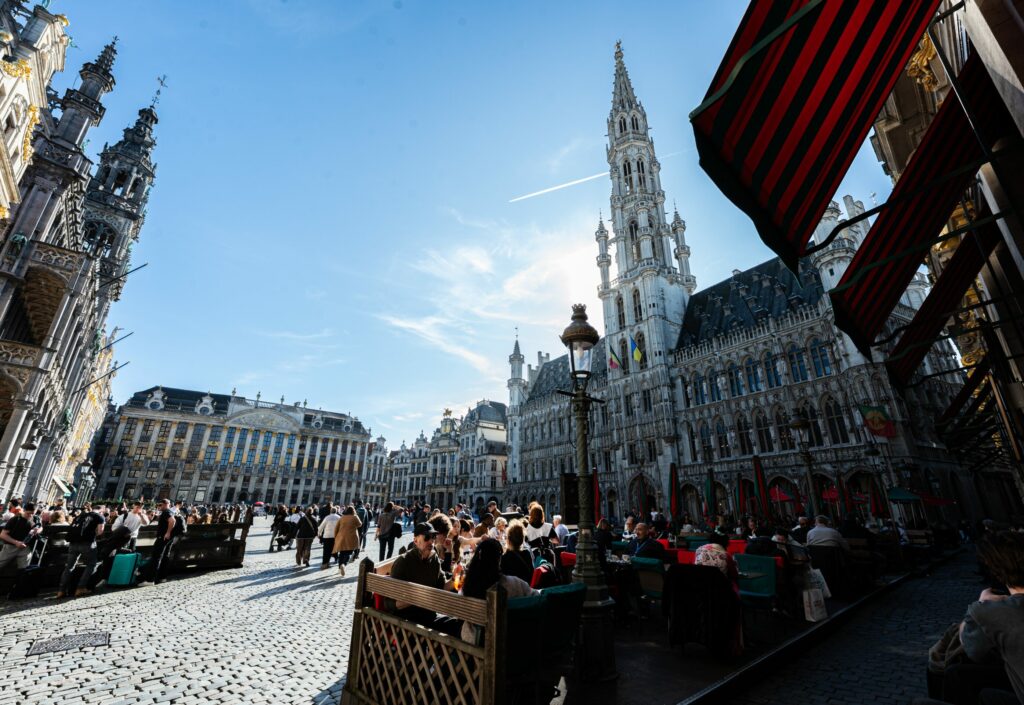
The City of Brussels is stepping up action to manage bar terraces that have crowded the city's pavements since the Covid-19 pandemic.
Led by the City of Brussels Councillor for Economy and Trade, Didier Wauters (Les Engagés), the "terrace plan" aims to restore pedestrian access to public space by regulating the proliferation of terraces and other obstacles on the city's sidewalks.
From now on, placing sales boards, displays, and terraces crowding the highly touristic Rue de l’Étuve, between Rue du Lombard and the Manneken Pis, is banned, reported Bruzz. Moreover, the City of Brussels is reevaluating terraces in the Grand-Place, the pedestrian zone, and Place Agora, according to L'Avenir.
"Our focus is first on the tourism area in the centre, the pedestrian zone, the terraces on the Grand-Place and the Rue du Marché aux Herbes," the Councillor's spokesperson, Yliana Mondele-Ondel, told Bruzz.
However, she noted that the City of Brussels is still consulting with the hospitality sector on further steps.
Covid legacies
The measure, introduced by the former Brussels Government led by Rudi Vervoort(PS), during the Covid pandemic, suspended the requirement for building permits for terraces and parking spaces.
To support restaurant businesses, the City of Brussels granted "tolerance" or temporary permits without the usual long administrative hurdles or high fees.
These terraces have since been extended (by the Brussels Region) to the point that they may be maintained permanently, Mondele-Ondel told The Brussels Times.
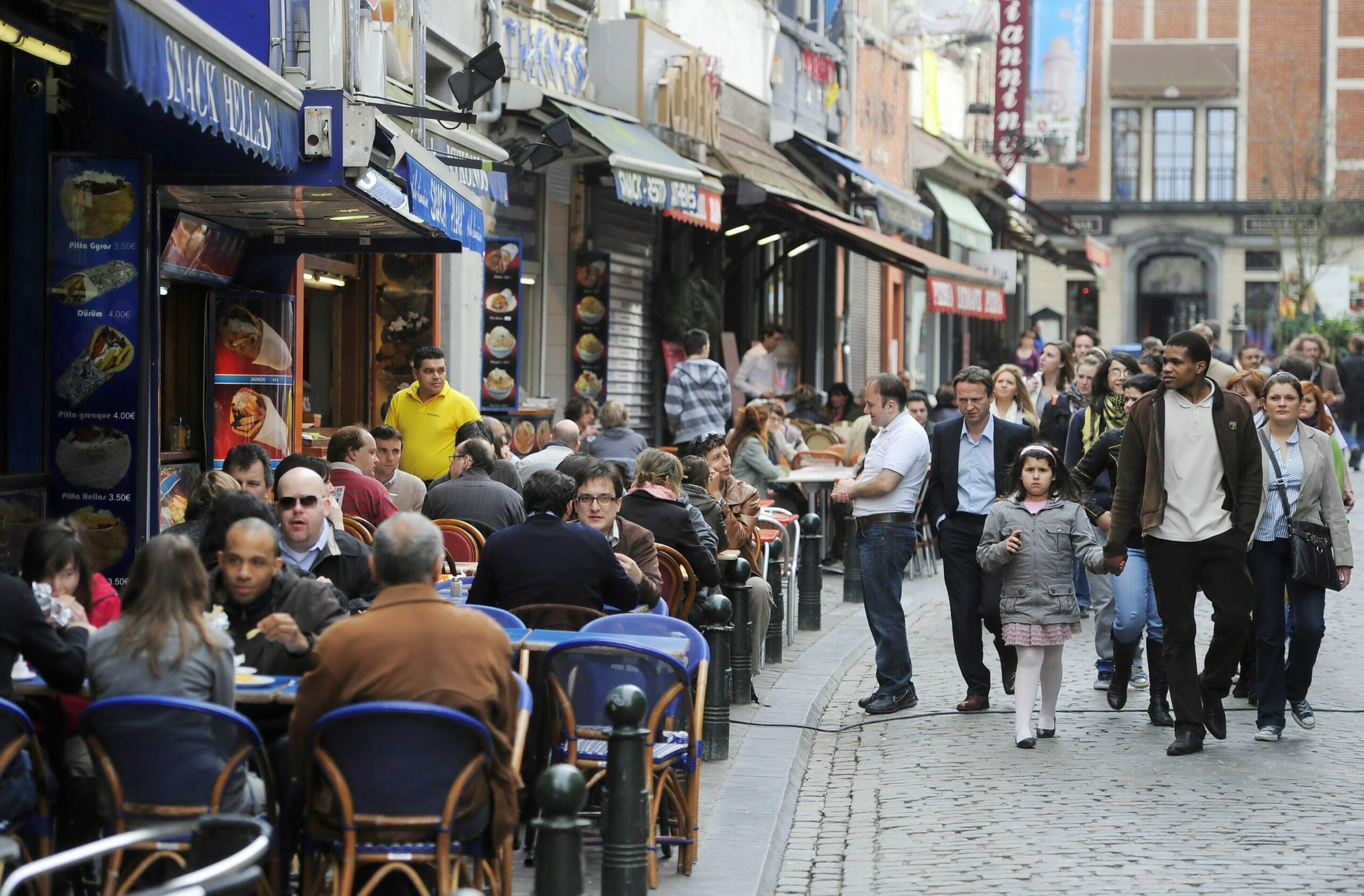
Illustrative picture shows people enjoying the nice weather at a terrace of a pub, in the so-called Little Pitta Street, near Grand-Place, in the centre of Brussels, Wednesday 24 March 2010. Credit: Belga / Eric Lalmand
While intended as temporary, these so-called 'corona terraces' were built rapidly, sometimes blocking pavements, making it difficult for strollers or people with reduced mobility to pass.
Many of them never went through the formal urban planning process, leading to the current push for "harmonisation" and legal re-evaluation.
"Public space must remain pleasant for everyone, tourists and residents. Pedestrians, and especially people with limited mobility, should be able to continue to move smoothly on the footpath," Mondele-Ondel said.
The City of Brussels has about 900 terraces, according to La Dernière Heure.
"The objective is to harmonise the streets of Brussels, to make sure that everyone can walk freely and safely in the streets, so a reinforced control will be necessary," Mondele-Ondel continued.
The plan is to revisit the terraces that are "not in order." If those terraces have a permit and comply with requirements, there will not be a reason to revoke, she underlined.
'Definitively permit terraces'
The newly appointed regional Brussels Government, on the other hand, is pushing for regularisation for terraces.
"The previous government never showed the will to anchor the system by extending the suspension each time. Today, the terraces can only remain until June 30," the spokesperson for the new State Secretary for Urban Planning and Spatial Planning, Audrey Henry (MR), told Bruzz.
The Brussels Government plans to establish a "clear framework" and "definitively permit the terraces," provided that the regulatory framework is adhered to, the spokesperson said.
