

A newcomer in Belgium may find the country’s institutional and bureaucratic complexity difficult to navigate, and the organisation of integration programmes — of which integration courses are a key component — is one such example.
A quick note on terminology: the use of the word “integration” is subject to a lot of discussions as to its weight and implications, which is why not all programmes in Belgium use this word. For the sake of simplicity, we will use the word “integration” in this article.
The various integration programmes are managed by regional or community authorities. The practical result is that newcomers arriving in Antwerp, Brussels, Liège or Eupen may be subject to different programmes depending on the region, and in the case of Brussels may even have a choice between two systems.
Depending on their legal status and residence situation, some newcomers are required to follow these programmes, while for others participation remains voluntary.
The Flemish programme, known as the civic integration pathway (inburgeringstraject), is implemented in Flanders by the Flemish integration agency (Agentschap Integratie en Inburgering) and also operates in Brussels, where newcomers can choose between the Flemish system and the francophone programme called the reception pathway for newcomers (parcours d’accueil pour primo-arrivants), organised by reception offices for newcomers (bureaux d’accueil pour primo-arrivants, BAPA).
Credit: Belga
In Wallonia, it is called the integration pathway (parcours d’intégration) and is coordinated by regional integration centres (centres régionaux d’intégration, CRI), while the German-speaking Community also refers to it as the integration pathway (Integrationsparcours).
Across the country, these programmes pursue broadly similar objectives: helping newcomers understand how Belgian society functions and navigate everyday life. Participants are introduced to topics such as institutions, employment, housing, healthcare, education and social security, often alongside language courses and individual guidance. However, when it comes to testing what participants have learned, the situation differs significantly.
Only one region has a standardised test
Among Belgium’s various integration systems, only the Flemish programme clearly includes a standardised test.
Participants in Flanders are required to pass a test at the end of the social orientation course (maatschappelijke oriëntatie) — the module on everyday life in Belgium, including work, housing, education and healthcare, as well as rights and duties. Participants who can demonstrate sufficient prior knowledge may take an exemption test instead.
This test consists of multiple-choice questions and is intended to assess whether participants have understood the content of the social orientation course.
The other programmes in the country — in Brussels, Wallonia and the German-speaking Community — do not include a comparable standardised test. Participants are generally expected to follow and complete the different components of the programme.
This difference reflects broader political and institutional approaches to integration policy across Belgium.
What kind of questions are asked?
The questions in the Flemish system are closely aligned with the content of the social orientation course and generally focus on practical aspects of everyday life.
Rather than testing abstract or purely theoretical knowledge, they are intended to assess whether participants have understood how to function in Belgian society in concrete situations.
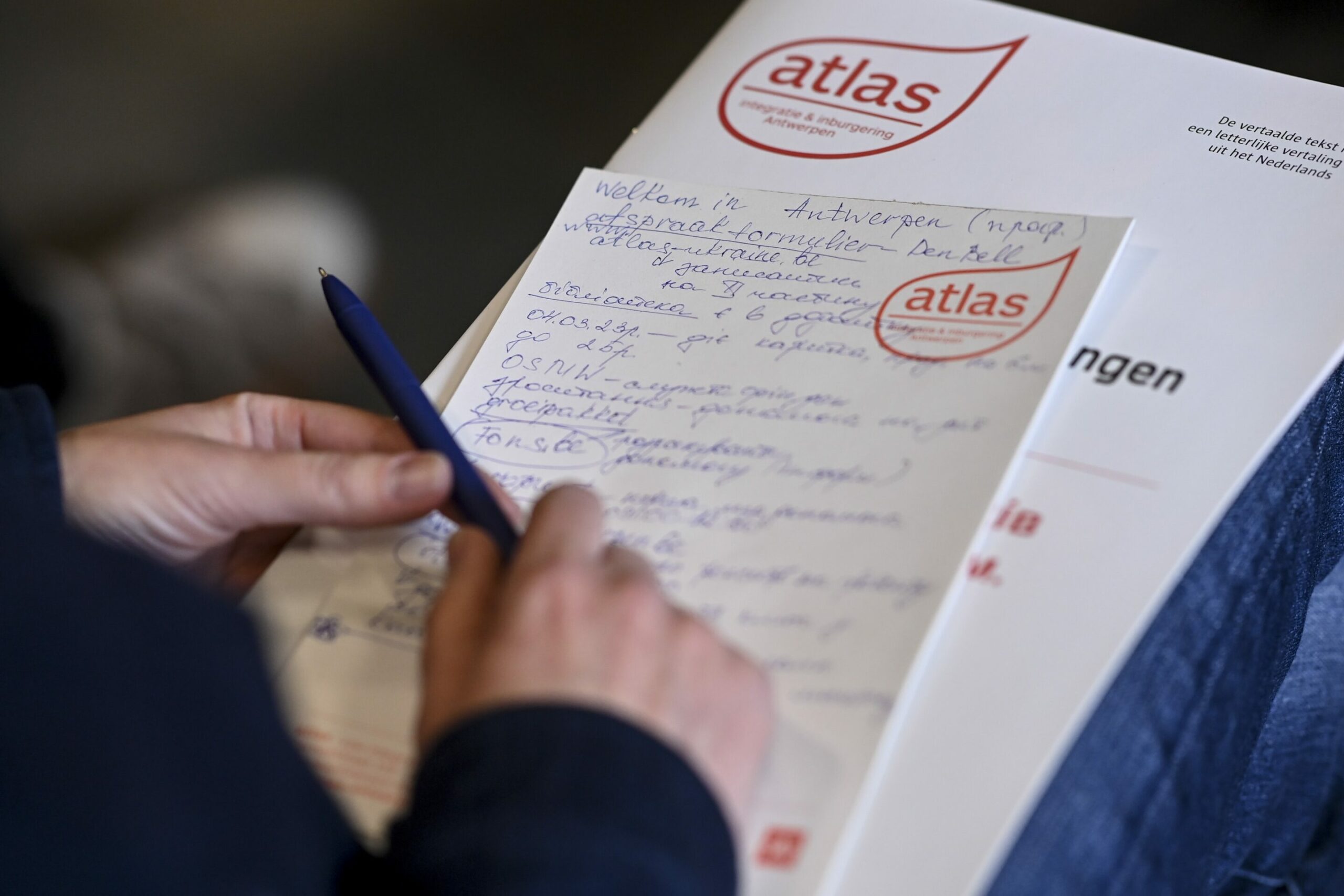
Illustration picture taken during a visit to the Atlas agency for integration in Antwerp, where Ukrainian refugees partake in a social orientation course on Thursday, 05 May 2022. Credit: Belga
In line with the topics covered during the course, questions may relate to areas such as work, housing, education, healthcare and administrative procedures, as well as rights, duties, values and norms.
For example, candidates may be asked what steps to take after moving to a new address, which authority to contact in a given situation, or which emergency number to call in Belgium.
Some questions also address social norms and legal principles. These may include, for instance, whether discrimination based on gender is permitted under Belgian law, or whether men and women have equal rights. Others may concern access to public services, such as whether residents are expected to register with a health insurance fund.
These examples reflect the overall approach of the test, which is designed to ensure that participants understand the practical rules, institutions and values that structure life in Belgium.
The future: a nationality test
According to the coalition agreement, the current Federal Government has indicated its intention of implementing a test that applicants for Belgian citizenship would have to pass.
The practical implementation and precise content remain to be seen. The Arizona coalition’s programme refers to the introduction of a citizenship test, with a requirement to adhere to key principles such as the neutrality of public authorities and equality between men and women.
Another debate concerns language requirements. The government also intends to raise the required level of language skills to B1. These are, however, proposed federal-level measures which, if implemented, would apply across the country.
For now, Belgium’s integration landscape remains distinctly fragmented. While newcomers across the country attend courses designed to help them understand their new society, only one region — Flanders — clearly requires participants to pass a standardised test as part of the programme.
