

Migrants and asylum seekers will be deported from the EU with greater ease after a right-wing and far-right alliance in the European Parliament passed controversial new rules on Thursday.
To speed up the removal of migrants from EU territory, a majority in the European Parliament voted on Thursday to facilitate the return of non-EU nationals staying irregularly in the EU with a common system.
When the vote was approved, a round of applause broke out among right-wing MEPs, angering centrist and left-wing counterparts in the room.
The proposal was passed despite loud protests from rights groups, who denounced it as an inhumane policy which denies the ability for EU countries to uphold migrants' and asylum seekers' fundamental rights.
Once again, centre-right (and pro-EU) EPP teamed up with far-right (and Eurosceptic) groups, ECR, ESN and PfE, to push it through. This included organising secret meetings and WhatsApp groups to negotiate the final text, according to an explosive report by German media agency dpa from last week.
However, Belgium's EPP members, Wouter Beke and Liesbet Sommen from the Flemish Christian Democrats (CD&V), were the only members in the entire conservative group to abstain on this vote. The text will now be negotiated with EU leaders at the European Council and the European Commission before final approval.

Two ECR MEPs, Nicola Procaccini (Italy) and Patryk Jaki (Poland), stand up to applaud the deportation of migrants passed in the European Parliament in Brussels, Thursday, 26 March 2026. Credit: EU
So what was agreed?
Under the new plans, the EU would force members to hand out a "return decision" – or deportation order – to any non-EU nationals found staying irregularly inside the EU.
These individuals would then receive a European Return Order, which is then added to a unified system enforceable across the Schengen area.
Special protection will be given for unaccompanied minors, and a proposed obligation to actively detect irregular migrants, like the United States under the Trump administration, was voted down.
The EU will trigger an entry ban across the bloc in the case of non-compliance, forced removal, or security concerns.
Controversially, deportations would also be carried out to countries in which the individual has no prior connection, in addition to regular deportations to the country of origin or transit country. In other words, undocumented migrants would be removed to safe third countries or other countries willing to accept the person (under an agreement with the EU or a member) – known as "return hubs".

Jet Airways taking off near the closed asylum centre 127bis. Credit: Belga
"It is turning Europe into a deportation machine where policy is dictated by violence and coercion," says Tine Claus, director of Refugee Work Flanders, in a joint statement with 11.11.11. "This deportation regulation is extremely dangerous. It raises serious questions about its compatibility with international obligations."
On Wednesday, a letter from Doctors of the World and hundreds of healthcare professionals also warned that vague and far-reaching surveillance measures in this proposal could turn hospitals and public services into "hotspots" for immigration enforcement.
However, the "return hubs" or "deportation camps", as critics call them, are what have sparked the indignation of opposition parties, civil society groups and human rights experts. Even migration experts question the viability of this law.
'Raises questions'
"At this stage, it remains unclear how return hubs would be operationalised, both legally and in practice," senior adviser on migration at the European Policy Centre, Virginie Jacob, told The Brussels Times on Thursday.
There are still differences between the positions of different EU institutions on responsibility, Jacob explains. While the approach of EU leaders at the European Council places it on Member States – like the Commission's first proposal, the European Parliament envisages a role for both Member States and the EU.
"The outcome of negotiations will therefore clarify the model," she explains. "This uncertainty, of course, raises questions, particularly in relation to fundamental rights, but also regarding responsibility, accountability, and the availability of effective judicial oversight."
Five countries – Germany, the Netherlands, Austria, Denmark and Greece – have expressed interest in building the return hubs.
Meloni model
In 2024, the European Commission President Von der Leyen said she would "draw lessons" from the Italy-Albania protocol to strengthen undocumented migrant expulsions.
This was a controversial and widely criticised deal, which enables Italy to transfer people arriving on its territory directly to detention centres in Albania to process their asylum cases, but has faced serious legal and operational hurdles.
"The Italy-Albania experience illustrates how complex such arrangements can be to implement, and how they may be subject to judicial oversight at the national level," Jacob says. "However, it is important to note that this model differs."
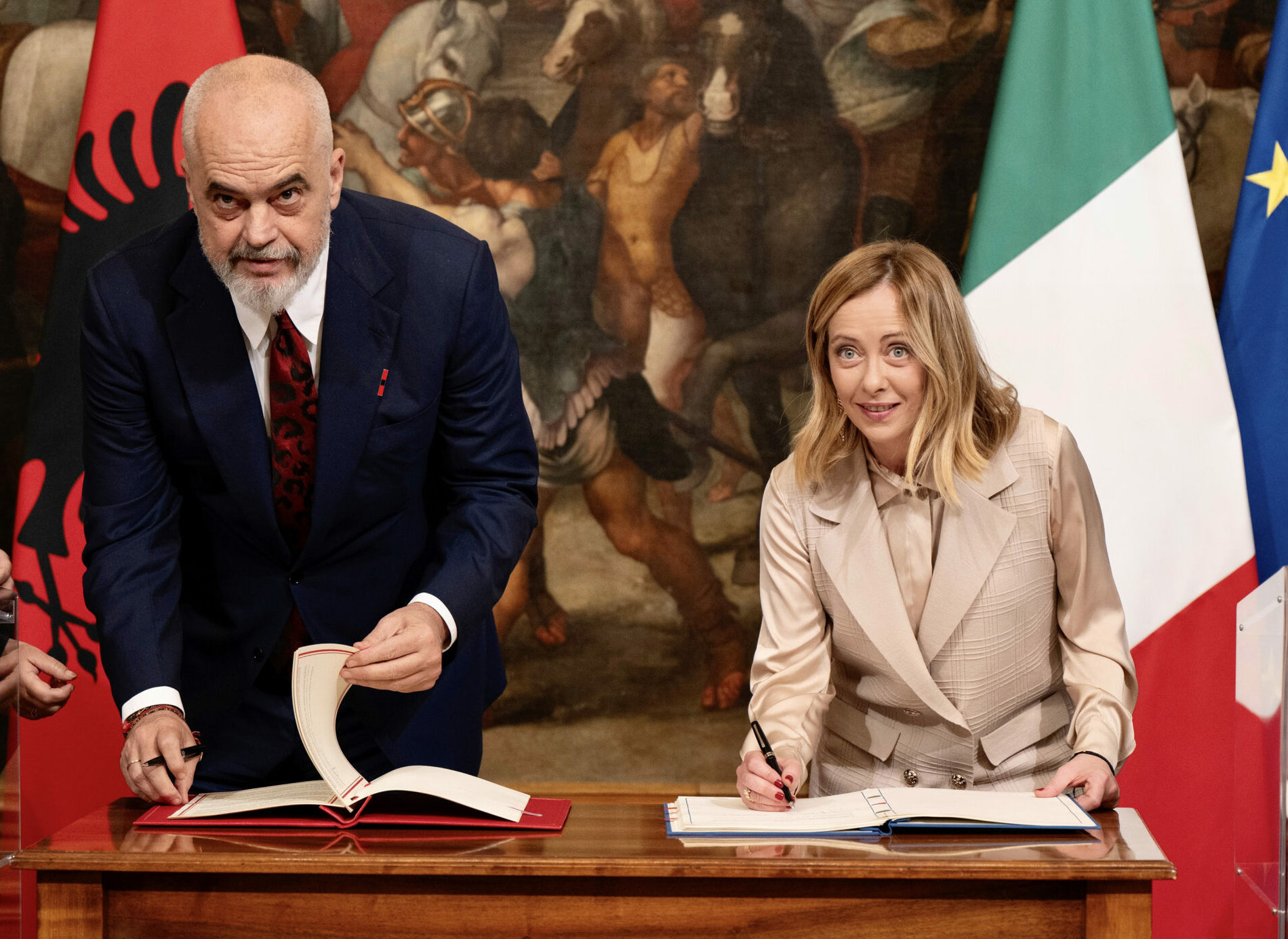
Albanian Prime Minister Edil Rama and Italian Prime Minister Giorgia Meloni announced the deal on Tuesday 8 November 2023. Credit: Governo Italiano
Political tensions around the role of the judiciary and the ability of EU countries to deport migrants will also influence whether the current rules will be implemented.
This week, the former director of the EU border agency, Fabrice Leggeri, who today is a far-right MEP with France's National Rally (PfE), is under investigation by a top French court for complicity in crimes against humanity during his time as director of the EU border agency, Frontex.
Attacks on ECHR
The rule of law and fundamental rights have come under attack by anti-immigration leaders, notably Belgium's Prime Minister Bart De Wever, whose party sits in the hard-right group the ECR.
Last December, a coalition of countries asked to reinterpret the European Convention on Human Rights (ECHR) and be allowed to deport convicted criminals even when they have family ties in the host country.
"We are indeed seeing increasing political pressure on the European Human Rights framework in the context of migration," Jacob says. "At the same time, it is important to distinguish between political narratives and legal reality."
She explains that, while the ECHR could be described as limiting certain return policies, available evidence suggests that the number of migration cases remains relatively limited and that its case law does not systematically prevent returns.

An illustration picture shows a visit of the Defence Minister to the Belgian Naval Component Godetia during a Frontex operation in the Mediterranean Sea, Monday 08 June 2015. Credit: Belga / Nicolas Maeterlinck
"That said, there is nonetheless a growing tension between policy objectives in the field of migration and the existing legal framework. It is not new, but it has become more visible in recent years."
For the European Policy Centre's expert, Thursday's approved proposal reflects a shift in the balance between enforcement and safeguards on migration.
A number of provisions have led to concerns about a weakening of safeguards, particularly regarding detention, access to effective remedies, and the use of return hubs, she continues.
"In that sense, whether the policy can be considered fair is already being contested for its legislative design, not only its future implementation."
Related News
- EU conservatives collaborating with far-right more than previously thought
- Belgium joins European anti-migration push to 'constrain' ECHR
- Council of Europe warns against third-country deportation
- European Commission wants to build offshore detention centres for migrants
- 'A political stunt': Confusion in Brussels over Italy-Albania migrant deal
