

Ireland has formally submitted an application to join a Benelux-led agreement that enables the country's higher education qualifications to be automatically recognised across participating European countries.
Launched by the Benelux countries (Belgium, the Netherlands and Luxembourg) together with the Baltic States, the Multilateral Treaty on the Automatic Recognition of Higher Education Qualifications was designed to welcome broader participation from across the European Higher Education Area.
"This Treaty is a significant initiative that advances and deepens cooperation in higher education across Europe," said James Lawless, Irish Minister for Higher Education, Research, Innovation and Science.
For him, the treaty reflects a "shared commitment" to academic mobility, robust quality-assurance standards, and the "enduring value of our qualification systems".
Less administrative burden
It ensures that higher education qualifications obtained in one participating country are automatically recognised at the same level in all other participating countries – eliminating lengthy and costly recognition procedures for students seeking to continue their studies abroad.
"As Ireland prepares to assume the Presidency of the Council of the European Union, I am pleased to mark our application to join this agreement, and I look forward to working closely with our European partners to realise its full benefits," Lawless added.
As education policy remains largely a national competence within the EU, Member States determine their own education systems and remain responsible for the recognition of diplomas and qualifications.
Therefore, for students and graduates, the treaty means less administrative burden and faster access to further studies or the labour market abroad.
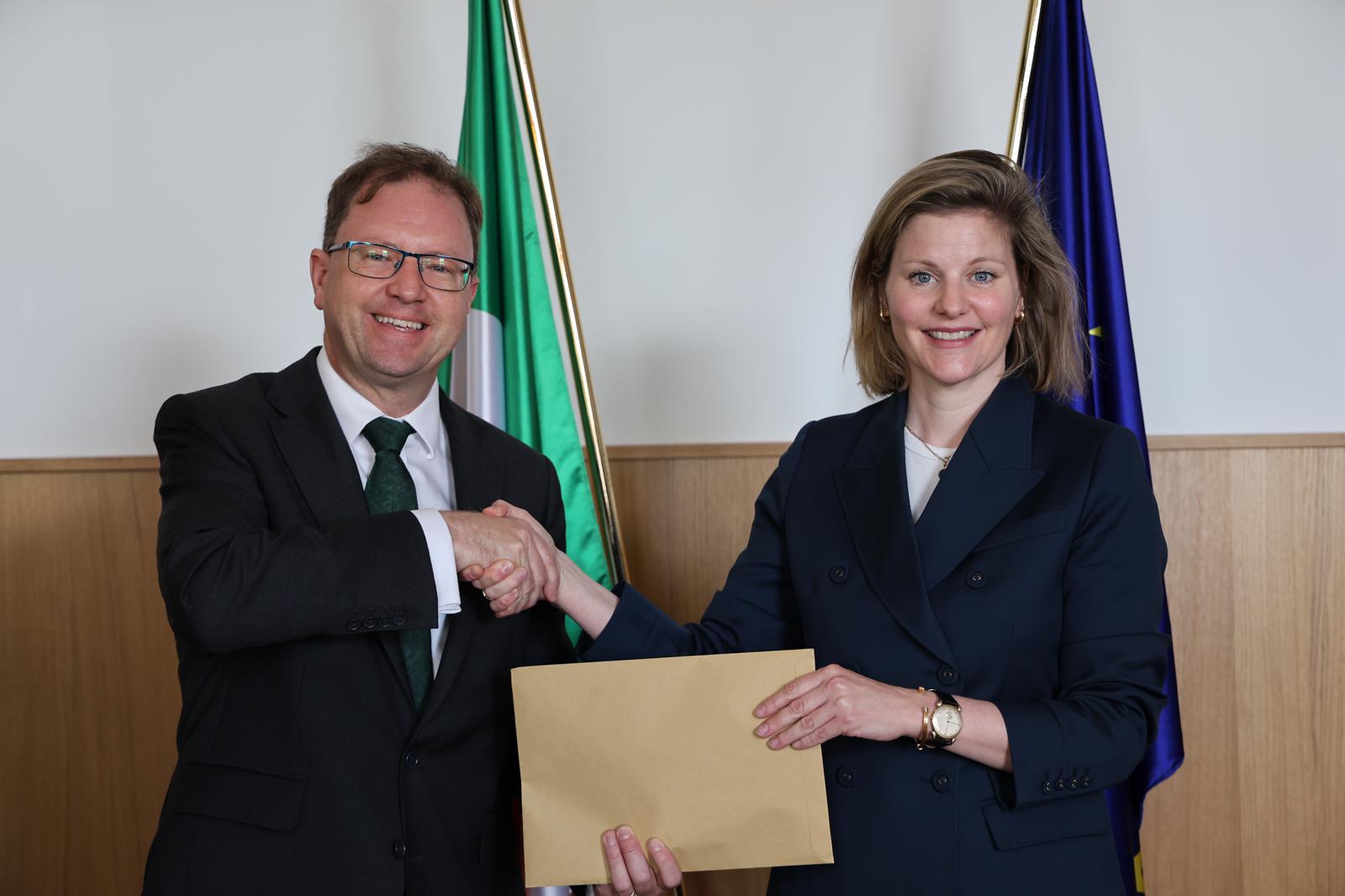
Irish Minister for Higher Education James Lawless (left) and Deputy Secretary-General of the Benelux Union Liesje Schreinemacher. Credit: Benelux
The foundation was laid in 2015, when the Benelux countries were the first to agree on automatic level recognition of higher education diplomas.
In 2021, this was expanded to include the Baltic states (which had made similar arrangements among themselves in 2018), leading to a legally binding multilateral treaty that has been in force since 2024.
This means that since 1 May 2024, the Treaty has been in force between Belgium, the Netherlands, Luxembourg, Lithuania, Latvia and Estonia.
Poland applied to join in May 2025 and is currently completing its national ratification process. Now, Ireland is following. At the same time, exploratory discussions are ongoing with other countries.
Strong momentum
"What began as a Benelux and Baltic initiative is now attracting more and more countries across Europe," said Liesje Schreinemacher, Deputy Secretary-General of the Benelux Union.
The country's accession process has now begun and will continue over the coming months. Once done, this means that the Irish higher education qualifications will also be automatically recognised – facilitating further studies and employment across the other signatory countries.
"Ireland's application confirms the strong momentum when it comes to the automatic recognition of qualifications and welcoming students and workers from other countries," she said. "It also shows how this development can strengthen cooperation in higher education across Europe and, ultimately, the EU’s competitiveness."
The Treaty does not apply to the professional recognition of qualifications for access to regulated professions, which is subject to wider EU law.
