
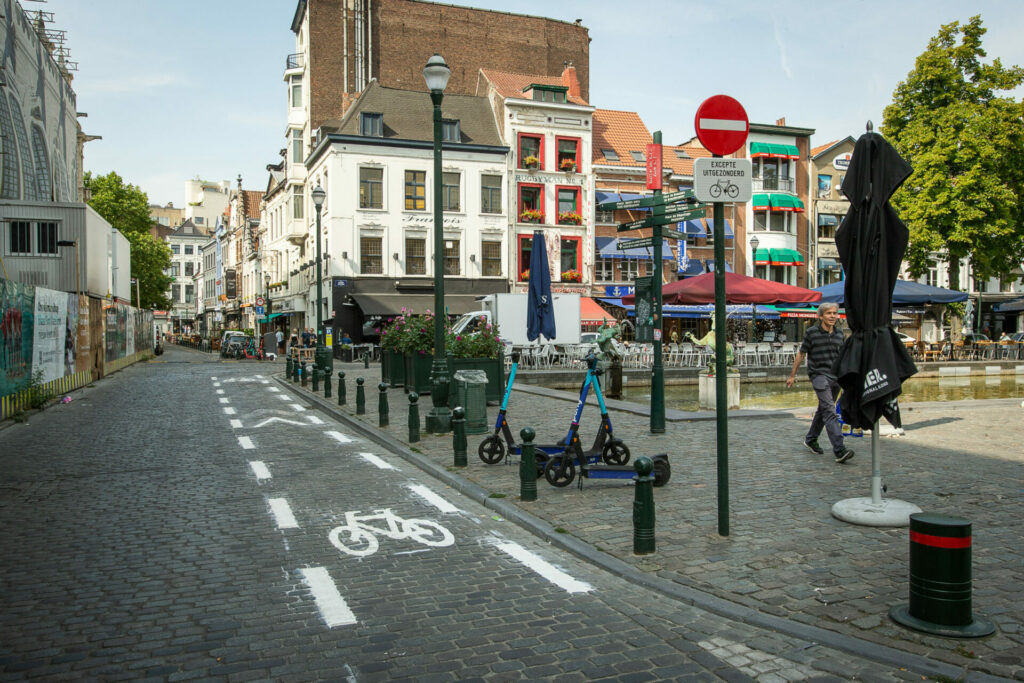
In recent years, the Good Move urban mobility plan has been at the heart of some of Brussels' most heated local debates, leading to tense municipal council meetings, angry exchanges between drivers and cyclists, and mayors trying to block changes to traffic circulation in their communes.
The plan, which was formally approved in 2020, had noble aims: to reduce traffic, decrease pollution levels, increase safety and quality of life, and encourage Brussels residents to switch to cycling or public transport. For supporters, Good Move meant calmer streets, fewer drivers using residential roads as shortcuts and safer conditions for pedestrians and cyclists.
Over time, however, the name became so tainted that the Brussels Government says it will evaluate the existing Regional Mobility Plan and prepare a new plan to succeed Good Move.
More recently, the removal of concrete blocks in parts of the city has added to the impression that some of the most visible symbols associated with the scheme are being rolled back. Some of these blocks predated Good Move and were installed for security reasons, while others were later used as part of changes to traffic circulation. But politically, they have become part of the same debate over car access, public space and the future of mobility policy.
So what exactly was Good Move supposed to do — and what will become of it under the current Brussels Government?
The Regional Mobility Plan for 2020–2030
Good Move was the name of Brussels' Regional Mobility Plan for 2020–2030. It covered a wide range of policies, from cycling routes, school safety, public transport and shared mobility to parking policy and efforts to encourage people to change how they travel.
Its most politically sensitive element was “Good Neighbourhood”, the part of the plan that most directly affected local streets and residential neighbourhoods.
In practice, this involved, among other measures, introducing a region-wide 30 km/h speed limit on most streets; local traffic cells — known as mailles in French and mazen in Dutch — where circulation changes were designed to discourage drivers from using residential streets as shortcuts; and the redesign of major public spaces.
These measures were intended to make residential areas calmer and safer. In practice, however, they also changed how people moved through neighbourhoods, affecting daily routes, parking habits, access by car and the distribution of traffic between streets.
That is why Good Move quickly shifted from a technical mobility plan into a tense political debate.
Several municipalities, including the City of Brussels, Anderlecht, Jette and Schaerbeek, made headlines at different moments during the implementation of local traffic circulation changes.
Supporters saw them as a way to transform a city long dominated by cars, while critics argued that specific local changes disrupted access and that consultation had not been sufficient.
A new Regional Mobility Plan?
After a prolonged political deadlock following the elections, a new Brussels Government took office in early 2026. In its Regional Policy Declaration, the new coalition says the existing Regional Mobility Plan will be evaluated and that a new plan will succeed Good Move.
The declaration also revisits the Low Emission Zone (LEZ) – controlled areas in which certain vehicle categories are not allowed to enter, or only under certain conditions, because they are too polluting. Although the LEZ predates Good Move, it has become part of the same wider mobility debate.
The Brussels Government plans clearer exemptions and changes intended to avoid disproportionate fines. The declaration also explicitly provides for the gradual replacement of concrete blocks that are not essential to immediate public safety.
No full reversal of Good Move
However, this does not mean a full reversal of Brussels’ mobility policy. The declaration still presents mobility as a key factor for quality of life, economic activity, public-space quality and the Region’s attractiveness. It says the government wants mobility to be safer, smoother, cleaner, faster, more accessible and more efficient for all modes of transport.
The main political shift appears to concern method and implementation. The declaration says new local traffic plans will be reviewed on smaller perimeters, adapted to socio-economic realities and designed with particular attention to schools. Citizen participation is also to be strengthened through consultations with citizens in the areas concerned, alongside input from emergency services.
The new government has also retained "Vision Zero" and the "STOP" principle, preserving the idea of safer streets and a hierarchy in which pedestrians, cyclists and public transport come before private cars. Its commitment to maintain its STIB-MIVB offer also suggests that public transport will remain central to the region’s mobility policy.
In other words, Good Move as a political label may be replaced, but Brussels is unlikely to return to the situation before Good Move. The next plan will keep many of the same priorities – safer streets, stronger public transport, more cycling infrastructure and calmer neighbourhoods.
The difference will lie less in the broad objectives than in the way these policies are carried out, the authorities have explained. The new plan is to distance itself from the symbols that made Good Move politically toxic: concrete blocks, abrupt circulation changes and controversy over how local changes were designed, communicated and consulted on.
The emphasis is to shift towards smaller perimeters, more localised consultation, maintaining access to shops, businesses and workplaces, and avoiding the displacement of traffic from one street to another.
