
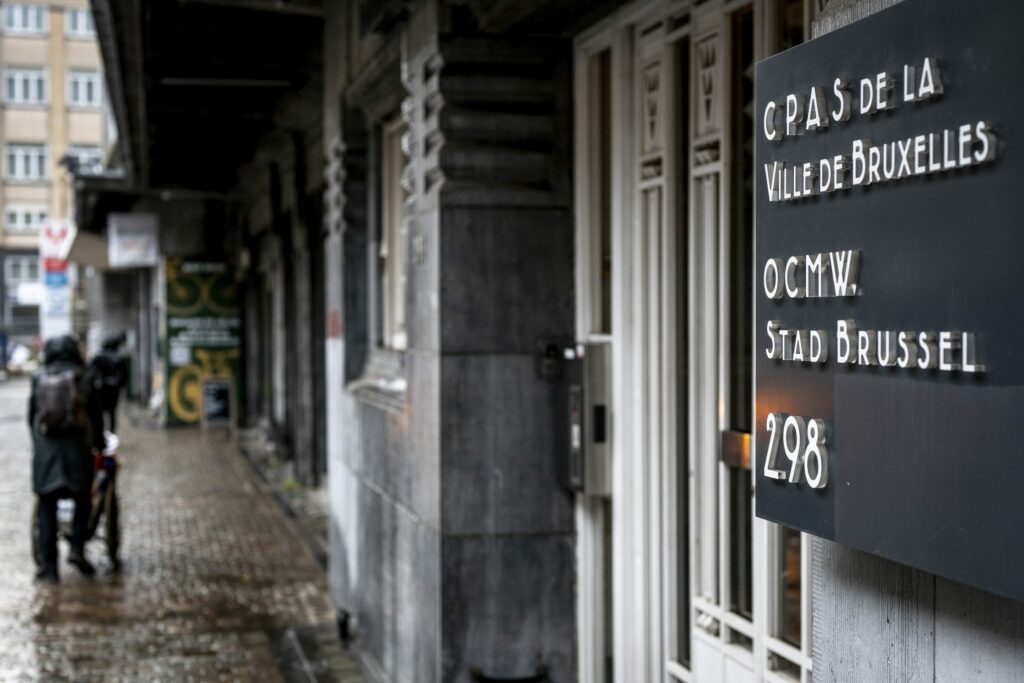
Losing unemployment benefits does not necessarily mean losing every form of support. Belgian social protection reflects the constitutional principle that everyone has the right to live in accordance with human dignity.
For people without sufficient resources, the main last-resort safety net is the Public Centre for Social Welfare, known as CPAS in French and OCMW in Dutch — which exists in every municipality.
From Christian charity to a public right
Public welfare in Belgium evolved from religious charity and local or private initiatives, where helping the poor was often seen as both a moral duty and a way to preserve social order.
In 1925, the creation of public assistance commissions marked an important step, but assistance still operated in a context of moral judgment.
A major shift came in the 1970s, with the introduction of the “minimex” — a guaranteed minimum income for people without sufficient resources — in 1974 and the creation of CPAS offices in 1976.
The central question was no longer supposed to be whether someone was “deserving”, but whether they had enough resources to live with dignity. The minimex was later replaced by what is now known as the integration income.
Integration income and social assistance
The CPAS system is institutionally complex, and practical differences can exist between municipalities. To understand the system, it is important to distinguish between the integration income and other forms of social assistance.
The integration income is a monthly allowance set at the federal level. Since 1 March 2026, the full monthly allowance is around €894, €1,340 or €1,812, depending on whether the person is considered a cohabitant, a single person living alone, or a person with a dependent family.
This last category normally requires living with at least one unmarried minor child who is financially dependent on the applicant.
These are full reference amounts: if the person already has income, it is normally taken into account. Some resources are excluded from this calculation. Family allowances, for example, are not deducted from the integration income.
These reference amounts do not change whether you live in Antwerp, Brussels or Liège. The purpose of the integration income is to guarantee a minimum income while supporting the person’s social or professional integration.
The allowance also comes with conditions. Depending on the person’s situation, the beneficiary may be expected to look for work, register with the regional employment service, follow training and report any change in income, employment or household composition.
There are also rules on stays abroad: in principle, a beneficiary cannot be absent from Belgium for more than one month per year while receiving the integration income. In some cases, the CPAS can offer an Article 60 work contract, allowing the beneficiary to work for an employer in partnership with the CPAS.
Social assistance, however, can vary from municipality to municipality. It can include support for medical expenses, energy bills, rental deposits, food aid, debt management and other practical help. The availability and level of support can vary even between neighbouring municipalities, depending on local policy, priorities and resources.
This kind of support is not only for people with no income. In some cases, people who work but whose resources remain insufficient may also receive CPAS help for specific needs.
Procedure and difference with unemployment benefits
The first step is to apply to the CPAS in the municipality where the person lives.
A social worker then examines the applicant’s overall situation to determine both what support they need and whether they meet the legal conditions. As part of this assessment, a home visit is carried out to verify the person’s household situation.
The social worker writes a report, which is submitted to the CPAS body responsible for deciding whether support should be granted. If the request is accepted, the person may receive the integration income, other forms of social assistance, or both. If support is refused, or if the person disagrees with the decision, they can appeal to the labour court.
The integration income is not unemployment benefits under another name. Unemployment benefits are part of social security and are linked to previous salaried work and the social security contributions paid on that work.
CPAS support, by contrast, is based on the person’s current needs and resources, not previous contributions. It is meant for people without sufficient means who cannot rely on other income, benefits or support.
This does not mean that the system always works perfectly. Recent controversies, including public scrutiny of the CPAS in Anderlecht, have raised questions about how some offices are managed and how oversight is exercised.
But such cases do not change the basic logic of the system: the CPAS is meant to be a last-resort safety net for people without sufficient resources.
