
New data on road traffic accidents in Belgium shows a sharp increase in the number of deaths caused by e-scooter accidents – prompting calls for the police to step up speed checks.
In 2025, 15 people in Belgium died after having an accident on an e-scooter, up from four the previous year. In total, over half of serious injuries from road traffic accidents in 2025 were for users of two-wheeled vehicles. This is according to the latest figures from Statbel, Belgium's statistics agency.
Alongside the increasing death toll for e-scooter users from road traffic accidents, 161 e-scooter riders had serious injuries and 2,083 minor injuries in 2025.
The data will likely boost support for the capital's recently announced ban on shared e-scooters. From January 2027, shared e-scooters will be banned in Brussels, a move designed to improve safety, de-clutter pavements and reduce their use in crime. There will be no outright ban on e-scooters, with private e-scooters still allowed to be used.
"Anyone who falls off a scooter is more likely to be injured than someone who falls off a bicycle, and haphazardly parked shared scooters make pavements even more difficult to navigate for people with reduced mobility, parents with pushchairs or the elderly," said Brussels Mobility Minister Elke Van den Brandt (Groen) when announcing the ban earlier this month.
Stef Willems from road safety institute Vias told The Brussels Times the likely reasons for the increase in deaths and injuries.
"With e-scooters the number of accidents have gone up 34% and deaths went from four to 15, basically what is going on is a lot of e-scooters are sold that go above the maximum speed limit of 25 km/h", he said.
The institute has been arguing for the police to use radar speed guns to track speeds, as many e-scooter models in private use are capable of illegally travelling several times the official limit.
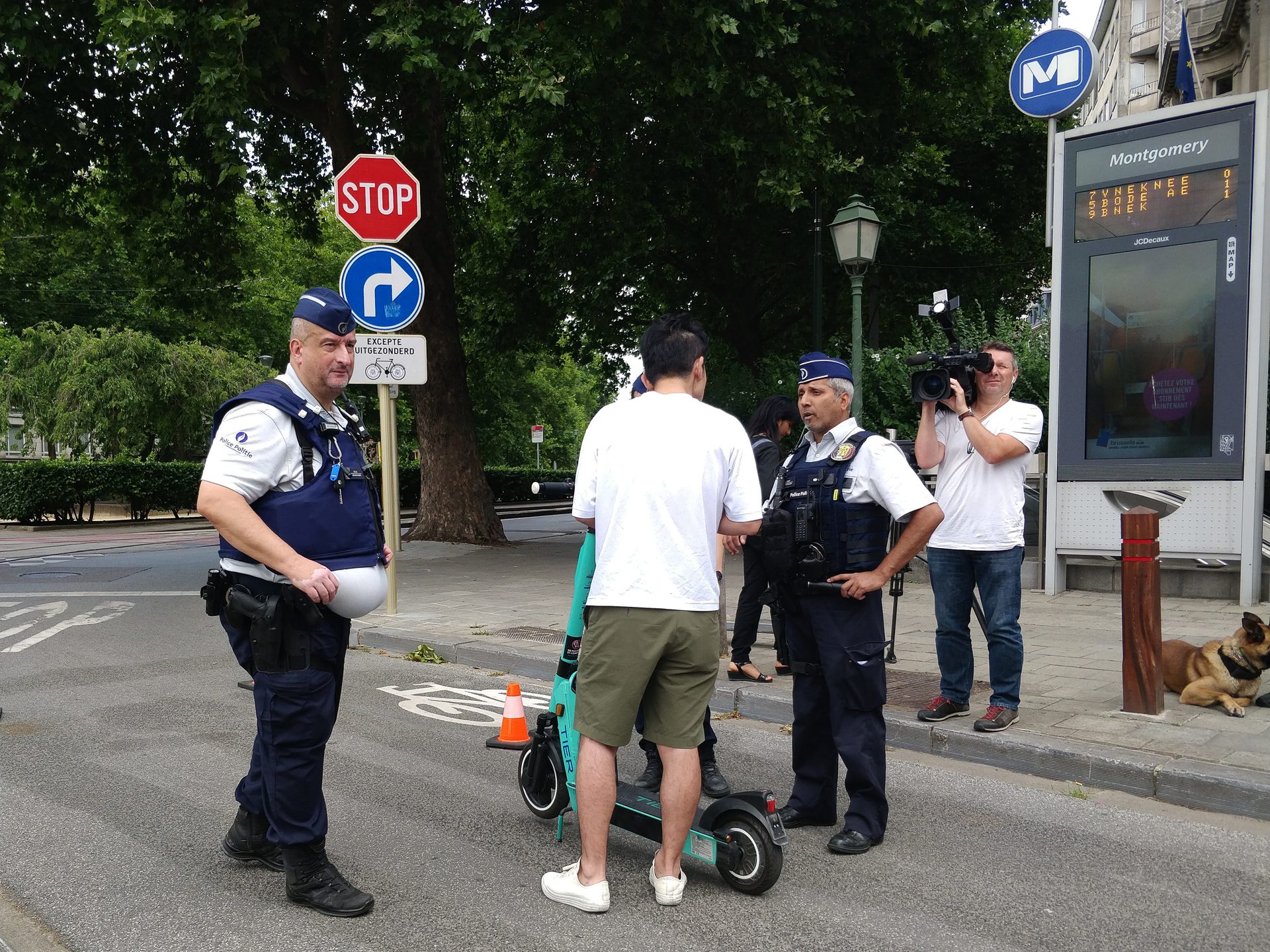
A police traffic operation involving e-scooters. Credit: Belga/Anthony Gevaert
Serious injuries on the up especially among two-wheeled road users
Last year, the number of people seriously injured in a road traffic accident in Belgium went up 7.1% to over 3,200 people.
Analysis of Statbel data by The Brussels Times shows that for users of bicycles, e-bikes and speed pedelecs, serious injuries from accidents increased 13.8% between 2024 and 2025, while for car users the number of serious injuries grew more slowly at 1.3% over the same period.
"If you look at the larger trend what you see over the long term is there is a decline in road deaths, and a shift from being killed to being severely or lightly injured." Willems told The Brussels Times.
He explains that "cars are better equipped with all kinds of advanced driver systems, which means that when an accident occurs it happens at a lower speed", this accounts for the slowing increase in the share of serious injuries for car users, in addition to more effective hospital treatment for those involved in car accidents.
However, while the improvement for car accidents is paying off, for two-wheeled road users, the opposite is true. Statbel explains that for cyclists "the trend is upwards, particularly for those seriously injured (+11.1%). There were a total of 82 fatalities within 30 days, of which 48 were on bicycles, 33 on electric bikes and one on a speed pedelec."
Over half (56%) of serious injuries from road traffic accidents in 2025 were for users of two-wheeled vehicles, for car users the figure is 27%.
Death toll from road accidents in decline
While the death toll from road traffic accidents in Belgium declined between 2025 and 2024, in Brussels, the death toll from road accidents nearly doubled in the same period.
According to Statbel, 464 people died within 30 days of a road traffic accident in Belgium – down 1.1% compared to 2024, when there were 469 fatalities within 30 days.
Road deaths mainly involved cars, bicycles and motorcycles. Deaths from car accidents declined slightly from 203 to 199, and bicycles from 85 to 81. But for motorcycles this increased from 57 to 61. Pedestrians killed from road traffic accidents also declined from 69 to 53.
Brussels was the only region where road deaths increased – riding from 11 in 2024 to 21 in 2025. Figures for vehicle type involved in accidents are not available at the regional level. Both Flanders (241) and Wallonia (202) saw a higher absolute number of road deaths in 2025.
According to Willems, while the overall decline in deaths is good news, "we are not being euphoric".
He added that "while it is always better to say the number is going down not up, we have to be vigilant, it isn't carved in stone that the number will continue to go down".
Analysis from the Vias Institute sugggested that overall road deaths were driven by a decline in the last three months of 2025 rather than a sustained fall over the year, a situation Willems describes as "not a durable decline of road deaths".
"You have to look at long-term results to see, are the figures, are they going down? What you see now is that the evolution is more stable if you talk about road deaths, but on accidents there is a slight increase, this has been the case for the last three years."
