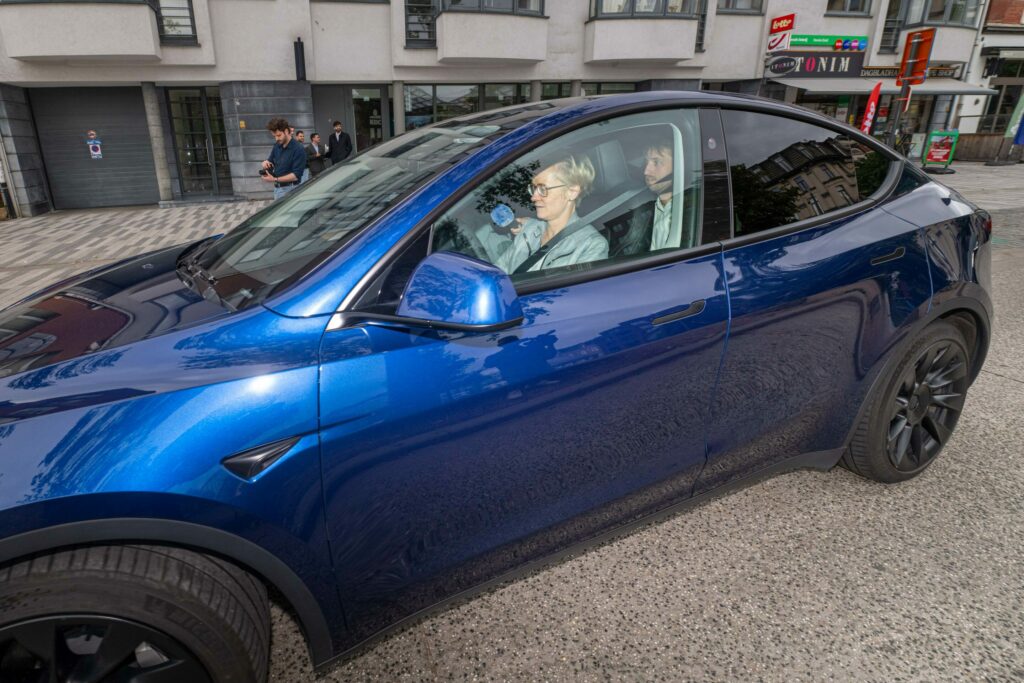
Self-driving Tesla vehicles were approved for use in Flanders despite the Flemish administration having raised serious reservations on the matter, De Morgen reported on Tuesday, citing an opinion from the Department of Mobility and Public Works (MOW).
The opinion comes from the office of the Flemish Minister for Mobility, Annick De Ridder (N-VA), and highlights “significant risks and uncertainties”. The minister received this opinion in June, on the very day she gave the green light to the Teslas.
In its assessment, the administration warned that the self-driving system’s limited alignment with Belgian traffic conditions posed a risk. During testing, it said, the software repeatedly struggled to interpret road signs, lane markings and some infrastructure elements, including level crossings.
MOW said these difficulties had, in several cases, led to traffic violations or situations in which the driver had to intervene. It also argued that the testing framework contained gaps, with some scenarios not examined.
Because of those omissions, the administration said the system’s safety and the extent of information provided to untrained drivers in real-world conditions could not yet be demonstrated sufficiently. MOW was also critical of Tesla’s offset function, which allows the permitted speed limit to be exceeded.
De Ridder’s office confirmed to De Morgen that one accident involving the vehicles has already occurred. A car is said to have hit a stationary vehicle at low speed after the driver took over steering on a roundabout in order to turn earlier than the system intended.
Flemish MP Bogdan Vanden Berghe (Groen) said the minister was taking too great a risk without sufficient safety guarantees. He said self-driving cars were clearly part of the future, but that they should contribute to smoother and safer traffic.
“The information we have today raises serious doubts about that. I expect Minister De Ridder to prioritise many more test kilometres in Flanders before the self-driving system is permitted on our roads,” he added.
Speaking later on the Radio 1 programme De Ochtend, De Ridder said additional test kilometres were unnecessary. She said results from billions of kilometres driven worldwide, as well as testing in the Netherlands and Belgium, consistently showed a far lower accident rate than with human drivers.
The minister said she would never have approved the system if she genuinely believed it posed a danger to road safety. She also argued that the report was far more nuanced than the “tendentious” way in which it had been presented.
De Ridder denied ignoring a critical opinion. She added that the most common complaint she receives is that the system drives too defensively, and repeated that it is not a self-driving car but a driver-assistance system in which the driver must be able to take over at all times.
