
21 July: Belgium’s national holiday. An annual opportunity to ask ourselves whether we feel any affection for our country, whether we qualify as patriots. If we do, should we hide it out of shame? If we don’t, should we feel guilty? Patriotism comes in many shades, and while some forms of patriotism are despicable others are essential to the thriving of a political community.
I could not resist it. On 7 July, just before 2 am, I crept out of bed, cycled down to Brussels’ city centre and watched, in noisy company, the football match between Belgium and the United States. Never before had I wished so ardently that Belgium would win. Was I driven by patriotism or rather by an aversion to patriotism?
Patriotism: aggressive and defensive
Donald Trump’s MAGA movement is a patriotic movement. It is love for their patria, for their fatherland, that makes so many Americans subscribe to Trump’s rallying cry to make America great again. It is patriotism that makes the American administration dream of swallowing Greenland. It is patriotism that makes an American president interfere with a referee’s red card decision against America’s best player and do his utmost to bend the rules of the game in the hope of making his team triumph over Belgium.
Zoom out and you will find countless instances of more extreme forms of this aggressive patriotism. It is patriotism that drove France’s revolutionary and later imperial troops to invade the rest of Europe singing “Allons enfants de la patrie, le jour de gloire est arrivé!” (still the first words of France’s national anthem).
It is patriotism that Hitler demanded from his soldiers when requiring them to promise “that they will at all times serve faithfully their people and fatherland [Volk und Vaterland] and be prepared to risk their lives at any time as brave and obedient soldiers”. And it is a “patriotic manifesto for Europe’s future” that brought together France’s Rassemblement national, Italy’s Lega, Spain’s Vox, Hungary’s Fidesz, Belgium’s Vlaams Belang and other far right parties form “Patriots for Europe”, the European Parliament’s third largest political group.
Should patriotism therefore be ditched by anyone who abhors imperialism and far right nationalism? That would be a great mistake. To start with, there is a perfectly appropriate defensive patriotism that is called for in response to aggressive patriotism. It is such a defensive patriotism that is celebrated opposite Brussels’ Palace of Justice on a monument for Belgian soldiers who died pour la patrie in the two world wars. Salus Patriae Suprema Lex (“The safety of the fatherland is the supreme law”), says the inscription underneath.
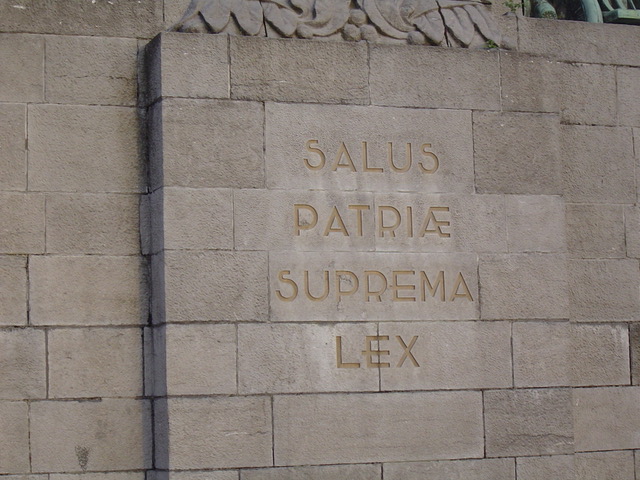
The inscription on the Belgian Infantry Memorial, Place Poelaert, Brussels
With far less at stake, it was an analogous defensive patriotism that made me crave for a Belgian victory on 7 July.
The Guardian made the connection explicit in a column published the same day: Worldwide outrage at Trump’s cheating “really brought the world together. The last time this many people cheered on a Belgian resistance, it was 1914 and the Germans had just crossed the Meuse.” This defensive patriotism is epitomized in the very choice of the name for the interceptor missiles that now serve as Ukraine’s main defensive weapon against Russian attacks: “Patriots”.
All political communities need patriotism
Patriotism, however, does not only deserve to be embraced when it responds to aggressive patriotism. It needs to be nurtured for a far more general reason. Other things being equal, a political community functions better if more of its citizens are prepared to sacrifice more of their individual self-interest for the interest of the whole community. Agreeing to risk one’s life in order to defend one’s country under attack is the most extreme form this patriotic self-sacrifice can take.
More mundane illustrations include taking on thankless political roles often at a high cost for one’s health and family, getting actively involved in organisations that aim to serve the common good, buying local when the economy is in trouble and even simply complying with regulations for sorting household rubbish or refraining from dropping litter in public places.
Most importantly, this patriotic self-sacrifice covers lending political support to the institutionalisation of economic solidarity with all one’s compatriots and contributing to the sustainability of this solidarity by not attempting to get more benefits than one is entitled to or by trying to minimise one’s contribution by exploiting the endless opportunities for tax avoidance.
For a political community to function well, therefore, enough of its members must be patriots. But not every form of patriotism deserves nurturing and developing with the same fervour.
Multi-layered, inclusive, cosmopolitan, self-critical
Firstly, patriotism can and must be multi-layered — unlike nationalism, which focuses by definition on a single level, that of the actual or hoped for nation-state. Identifying at one and the same time with our municipality, our region, our country and the European Union and cultivating patriotic feelings at each of these levels is perfectly possible. Feeling European is part of feeling Belgian, and feeling Belgian is part of feeling Flemish, Walloon or Brusseler.
Multi-layered patriotism is particularly important in a country like Belgium, as some of the instruments of economic solidarity are devolved down to the regions, where they are more vulnerable to fiscal competition, or raised up to the European Union, where they cannot count on the “natural” solidarity stemming from centuries of nation-building.
Secondly, the patriotism that is most valuable ought to be inclusive. It must be a territorial patriotism that unites all the permanent residents of a particular place, large or small, whether or not they were born in that place and whether or not they retain a patriotic attachment to some other place from which they or their ascendants originated. Such a territorial patriotism is crucially different from an ethnic patriotism restricted to those who share the same ancestry, culture, religion or native language.
Our patria, therefore, must not be defined as the land of our forefathers. It must be understood as a place in which we want our children and grandchildren to aspire to live, as a possibly quite diverse community to which we want them to be proud to belong, thanks to our collective efforts to make that place a better place, that community a better community.
Thirdly, patriotism does not amount to giving the self-interest of one’s own patria an absolute priority. It must be compatible with caring for the legitimate interests of other patriae than one’s own. Indeed, it must be compatible with a “cosmopolitan” concern for global justice.
What makes one love one’s patria can be its scrupulous compliance with international law, its commitment to the development of fair supranational institutions, its contribution to humanitarian aid and development projects, and its hospitality for refugees from all over the world. Patriotism is by no means equivalent to trying to make one’s country great again at the expense of the rest of the world.
Finally, patriotism must be compatible with self-criticism. Some pride in our patria’s and its members’ achievements, past and present, is appropriate. But patriotism is not the same as smug pride. Collective shame at the wrongs committed by or within our political community, impatience with the many inefficiencies of its institutions, anger at the unfairness of its current functioning or behaviour are all healthy antidotes for complacency. And they are useful drivers of efforts to correct shortcomings and make improvements of which we shall, in due course, have the right to be proud.
National holidays and national teams
Patriotism of this sort — multi-layered, inclusive, cosmopolitan and self-critical — is nothing to be ashamed of. Indeed, it is something worth rekindling and celebrating on such occasions as a national holiday.
In particular, the Belgian national holiday offers an opportunity to pay homage to the existence of the last remaining multilingual remnant of the Habsburg Empire, a country that has painstakingly managed to recognise two languages on an equal footing, to ascribe territories to each so as to effectively protect the more vulnerable of the two and to grant a high degree of autonomy to linguistically distinct regions whilst maintaining solidarity across them.
This is a very different matter from bringing together populations of very diverse origins in an American-style melting pot. And it is a far trickier task, as the European Union, with Brussels at its core, has been discovering in its own way. Plenty of room for improvement. But no reason to decry what has been achieved.
Games played by national teams provide another such occasion. In the Belgian case, inclusiveness is manifested by the support given by residents of all three regions to a team composed of players from all three regions. But like in all other Western-European teams, it is made even more evident by the growing proportion of players of African descent, most of them born in the country for whose team they play. Without them, Western-European teams would not have accounted for three quarters of the World Cup’s quarter- and semi-finalists.
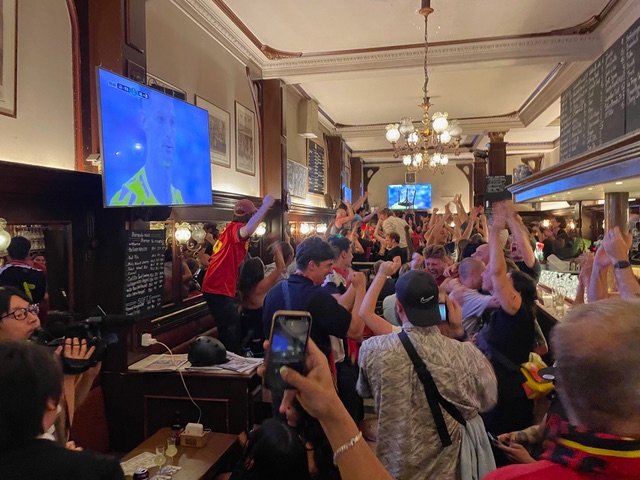
7 July 4 am: celebrating Belgium’s victory in a café of central Brussels
The patriotism triggered by our national teams should therefore have less and less difficulty being inclusive. But it is no less important that it should be “cosmopolitan” — which means at least honouring the norms of fair play, respecting the referee’s decisions and congratulating the opponents. A global sport event must not be a fight between nations that want to win at all costs. It can and must be a celebration of mankind’s ability to come together respectfully and peacefully.
I can therefore confess it without shame. What made me creep out of bed before 2 am on 7 July was not just the defensive patriotism triggered by President Trump’s attempt to win by cheating. It was also the affection of a citizen for his country and its team — an affection which, if it satisfies the conditions sketched above, I wish that every citizen of every country should feel.
Under those conditions, yes, being a patriot is perfectly OK.
Related News
- Two buildings, three languages: Why Brussels will speak more and more English
- What Brussels truly is: A multilingual region
- Vive la Belgique? Leve België? Why there is plenty to celebrate after all
- Why did Brussels become the capital of the EU? Because Belgium starts with B.
- Why Flemings know French better than Walloons know Dutch and why this will never change
