
The National Bank of Belgium was designed to project permanence, with a monumental headquarters that has loomed over central Brussels for decades. But the institution – and the city around it – has kept changing. Tim King explores the architecture, history and hidden passageways of a building now undergoing another transformation.
At the end of the 1930s, when plans were drawn up to remodel the headquarters of the National Bank of Belgium, the country’s great and good opted for monumentalism.
After the economic turbulence of the Great Crash and its aftermath, they wanted to send a message of solidity and permanence. In 1940, they chose as architect Marcel Van Goethem, who with Alexis Dumont had already designed the Shell and Assurances Générales de Trieste buildings on Rue Ravenstein, as well as the Citroën building at Sainctelette.
The bank project was interrupted by the Second World War. Construction eventually began in 1947 and took ten years.
National bank of Belgium.
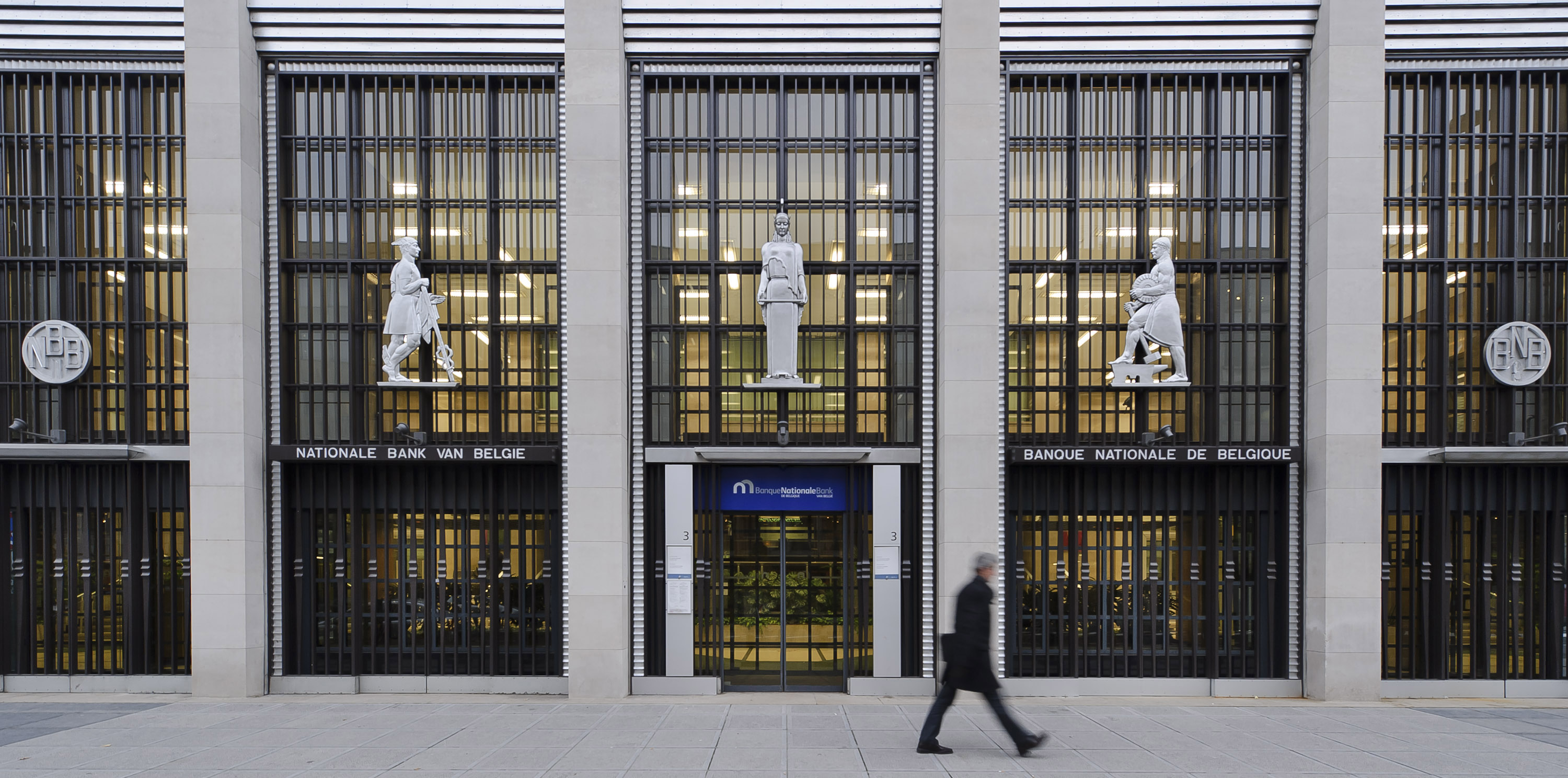
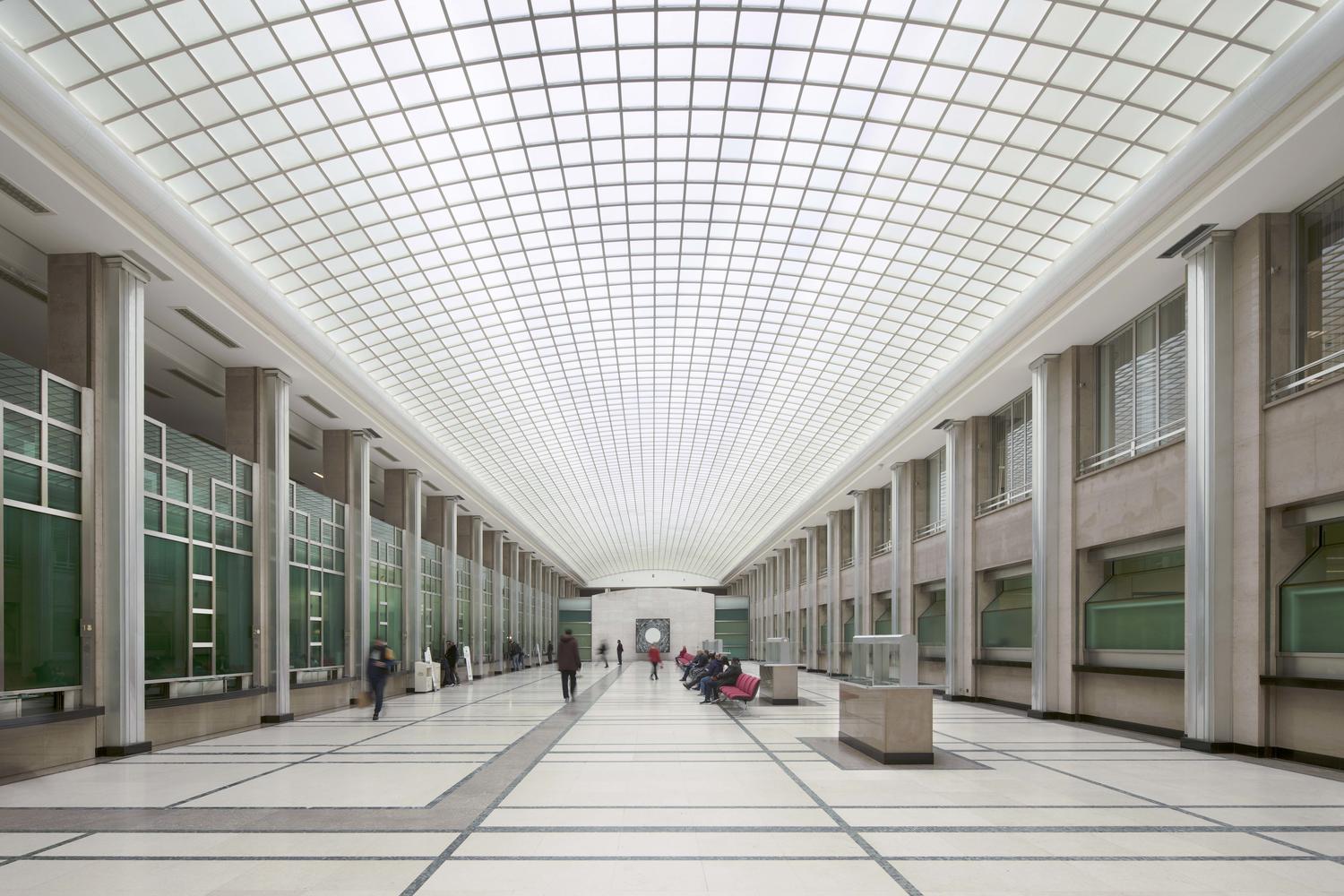
Van Goethem’s design was classical modernism on a grand scale. A colonnade runs the entire 200-metre length of the building’s frontage, made up of 52 identical reinforced-concrete columns, each 20 metres high from floor to cornice.
At the lower levels, iron railings separate the shallow colonnade from the street. In the centre, occupying five bays, is the building’s sole public entrance – for reasons of security as much as aesthetics – leading into the lobby and the cashiers’ desks.
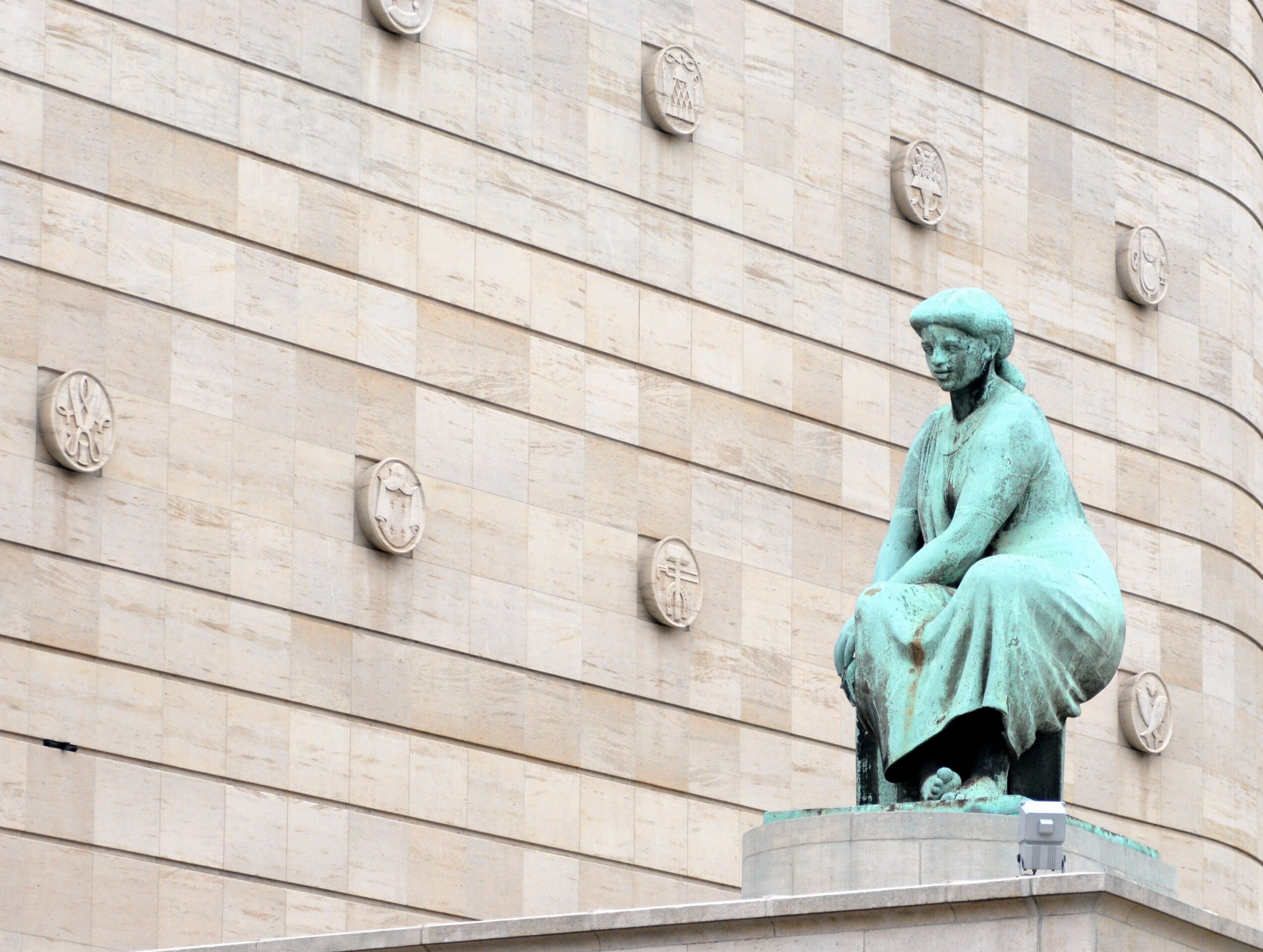
Above the doors, the entrance grille is decorated with neoclassical aluminium figures, flanked by medallions bearing the bank’s initials in Dutch and French. At either end of the façade stands a giant bronze sculpture: to the south, a seated woman by Georges Grard; to the north, a kneeling young woman by Charles Leplae.
A tale of two styles
The bank occupies a triangular site, with its long frontage on Boulevard de Berlaimont and its two shorter sides on Rue de la Banque and Rue du Bois Sauvage.
Climb Rue du Bois Sauvage and you encounter a surviving fragment of the 19th-century bank. Van Goethem’s original plans would have swept everything away, but protests won a reprieve for the Governor’s residence.
It makes an extravagant contrast with the sober façade of the mid-20th-century headquarters.
The residence is classicism embellished with all the excesses of Napoleon III’s Second Empire. You need to step well back to take in its pillars and porticos, although there is little room to do so: the north wall of the Cathedral of Saints Michael and Gudula stands on the opposite side of the street, with trees further obstructing the view.
The Governor’s residence survived, but the rest of the 19th-century bank buildings were demolished and replaced – all while the bank continued operating.
And that was far from the only upheaval going on around it.
A bank divided
Construction of the North-South railway link between Brussels-Midi and Brussels-North stations added another layer of complication.
Work had begun in 1911, only to be halted by the First World War. It resumed in 1936, was interrupted again by the Second World War, and was finally completed in 1952.
The project involved almost two kilometres of tunnel, two lengthy viaducts and the creation of a new Central Station, along with the intermediate stations at Congrès and Chapelle.
Below ground, the work threatened the stability of buildings including the cathedral. Above it, new boulevards were driven through Brussels’ central Pentagon.
The consequences remain visible today. The Pacheco-Berlaimont-Empereur axis forms a barrier between the upper and lower parts of the city.
The National Bank has suffered from its surroundings. For all the monumentalism of Van Goethem’s design, the building is a victim of its setting: Boulevard de Berlaimont is bleak and uninviting to pedestrians, a road apparently leading nowhere.
Now a new generation of architects and urban planners is being given the chance to improve it.
All change
The National Bank has temporarily vacated its triangular headquarters, including the banking halls and Governor’s residence, and moved into its 1950s and 1960s annexes across the road.
A full-scale refurbishment is under way, with the aim of bringing all the bank’s staff and operations together on the main site by 2030.
There is even a subterranean dimension to this divided estate. A passage beneath the boulevard once allowed staff to cross the road without seeing daylight, although it is currently out of use because of the refurbishment.
National Bank of Belgium.
Other passageways connect the bank’s various buildings. Three years ago, journalists from Flemish broadcaster VRT discovered that one even contained a door opening onto the North-South railway line.
The most imposing of the bank’s additional buildings across the boulevard is its former printworks, where Belgian banknotes were once produced. The site was sold five years ago and is destined to become a hotel.
Another building of historical and architectural interest lies further downhill, at Rue Montagne aux Herbes Potagères 57. Dating from 1872 and once home to the Union du Crédit, it now houses the National Bank’s museum, which from 1982 until 2018 was located in the Governor’s residence.
As well as recounting the history of the National Bank and Belgian banknotes, the museum tells the broader story of money through the ages.
Back in the 1930s, the architect Marcel Van Goethem strove to convey a message of solidity and permanence. The museum offers a rather different lesson: money has always been a story of fluidity and invention.
