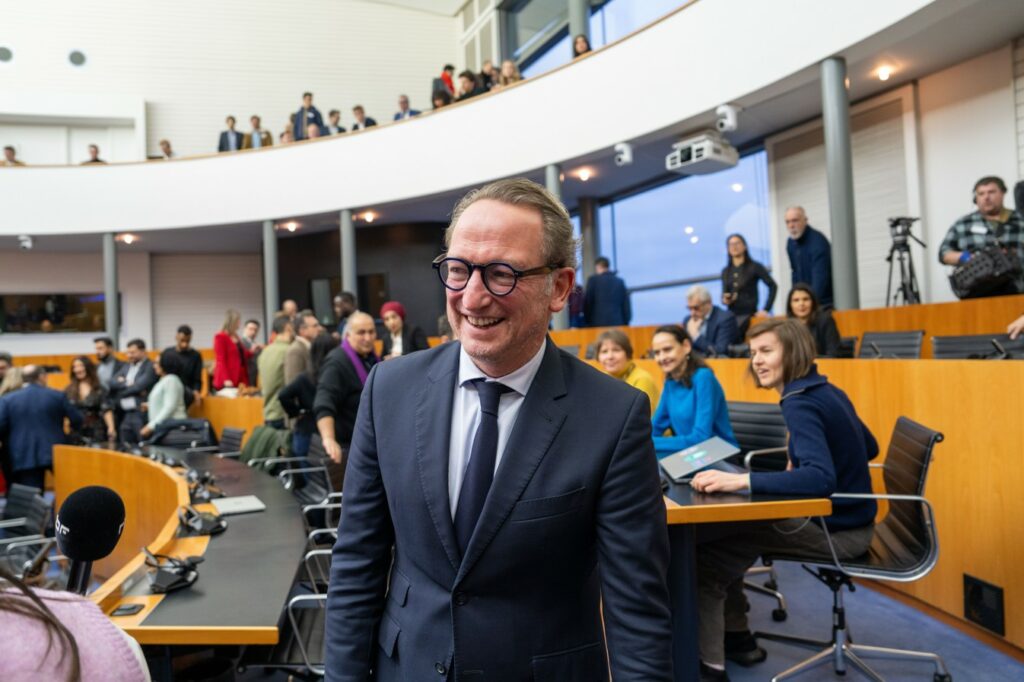
To many people's surprise (including his own), former Uccle mayor Boris Dilliès (MR) unexpectedly became the new leader of the Brussels-Capital Region last weekend.
Old-school liberal, bon vivant, likeable, very Francophone, unafraid of ruffling a few feathers, both resolute and conciliatory, and not averse to a joke – these are all descriptions that have been applied to the new Brussels leader.
Following the formation of a new Regional Government last week, Flemish, Brussels and Walloon newspapers all drew up lists of who they considered likely candidates to succeed Rudi Vervoort (PS). Boris Dilliès was not featured in any of them – and his appointment took the country by surprise.
He himself only found out that he would be Minister-President on Saturday morning. Around 07:00, he got a phone call from his party leader, Georges-Louis Bouchez, asking him if he wanted the role. Dilliès did not have much time to think about it, because the new Brussels Government was due to be sworn in just an hour later, at 08:00 in the Brussels Parliament.
He took the leap, became the new leader of the Capital Region not much later, and immediately had to get to work.
Cramming the coalition agreement
Even within MR, no one saw his appointment coming. By choosing Dilliès, Bouchez lived up to his reputation of always coming up with a last-minute surprise.
He said that he only made his decision at 06:30 on Saturday morning, after spending the whole night analysing the election results, the qualities of the candidates and even their television appearances.
"If you do something that is expected, you add nothing. When casting someone in this role, it is very important that you do something new. MR has not been in this position for 22 years, so the choice has to be the right one," Bouchez said on Saturday morning in front of the television cameras.
Now, Dilliès has his work cut out: he did not participate in the negotiations at all in recent days and is therefore not familiar with the coalition agreement.
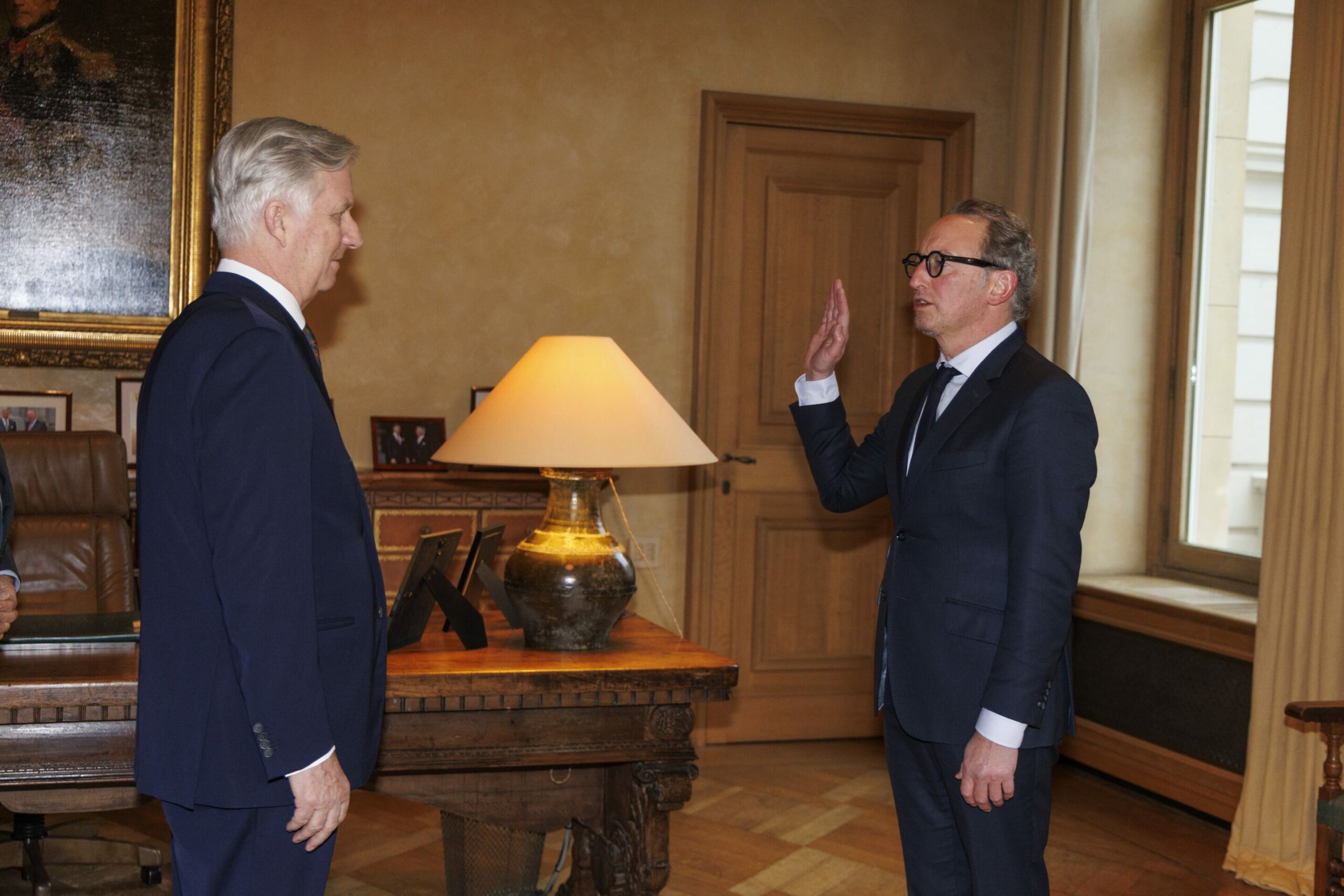
Newly appointed Brussels Region Minister Boris Dillies (R) takes the oath before King Philippe, at the Royal Palace in Brussels, on Saturday 14 February 2026. Credit: Belga/Nicolas Maeterlinck
But that does not mean that he is unfamiliar with the capital and Brussels politics – on the contrary: Dilliès has been immersed in Brussels politics for 30 years.
Strikingly, however, he does not speak Dutch. While having sufficient command of both languages in an officially bilingual region is recommended for the person in charge, Dilliès would not be the first Minister-President in the capital who struggles with the language.
His Dutch skills (or lack thereof) led to some embarrassing television footage in the Brussels Parliament on Saturday morning, when he was unable to reply to questions from the Flemish press. He admitted that his Dutch should be better, and promised to brush up.
"I will work on it. I have not had time for language immersion in the past few days, but I plead guilty. My level of Dutch is unacceptable for a Minister-President of a bilingual region," he said.
30 years of experience
The son of a French father, Dilliès, who is a dual citizen of France and Belgium, spent his early childhood in the south of France before returning to Uccle at the age of 10. Five years later, he joined the Jeunes Réformateurs Libéraux (Young Liberal Reformers), of which he later became chair.
At 21 years old, Dilliès was first on the liberal electoral list for Uccle, and narrowly missed out on being elected (he was reportedly five votes short).
He worked in various cabinets of Brussels politicians, including that of then-Minister-President François-Xavier de Donnéa (MR), before taking a seat in the Brussels Parliament.
Dilliès has been chair of the Uccle MR section since 2016. In 2017, he was re-elected vice-chair of the Brussels MR and also sworn in as mayor of Uccle. In the two elections after that, he was re-elected.
In the May 2019 regional elections, Dilliès was at the bottom of the MR list – usually a symbolic position for a political heavyweight, which allows them to show their support for the list – with low chances of winning. Still, he was elected, but decided not to take up his mandate because Uccle already has an MR MP in the Brussels Parliament in Aurélie Czekalski. This allowed him to concentrate on his role as mayor.
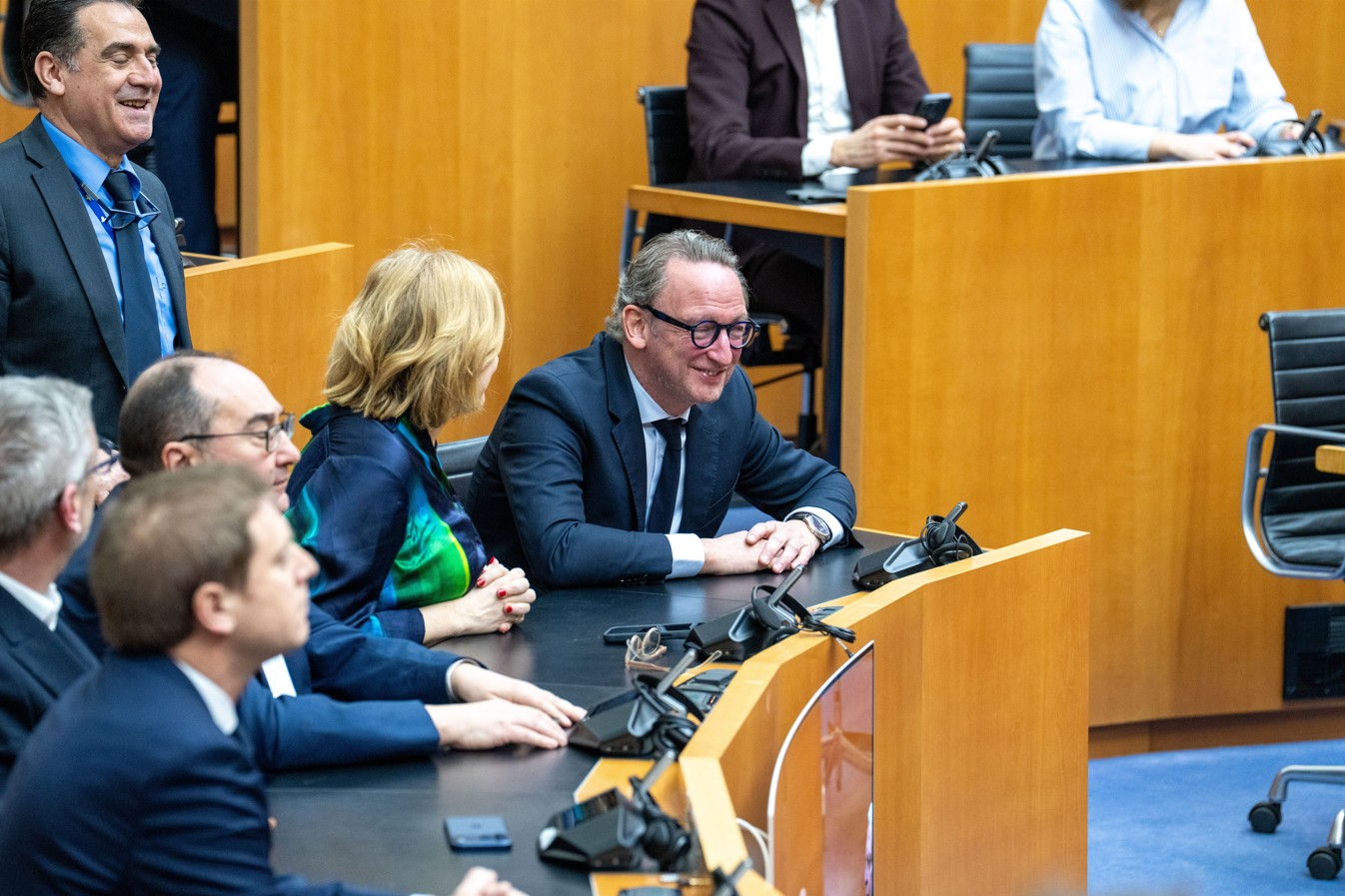
The Brussels-Capital Region's new Minister-President, Boris Dilliès (MR). Credit: Belga/Marius Burgelman
Those who know him well say that Dilliès is extremely courteous and "a true gentleman" who is able to get on well with everyone. Often described as "a pragmatist," he has reportedly mastered the art of the compromis à la belge.
This becomes clear when looking at the municipal council he headed in Uccle: a coalition of his MR party, the centrist Les Engagés and the Francophone green party Ecolo.
While MR and Les Engagés joined numerous coalitions and even governments together after the elections, Ecolo's vision does not exactly align with that of the liberals. From mobility to housing costs, MR leader Bouchez has made no secret of the issues he has with the greens.
Dilliès's ability to compromise will be much-needed in Brussels's new seven-party coalition: vetoes and political egos were not the only things that prevented a coalition from being formed. The parties around the table – greens, socialists, centrists and liberals – also have large ideological differences.
Still, Dilliès's track record of working with Ecolo and the Flemish green party Groen – which launched the mobility Good Move plan to make Brussels more bicycle and pedestrian-friendly – was not all plain sailing. At the end of 2024, Dilliès had bicycle racks (which the region had installed in his municipality) removed with grinding discs.
More than the Beverly Hills of Brussels
Having developed a reputation for wanting to keep cars on the streets of Brussels at all costs, he is vehemently opposed to everything the Good Move plan stands for. While the mobility plan is now being renamed and applied on a smaller scale as part of the Brussels coalition agreement, Dilliès will still have to implement it.
Despite having the reputation of being a loyal party soldier, he clearly does not always follow the party line; one of his first acts as mayor was to raise taxes in Uccle – a cardinal sin in the liberal party.
Importantly, the municipality has a reputation for being almost exclusively French-speaking and very wealthy, leading some to question whether Dilliès has enough affinity for the whole of Brussels – which includes some of the country's poorest communes, such as Saint-Josse, Molenbeek and Anderlecht.
On Saturday, however, Dilliès did his best to counter that image and indicated that he will be there for all Brussels residents. "I want to make it clear that the caricature of Uccle as the Beverly Hills of Brussels does not hold water. We also have different neighbourhoods."
"I will become the Minister-President of the people of Brussels, of all 19 municipalities," he stressed. "And we must get to work in all municipalities, especially the most vulnerable ones."
