Less than a week before new fines are supposed to be issued to owners of polluting vehicles driving through the Brussels Low Emission Zone (LEZ), uncertainty remains over whether the penalties will actually be enforced from 1 April.
From 1 January this year, Euro 5 diesel vehicles and Euro 2 petrol vehicles – alongside motorcycles meeting Euro 1 or Euro 2 standards – were banned in the Brussels Region. This amounts to around 7% of the city’s vehicle fleet.
Diesel cars with Euro 5 standards are vehicles first registered between January 2011 and September 2015, while Petrol Euro 2 vehicles are those dating from before 2001.
Grace period comes to an end
Following the introduction of the ban, regional environmental agency Bruxelles Environment has been issuing warning letters to owners of non-compliant vehicles, advising them that fines will follow if another violation occurs after three months.
With this three-month grace period coming to an end on 31 March, the first penalties should – in theory – be issued to motorists as of next Wednesday, 1 April. As it stands, a quarterly fine of €350 will be imposed on rule-breakers.
However, sticking to the planned timetable (which was reinstated in December by the Constitutional Court, annulling a parliamentary postponement) is proving to be a challenge for the newly-formed Brussels Regional Government.
The government is seeking a way to avoid dishing out excessive fines to drivers of non-compliant vehicles while keeping to the court-ordered timetable.
One solution is to issue an annual pass to owners of non-compliant vehicles, costing €350. Another solution is to cap monthly fines at €80.
These measures have been announced, but not yet formally agreed, and changing the legislative framework in time for 1 April is proving difficult – not least because any outright suspension of the LEZ fines would, as La Libre suggests, open the door to legal challenges.
A temporary solution in the offing?
A spokesperson for Ans Persoons (PS), Brussels State Secretary for Environment and Climate, told The Brussels Times that regional authorities are “working hard to find a temporary solution” to address the issue, but said there are “still some details that need to be clarified within the government” before any announcement is made.
A decision is expected to be made during the cabinet meeting on Thursday.
Earlier in the week, the region’s Mobility Minister Elke Van den Brandt (Groen) told BX1 that ministers were “working tirelessly” on a new system, but she refused to be drawn on whether fines would actually be implemented on 1 April as originally planned.
"The two ministers [Persoons and Dirk De Smedt] are working on an annual pass to avoid fines," she said. "But I prefer to remain cautious in my communication until the details are finalised and definitive.”
However, Van den Brandt confirmed that exemptions will exist for some motorists. “In the past, passes have already been given to people with disabilities. Analysing whether people truly need an exception is part of the policy. There will be passes offered to people who genuinely have no other option.”
The Brussels Regional Government is coming under increasing political pressure to reach a decision on the issue. Alain Maron (Ecolo), who was Climate and Environment Minister in Brussels' previous government, told La Libre that the new Dilliès administration has "sown the seeds of doubt where clarity is needed”.
Meanwhile, Jamal Ikazban (PS) told BX1 that the solution was to accelerate the implementation of the €350 annual pass.
What are LEZs and how effective are they?
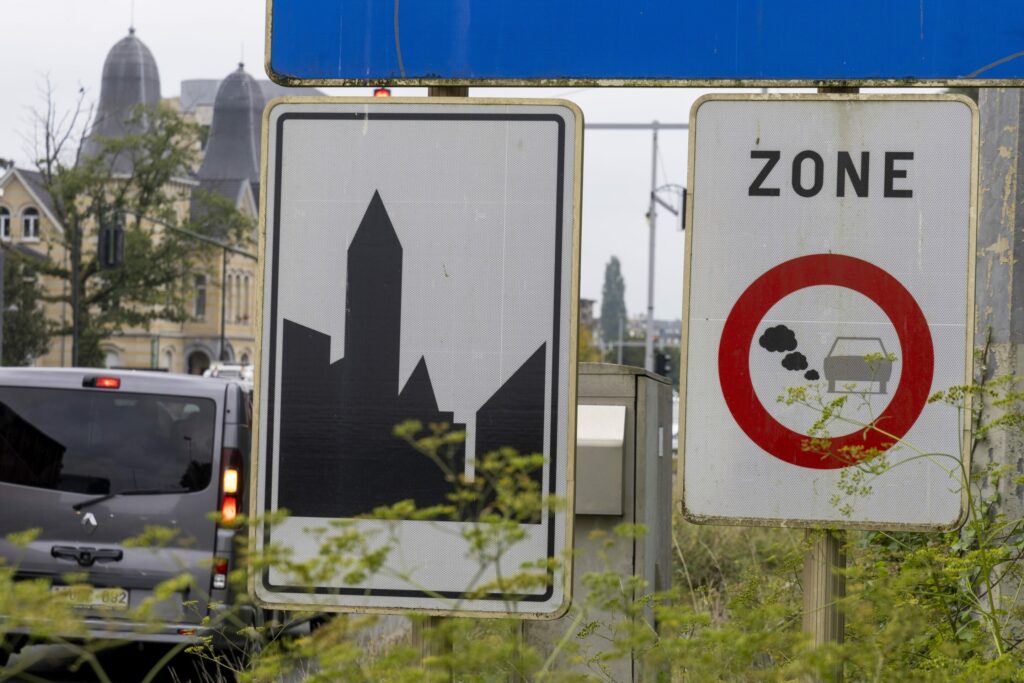
LEZs are marked-out areas where certain vehicle categories are not allowed to enter – or only under certain conditions – because they are too polluting. Drivers entering an LEZ with a vehicle that is not permitted, or who do so without the necessary authorisation, will be fined.
The start and the end of the zone are also always demarcated with specific traffic signs. The LEZ is valid 24 hours a day, seven days a week.
Brussels introduced its LEZ in 2018 to tackle air pollution. It covers all 19 municipalities (see map), excluding the Ring Road (R0) and certain roads providing access to Park and Ride transit car parks (P+R). Vehicles that do not meet the LEZ access criteria can be parked here, and people can reach the city centre by public transport.
According to Brussels Environment, air pollution in Brussels is on the decline, partly as a result of the restrictions placed on polluting vehicles.
Among the main pollutants from road traffic emissions are nitrogen oxides. Between 2018 and 2024, the traffic emissions of these pollutants dropped by 55%, with nitrogen dioxide (NO2) concentrations falling by around 45%.
In the same period, the emissions of black carbon and fine particulate matter (PM2.5), which also pose health risks, dropped by 62% and 33%. The changes are calculated based on a constant volume of traffic.
The next stage of the LEZ restrictions in Brussels will begin in 2028, prohibiting Euro 6 diesel vehicles and Euro 3 petrol vehicles.
