
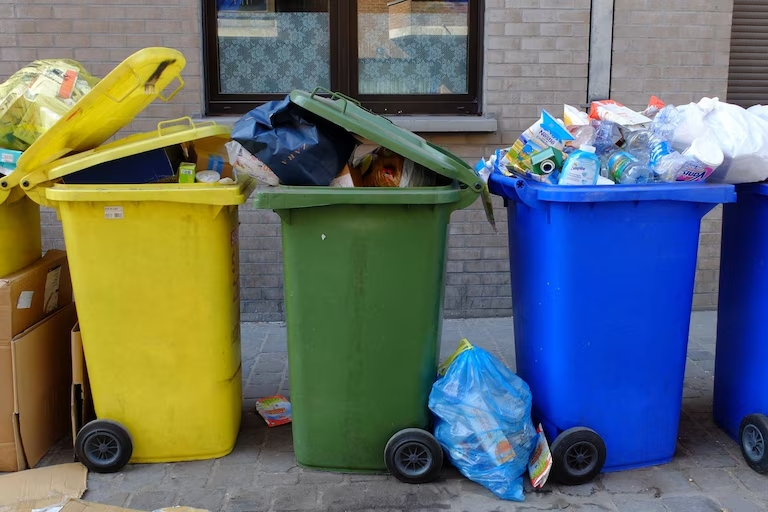
People who have just arrived in Brussels or reside here for a short period of time might take a while to get accustomed to the capital's household waste collection.
Unlike other European cities, waste management in the heart of Europe can be rather confusing, if not annoying.
A week ago, The Brussels Times asked its readers to suggest a few solutions to improve the city's cleanliness. Installing big plastic bins was a popular solution our readers came up with for managing household waste and getting smelly and unsightly bags of rubbish off the streets.
But for Brussels Cleanliness, the para-regional body responsible for keeping Brussels' streets clean, plastic bins are not the solution. In fact, to them, there is no miracle fix to the city's waste disposal problem.
"Historically, we have always worked with plastic bags in Brussels. It is worth noting that there are many densely populated neighbourhoods where it is extremely difficult to determine where a bin could be placed," Adel Lassouli, spokesperson for regional agency Brussels Cleanliness, told The Brussels Times.
"Additionally, these bins are waste magnets, often overwhelmed by people who do not necessarily live in the same neighbourhood but come to dispose of their waste in them. So there is no magic solution; it is a highly complex issue," he said.
A lesser sense of responsibility?
Another issue with bins for Brussels Cleanliness is recycling. The organisation claims that people are less careful with recycling their rubbish if they know they will throw it in bins. "There is a lesser sense of responsibility," Lassouli argued.
"In apartment buildings that have space to put bins, we often see rubbish that is badly recycled or does not comply with all the rules. As a result, we are sometimes unable to collect it, or if we do so, it is never well done."
In certain municipalities like Woluwe-Saint-Pierre or Woluwe-Saint-Lambert, bins are already installed in certain neighbourhoods and apartment buildings, but according to Lassouli, "those bins take space, and they should be integrated in urban design if installed elsewhere, and that is the difficulty".
Brussels' household rubbish management is often compared to other European cities. Madrid or Barcelona, for instance, often come up in comparison to the capital of Europe. But Brussels Cleanliness explains that the objectives of cleanliness differ from city to city.
"I do not know any city that does not have a problem with cleanliness," said Lassouli. "Spain is, of course, an interesting model. But I know that in some Spanish cities – and we looked into this when benchmarking bin systems – authorities are actually moving away from placing bins everywhere, because people end up disposing of their rubbish whenever they like, the system is misused."
According to Lassouli, the fact that the capital has a very high turnover of population also has an impact on waste disposal in Brussels. "Some municipalities renew their population every five or six years," he said.
"Take Ixelles, for instance, where there is significant turnover over that period. As a result, some do not follow or adhere to the rules, and cleanliness issues tend to be more acute in areas with high levels of transit and turnover, rather than in more residential neighbourhoods where people own their homes and stay for many years."
Apart from urging citizens to "play their part", Brussels Cleanliness proposes buying a "small rigid bin" where they can put plastic rubbish bags on the day of collection.
