The Federal Parliament is expected to vote on the controversial and much-discussed merger of Brussels' six police zones on Tuesday, but local mayors are considering challenging the proposal before the Constitutional Court.
The merging of the six police zones in Brussels has been the topic of discussion since mid-2024 during the negotiations to form the Federal Government. The merger was confirmed when the 'Arizona' government took office in February 2025, as it had been made part of the coalition agreement.
"Brussels is being discriminated against," Christian Lamouline (Les Engagés), the mayor of Berchem-Sainte-Agathe and chair of Brulocalis, the association of Brussels cities and municipalities, told De Morgen.
"In the rest of the country, police zones are encouraged to merge. But that happens on a voluntary basis," he said. "In Brussels, this merger is being imposed."
Too fragmented
While the Federal Government, led by Prime Minister Bart De Wever (N-VA), indeed speaks of a "voluntary" merger of police zones across the country, the coalition agreement singles out the Brussels-Capital Region, stating that its security policy is "too fragmented".
They argue that having six separate command structures, six separate administrations and six separate police chiefs makes the police force slow and inefficient.
"As a result, crime and public nuisance are not being tackled most efficiently. There is a clear need for greater unity of vision and leadership in the field of policing and security policy in the capital," the agreement reads.
"Given the territorial interdependence of the Brussels-Capital Region in terms of urbanisation and security, there is a need for a clear and consistent security policy. We are therefore merging the six Brussels police zones into a single zone," it concluded.
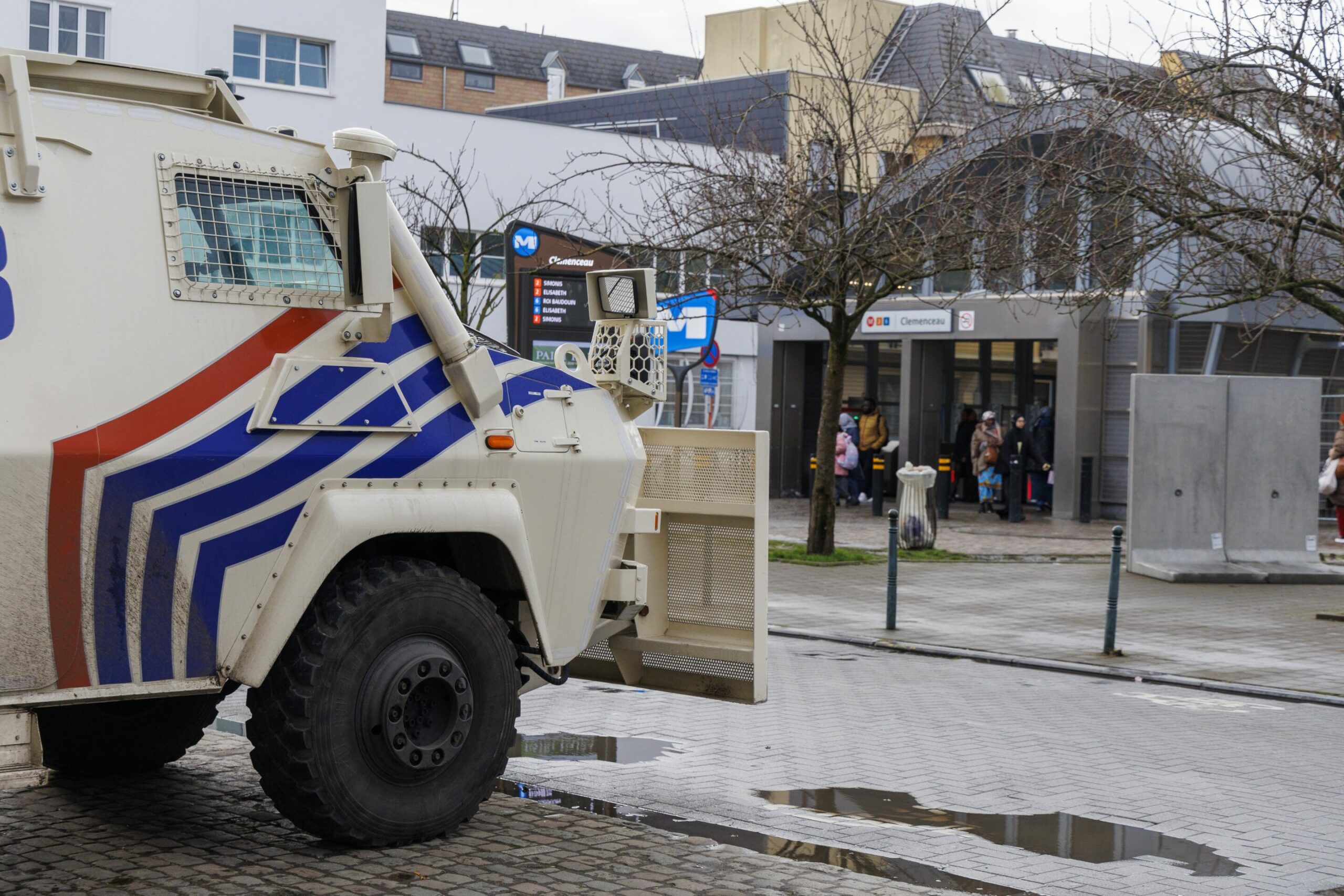
Police pictured near the Clemenceau metro station during 'Pause 1070' a solidarity neighborhood meeting in Anderlecht, Brussels, on Thursday 27 February 2025, after the recent shootings in their neighborhood. Credit: Belga/Nicolas Maeterlinck
From the start, however, all 19 mayors in the Capital Region vocally opposed the unification. Last summer, they issued an advisory opinion that unanimously rejected the plans. Still, the proposal was pushed through.
Now, MPs in the Federal Parliament will vote on various texts that will establish one unified "Brussels-Capital" police zone on Tuesday. The aim is for the six different zones to merge into one large zone over the course of 2027, as the entire process is due to be completed by 1 January 2028.
If the merger is approved by the Federal Parliament, the Brussels mayors are planning on taking legal action: they will “most certainly challenge” that legislation, according to Lamouline.
However, they will first need some time for the individual municipal councils to discuss the legal texts and decide what exactly they are going to do. Still, Lamouline made clear that they might even take the law to the Constitutional Court.
'Complying in good faith'
Those in favour of a merger – the Dutch-speaking parties (and the French-speaking liberal MR) – believe it would lead to a Brussels police force better equipped to deal with the challenges of drug-related gang violence that does not stop at municipal borders.
Apart from MR, there is hardly any enthusiasm for the merger among French-speaking parties.
The expectation is that most Brussels mayors will join the legal proceedings – although it is unclear what will happen in the municipalities with an MR mayor, as they would be going against MR's own Interior Minister, Bernard Quintin.
In his previous position as mayor of Uccle, the current Brussels Minister-President Boris Dilliès, also an MR member, was very outspoken in his opposition to the merger as well.
Now, he has promised to dutifully carry out the Brussels Government's coalition agreement. "As soon as the merger of the police zones is approved by the Federal Parliament, the region will comply with it in good faith," it reads.
Approached for comment by The Brussels Times, Dilliès could not be reached for comment by the time of publication.
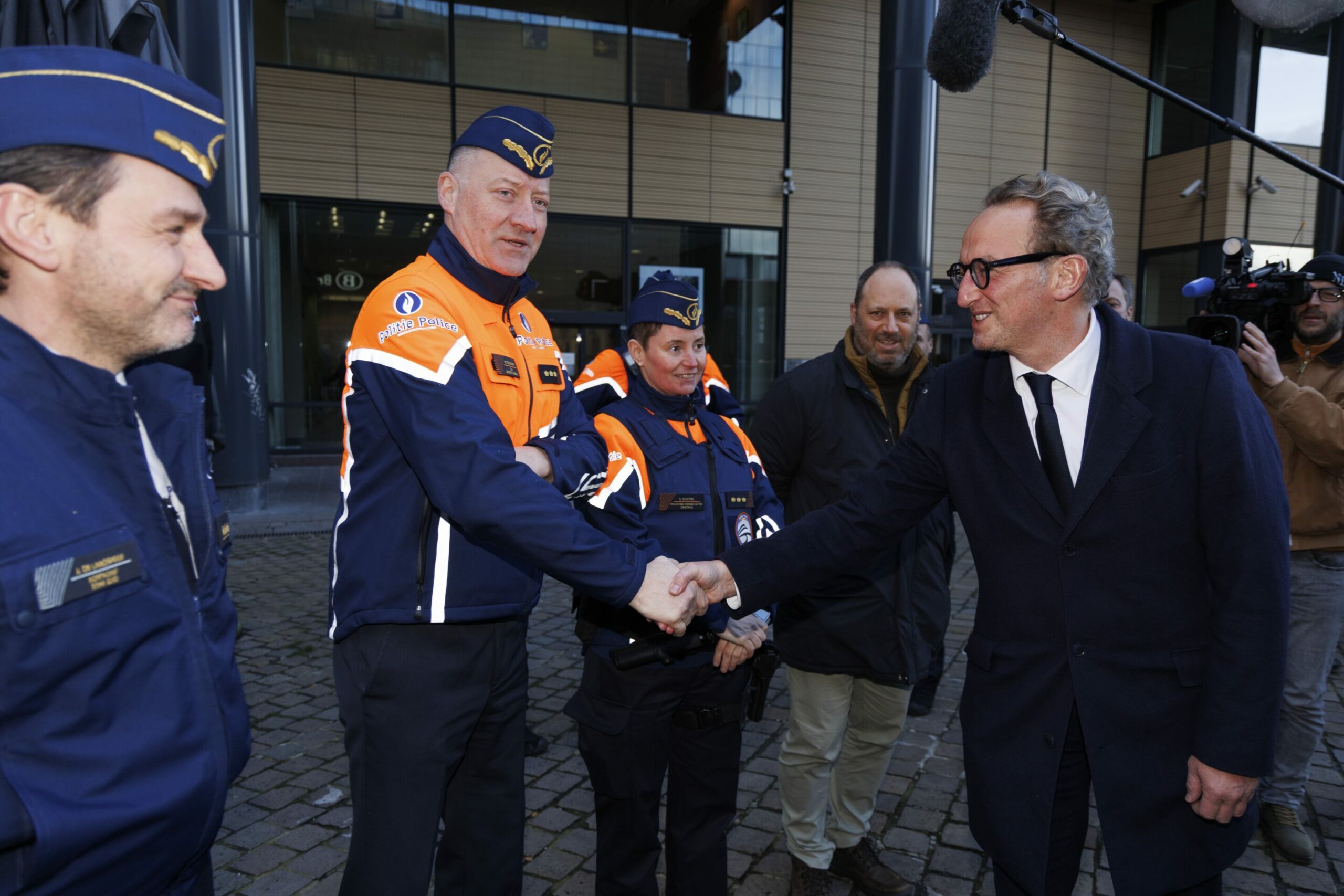
Brussels Minister-President, Boris Dilliès, meeting police at Brussels Midi station. Credit: Belga/Nicolas Maeterlinck
Valentine Delwart, who has been acting mayor of Uccle since Dilliès assumed the role of Minister-President, told De Morgen that she is not fully on board with the merger, but believes that legal action goes "too far".
"It seems the costs will rise significantly, but will Brussels actually gain more security in return? How are we going to harmonise the different IT systems of the police zones?"
A senior source within the Brussels police told the Flemish newspaper that the reform is so radical that it will mainly cause "chaos" in the coming years.
Budget issues
The merger is also seen as a measure to counter the shortage of officers, but the senior source believes that the shortage is so severe that it cannot be resolved with a few reshuffles. Under current plans, it will lead to a force of between 6,700 and 6,800 officers, while some 7,700 are deemed to be necessary on the streets.
The Association of Brussels Municipalities is also concerned about funding, as the Brussels police zones are financed partly by the municipalities and partly by the Federal Government.
The federal money is calculated based on the number of inhabitants. However, Brussels is currently still working on the basis of a theoretical population of 900,000 inhabitants. In practice, this number has already risen to 1.2 million.
As a result, the Brussels police zones would be missing out on at least €300 million in revenue during this legislative term (2025–2029), according to an analysis by Brulocalis.
Related News
- Why Belgium struggles with 'dirty money' in drug trafficking
- 'Shocking, detached from reality': How is Brussels responding to latest drug explosions?
- Dilliès wants more money to boost security in Brussels - with an important caveat
- Turf wars in Brussels: Rival gangs feud again in violent week of explosions and shootings
