

Workers from the domestic services sector gathered in Brussels on Wednesday to denounce stricter funding measures they say will affect the livelihoods of over 700 people.
Domestic workers, such as cleaners, are paid through service vouchers, a payment method that is partly publicly subsidised.
Companies in this sector have long been able to receive additional funds for social employment integration, as they often help train and employ disadvantaged workers or people with lower skill sets.
However, this is set to change starting next year, as the Brussels Employment Minister, Laurent Hublet (Les Engagés), is expected to establish a strict enforcement of a 2024 decree, which excludes the service voucher sector from additional integration funding. There are concerns that this will lead to lay-offs within the domestic services sector.

Protesters hold various signs. Credit: Vicente Torre Hovelson/ The Brussels Times.
'We want to work’
Cleaner Sónia Goçalves, a mother of two teenagers, was among the demonstrators who gathered in front of the Les Engagés HQ on Wednesday, a protest organised by representatives of the sector with the support of Belgian trade unions.
Originally from Portugal, Gonçalves has worked in Brussels at a cleaning company for around 20 years.
If she loses her job, Gonçalves will try to find work within the private sector. However, this will cost her several additional perks, such as meal vouchers and the reimbursement of travel expenses.
For Goçalves, the new funding rules are counterproductive, particularly amid austerity measures affecting unemployment benefits.
Her feelings were echoed by Emerence, a seamstress in the service voucher industry who is also at risk of losing her source of income.
“The government needs people to be able to work. People here work to earn a living and contribute to Belgium’s economy…so why scrap this [additional funding]?,” she said. “We want to work.”
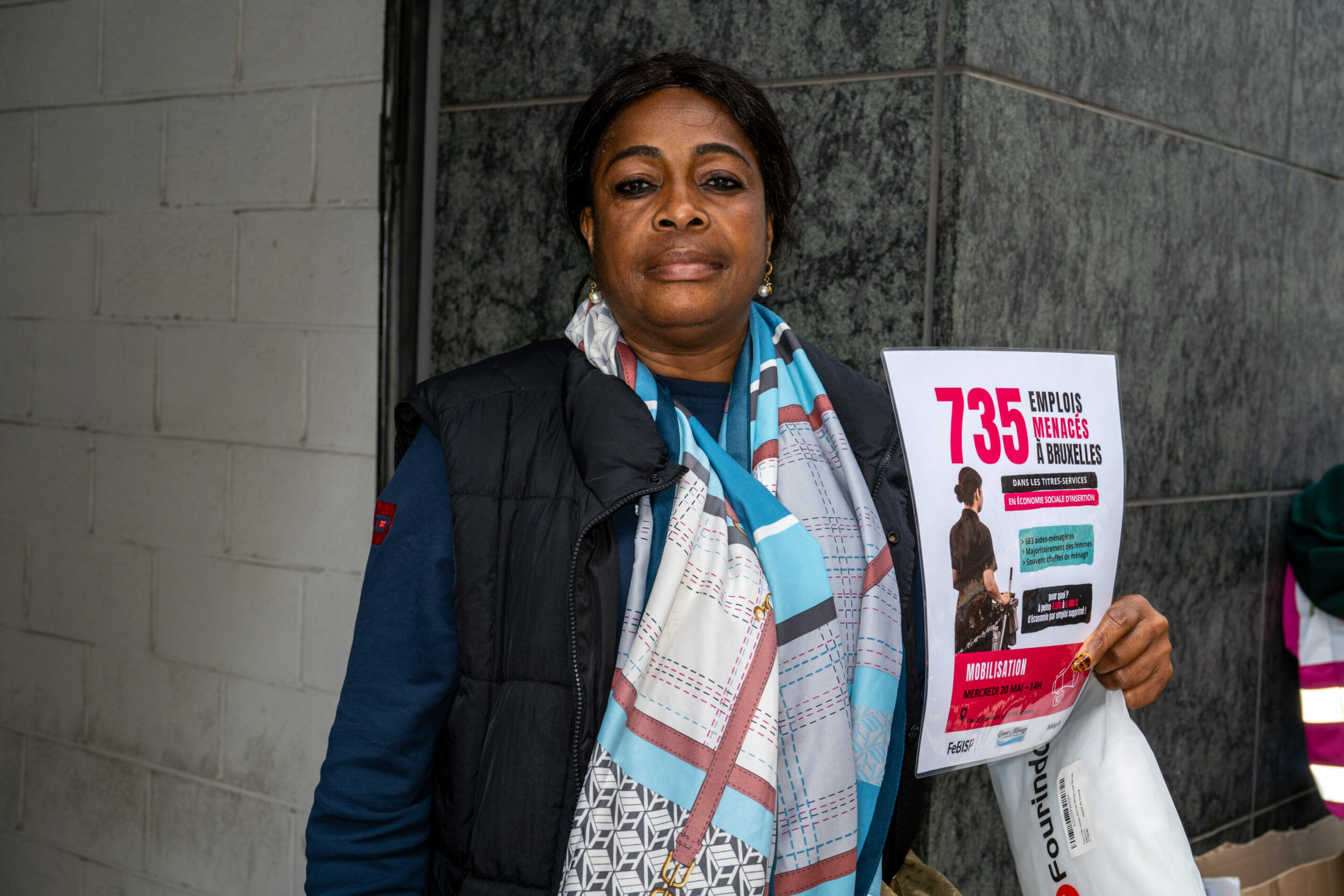
Emerence is a streamess who joined the demonstration outside the Les Engagés HQ on 20 May 2026. Credit: Vicente Torre Hovelson/ The Brussels Times.
The seamstress further stressed the particular impact of the changes on women, who make up a significant proportion of jobs in the “voucher sector”.
This point was highlighted by Celine Laurent, the director of the cleaning and integration agency Acelya.
“These are genuinely vulnerable women in the job market who now have jobs with decent working conditions and whom we risk sending back into unemployment just like that, with no guarantees,” she told The Brussels Times.
'Merely applying the law’
The Brussels employment minister has previously clarified to the press that the change to the funding rules is not new but merely the “application of regulations adopted during the previous legislative term”.
Speaking to La Libre on Monday, a spokesperson for the minister said that “Hublet is merely applying the decree and therefore the law”.
According to the Francophone news outlet, the former Brussels Employment Minister Bernard Clerfayt (Défi) has suggested that the decree could still be reviewed and indicated that debates have been raised over the different interpretations of the 2024 measure.
Nonetheless, as it stands, the reduced funding available could affect the jobs of 735 people, according to Nathalie Paquet, a press officer representing several Brussels-based voucher service companies.
The affected organisations are calling for the measure to be amended, Paquet added.
While the Brussels Government considers the number of redundancies an overestimation, the regional unemployment agency Actiris has been asked by political figures to provide support for any affected resident, a spokesperson for the agency told The Brussels Times.

Protesters hold various signs. Credit: Vicente Torre Hovelson/ The Brussels Times.
Hublet was initially expected to propose on Thursday a call for social integration projects to apply for subsidies from 2027. This call was set to exclude, as per the 2024 decree, companies that service voucher schemes.
Nonetheless, representatives of the Belgian trade unions told Belga News Agency that Hublet's party has indicated that they may consider alternative solutions following a meeting during Wednesday's demonstration.
It remains unclear whether Hublet will proceed with the call for social integration projects on Thursday.
The Brussels Times contacted Hublet and the previous Brussels’ Employment Minister Bernard Clerfayt (Défi) for comment, but it has yet to receive a response as of the time of publication.

Acelya director Celine Laurent. Credit: Vicente Torre Hovelson/ The Brussels Times.
How do service vouchers work?
In Belgium, residents who want to hire someone for household services, such as cleaning, must use service vouchers, or titres-services in French.
Service vouchers are a type of payment method that is subsidised by the government. It was first introduced in 2004 as an effort to cut back on undeclared work in the hopes of creating better social protection and living conditions for workers in the sector.
In 2014, the management of the voucher system was made a regional competence.
One service voucher is equivalent to one hour of work, and the cost of service vouchers varies depending on whether you live in Brussels, Flanders or Wallonia.
Accredited companies that use the service voucher scheme can be found through the titre-service website hosted by the Brussels Government.
Related News
- Number of Belgians training for shortage jobs doubles after unemployment reform
- 'Poverty is very expensive for society': Thousands protest Belgium's budget cuts
- Public welfare centres call for support to continue services across Belgium
The voucher sector includes jobs such as cleaning, cooking, doing laundry, running errands, providing transport for people with limited mobility, or even sewing.
Not all household jobs can be paid for with service vouchers. Prohibited jobs include: general gardening, landscaping, babysitting or childcare, caring for the sick, elderly, or pets. Manual work such as painting, wallpapering, or electrical/plumbing repairs.
Additionally, cleaning services for commercial premises are not covered by the voucher scheme.
