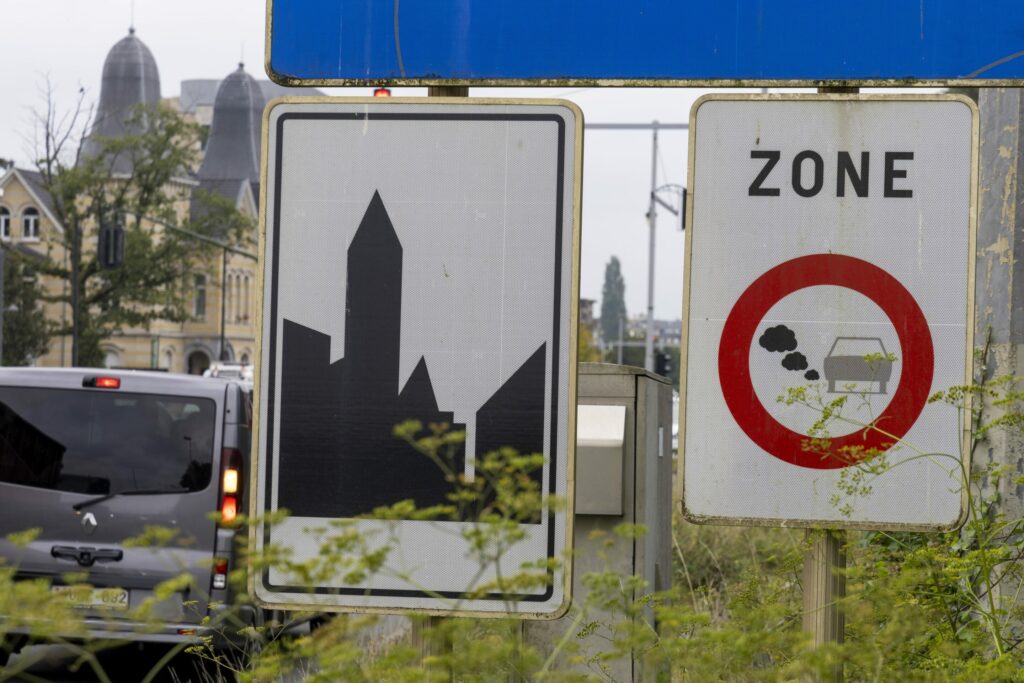
Despite strong opposition and protests against the Low Emission Zone (LEZ) in Brussels, a majority of the capital's residents are in favour of banning combustion-engine vehicles from 2035.
On the day that the Brussels Government is reintroducing fines to enforce compliance with the LEZ, the non-profit organisation Les chercheurs d'air published the results of a new survey showing that 56% of residents support the measure.
"The Low Emission Zone is a powerful tool for combating air pollution and CO₂ emissions. These emissions are largely responsible for the heatwaves that are hitting us so hard," Pierre Dornier, director of Les chercheurs d'air, told The Brussels Times.
From July, Euro 5 diesel and Euro 2 petrol vehicles are no longer allowed to enter the Brussels-Capital Region. It concerns some 13,000 vehicles in Brussels, whose drivers already received a warning earlier this year.
Anyone caught violating the stricter LEZ standards for the first time will receive a warning. Three months later, a fine may be imposed for a new offence.
"The majority of Brussels’ population is in favour of this LEZ. We are calling on our elected representatives not to turn it into an empty shell with a weak annual pass scheme," Dornier said. "The health of Brussels residents, particularly the most disadvantaged, is at stake.”
Growing support
The survey, conducted by the independent market research organisation Dedicated, shows that 56% of Brussels residents are in favour of banning combustion-engine vehicles in the Brussels Region from 2035 onwards, via the LEZ.
For the same question, 52% of people responded favourably last year – meaning support grew by four percentage points, Dornier said.
This support, although it varies slightly, is equally widespread among women and men (56%), among car owners and those without a car (51% and 59%, respectively), and among parents and those without children (56%).
However, while the 18–34 and 35–54 age groups are largely in favour of this measure (61% and 56%, respectively), the only group where there is no majority support for the initiative is the over-55s, with 49% in favour.
"A majority of the population does not have a car, so they are not impacted. And of the people who do have a car, a large majority of them already comply with the stricter LEZ standards, so they are not affected either," he said. "Neither are most of the people with company cars."
Credit: Belga/Benoit Doppagne
The results also show that 64% of respondents say they are concerned about the impact of air pollution on the health of Brussels residents.
“These figures confirm what we hear in every neighbourhood: Brussels wants to breathe,” Brussels Mobility Minister Elke Van den Brandt (Groen) told The Brussels Times.
“Two in three residents worry about the air pollution, and they are right. Often it is the most vulnerable families, in the poorest neighbourhoods, who pay the highest price,” she said.
According to Van den Brandt, an LEZ is one of the most effective health measures a city can put in place.
The results of this survey have been published just as fines for non-LEZ compliance are being reintroduced, which came after a controversial decision in October 2024 to postpone the tightened rules just a few days before the local elections.
Almost a year later, in September 2025, this decision was overturned by the Belgian Constitutional Court, which reinstated the January 2025 deadline.
However, as this meant that many drivers had unknowingly been violating the rules for nearly nine months, the authorities decided not to start issuing fines. They first set 1 April as the date to start fining people, but that was later postponed until 1 July. The amount of the fine (€350) is equivalent to the cost of a pass for 12 months.
“It is the task of this government to make the shift away from polluting cars a real choice for people, with better public transport, safer streets, room to walk and cycle, so that we can stay the course,” Van den Brandt said. “We owe that to the people of Brussels.”
Loud minority
The Region is also exploring the possibility of introducing annual passes that could be renewed after the next tightening, set for 1 January 2028.
It will be essential that these schemes remain consistent with the LEZ's objectives, namely the phase-out of diesel by 2030 and of internal combustion engines by 2035.
"These survey results remind us that there is a difference between what the majority of the population thinks and what a small minority of the population shouts about very loudly," Dornier said.
For this survey, a total of 1,000 Brussels residents aged 18 and over were questioned, representative of the population in terms of gender, age, municipality and car ownership.
