It’s a busy Monday morning at the start of Mobility Week and I’m trying to figure out why mobility in Brussels is such a mess.
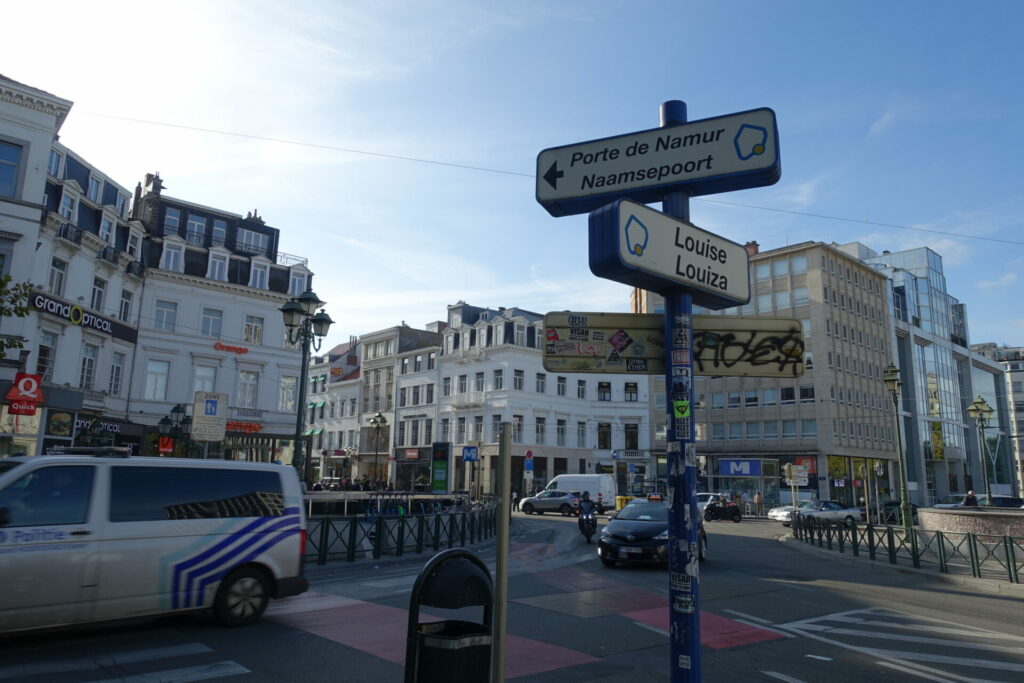
I’m at a crossing on Avenue Louise, where many different types of transport are fighting for a very limited space. You have the cars, which have been here for generations, taking up all the space they need. And then you have the invasive species – the bikes, scooters, joggers and pedestrians – all trying to grab a share of the space.
The different ways of getting around just don’t fit together very well in a city like Brussels that has focused on the needs of car drivers for more than a century.
You reach the crossing, stop, and think, what do I do now? The cars should stop, but sometimes don’t. The bikes should stop, but mostly keep going. The scooters should also stop, but they can’t, or they won’t. And then you have the trams, which have priority over everything else.
As you stand at the crossing, you might feel you need a degree in psychology to work out who is going to let you cross the road.
It’s not just the roads that are designed for cars. The fiscal policy in Belgium favours car use by offering a tax break for company cars. The deal is that the employee pays a tax rate that is lower than the value they receive.
Roughly speaking, you pay about a quarter of the real cost of running a car. And that is a tempting perk in a country with a tax rate that claws back more than half your earnings.
More than half a million of the cars crawling along Belgium’s congested roads are company cars. The government is trying to figure out ways to end this unfair system that favours relatively well-paid employees.
A few years ago, it introduced a mobility budget that allowed large companies to offer an alternative to a company car, like a bicycle or a public transport card. But only 15% of employees have been tempted by the offer.
Meanwhile, cars in Brussels (and everywhere) are getting steadily bigger. The average car has expanded in every direction by more than one centimetre every year. Even the iconic Mini has put on weight.
This autobesity, or car bloat, is not a huge problem in the United States, where the roads are wide and parking is plentiful, but it causes problems in Brussels where parking is tight and spaces were marked out when cars were much smaller.
But it isn’t just that cars have got bigger. They have also got more dangerous. People are driving huge US-style pick-up trucks like the monstrous Dodge Ram. Fine in the wide open spaces of America. But how come you see them squeezing down the cobbled lanes of mediaeval Bruges?
The answer – you might have guessed – is tax. These big polluting vehicles used to be taxed at a lower rate than ordinary cars. The loophole has been closed, but these menacing vehicles are still on the road.
Despite the challenges, Brussels is pushing ahead with plans to cut car use in the city.
This Sunday, 20 September, the entire Brussels Region will turn into Europe’s largest car-free urban area. Launched in 2000 to mark the end of Mobility Week, the event brings thousands of cyclists and pedestrians to the streets in a crazy fiesta that runs from 09:30 to 19:00.
Cynics like to point out the cars rush to reclaim the streets at 19:01, sometimes roaring off to vent their anger. Yet it’s hard to deny that the city’s attitude to cars has changed over the past 26 years, as more people cycle and use the improved pubic transport network. And car-free day has become such a success story that Brussels plans to organise a second version every year in May.
Meanwhile, the Federal Government is currently trying to vote through a measure that would gradually remove the tax break for company cars. Analysts have calculated that it could raise around €5 billion, or about half the savings the government urgently has to find.
But there is fierce resistance from some politicians who see the company car as a basic right. “I’d rather swallow a light bulb than abolish the company car,” said Sammy Madhi, party leader of the Flemish Christian Democrats (CD&V).
