After decades of grand plans, abandoned tunnels and dashed hopes, Brussels’ Schuman Square has finally been transformed. But is it a fitting centrepiece for the European Union’s capital? Philippe Van Parijs reflects on a long battle to reclaim the square from traffic – and what still needs to be done.
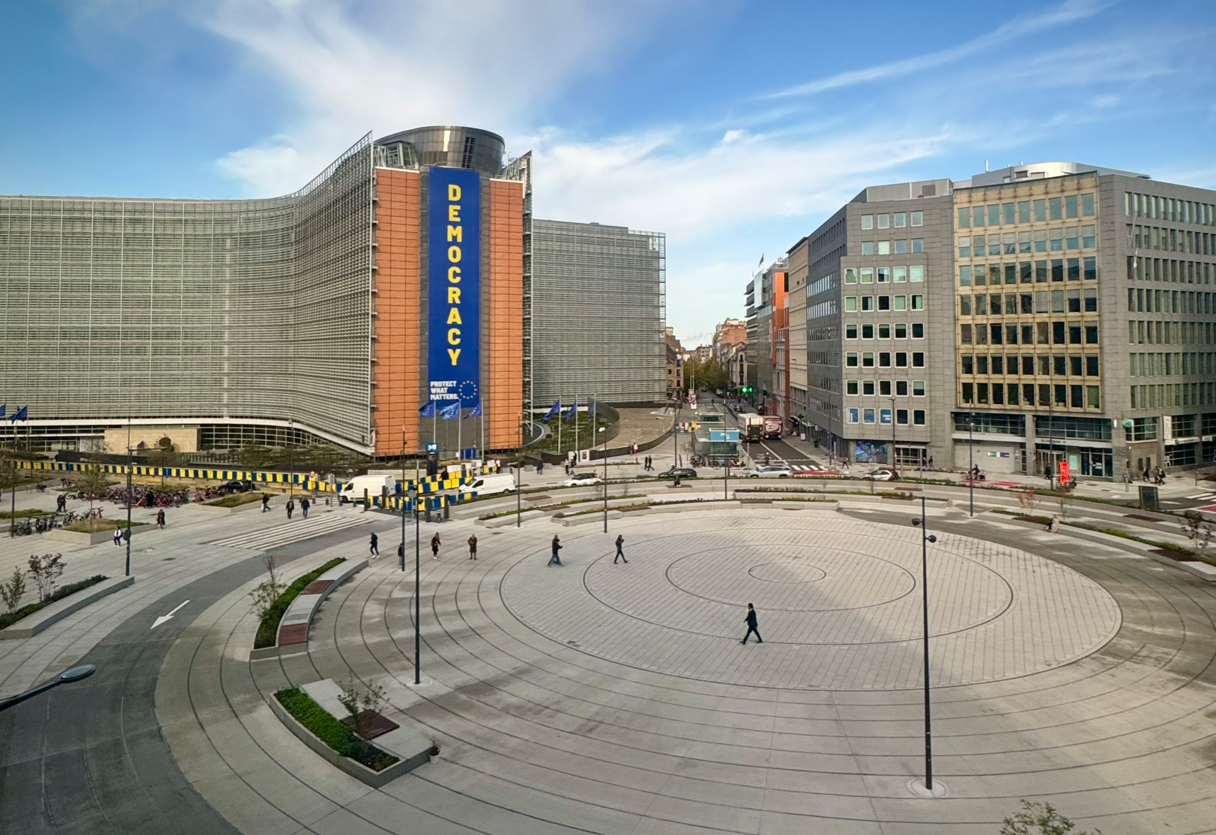
Earlier this year, when the long works on the Schuman Square were seemingly completed, the result was a flat, barren concrete space that was widely mocked online and criticised by its own architect as "the square nobody wanted".
To say the least, Schuman Square leaves much to be desired. But compared with what it looked like at the turn of the century – little more than a glorified junction on the E40 motorway into Brussels from Liège – today's square is a vast improvement.
Back then, it was a traffic-choked nightmare. Cars poured in along three lanes from Avenue de Cortenbergh, joining a frequently gridlocked roundabout. More traffic converged from four other directions, most of it funnelling into the five-lane Rue de la Loi.
The need for a radical rethink was obvious, even if the solution was not.
A broad consensus gradually emerged: if Schuman Square was to become a fitting centrepiece for the European Quarter of Europe's capital, through traffic had to go.
In November 2001, Belgium's Mobility and Transport Minister Isabelle Durant published a masterplan for the Léopold-Schuman district. It proposed converting an existing short exit tunnel on Avenue de la Joyeuse Entrée into an entrance tunnel, allowing cars arriving from Avenue de Cortenbergh to reach Rue de la Loi beneath Schuman Square.
In a more ambitious plan published in May 2002, the Brussels Region explored the possibility of keeping traffic underground all the way from the E40 to Rue de la Loi. This would involve allowing traffic in both directions through the existing tunnel beneath Avenue de Cortenbergh, which connects Rue Belliard to the E40.
The drawback was considerable: maintaining access to the Berlaymont and Justus Lipsius car parks would require complex engineering work deep beneath Schuman Square.
A subsequent study, jointly commissioned by the federal and regional governments in July 2023, explored a more radical solution: reversing the direction of the one-way traffic on Rue de la Loi and Rue Belliard.
This would also require substantial work in Cinquantenaire Park, conveniently providing an opportunity to close the gaping opening where the road emerges – an eyesore that spoils both the view and the park's tranquillity.
Unfortunately, this ingenious solution ran into an obstacle some distance from Schuman Square. The series of tunnels between Place du Trône and Rue de la Loi was designed to allow cars to enter Rue Belliard smoothly, but not to leave it.
The great disappointment
Attention therefore focused for more than a decade on a fourth option, first explored in the May 2002 report.
In 2001, the federal and regional governments had endorsed SNCB's plan for a kilometre-long railway tunnel connecting Schuman station to the small Josaphat station, creating a direct rail link to Brussels Airport and Leuven.
Construction began in 2008, the structural work was completed in 2012, and direct trains between Schuman and the airport began running in 2016.
Crucially, there was enough room between the new railway tunnel and the existing road tunnel – which carries traffic from Rue Belliard towards the E40 beneath Schuman Square and Avenue de Cortenbergh – to build another road tunnel in the opposite direction.
Cars arriving from the E40 could enter this new tunnel at Boulevard Reyers and emerge only on Rue de la Loi, bypassing Schuman Square altogether.
This avoided the problems that had scuppered the other proposals. It was both the most practical and the most promising option.
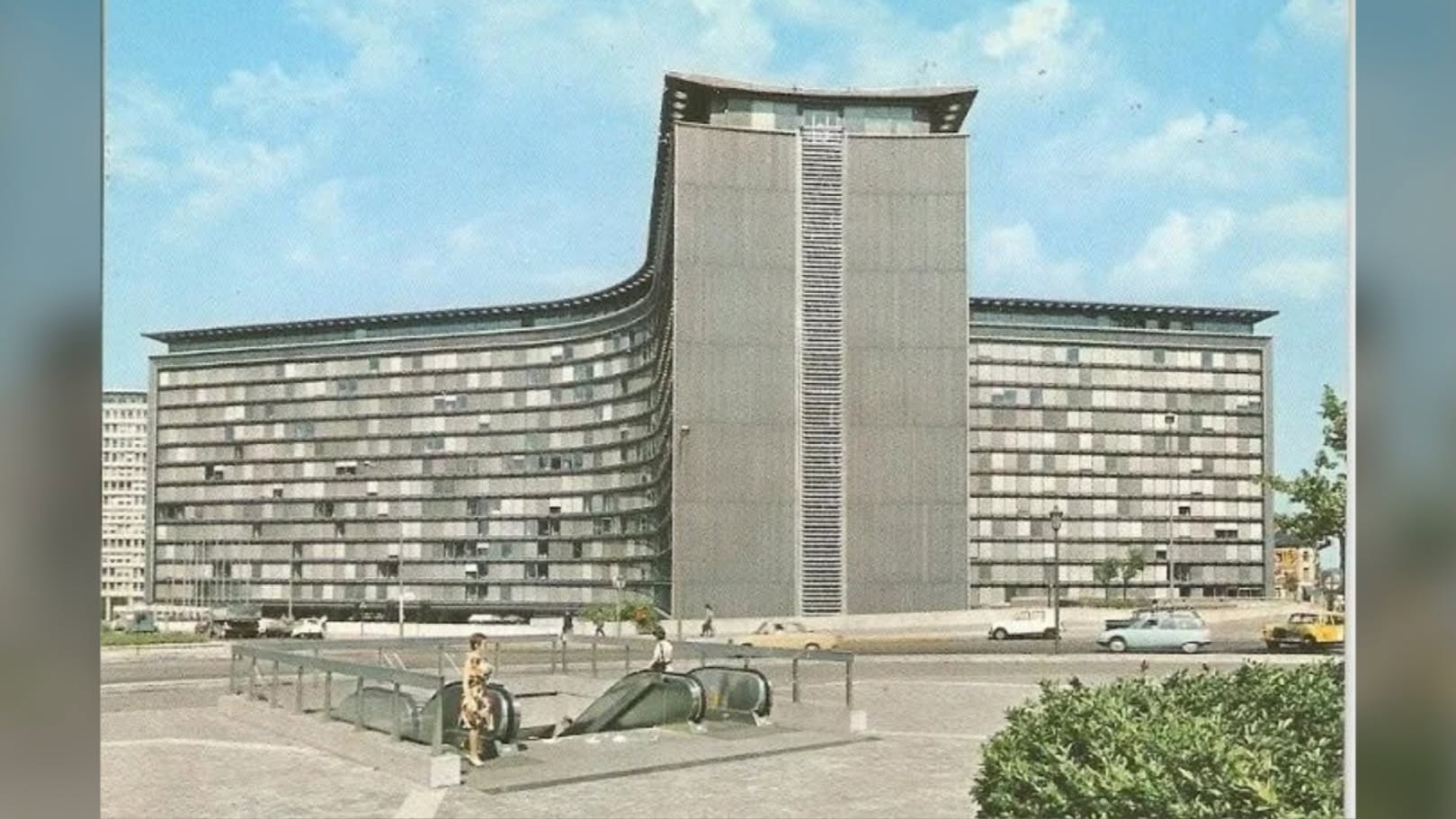
Berlaymon building.
In 2010, the Brussels government decided to proceed. A planning application followed in July 2013. At last, Schuman Square seemed on course to be freed of through traffic.
But it was not to be.
A 2004 European directive had introduced minimum safety requirements for tunnels longer than 500 metres, particularly concerning emergency exits. On March 13, 2012, a coach crashed in a Swiss tunnel, killing 28 people, including 22 children, most of them Belgian.
The tragedy prompted the Brussels authorities to scrutinise the implications of the directive for the proposed tunnel.
Preliminary estimates suggested that meeting the safety requirements for the 1.3-kilometre road tunnel from Boulevard Reyers to Rue de la Loi would triple its cost.
The new regional government, formed in July 2014, judged this far too expensive given Brussels' other needs. With that decision, the dream of removing all through traffic from Schuman Square was over.
Two steps forward
For those of us who care about the European Union's image – and therefore the appearance of its most symbolic public space – the disappointment was immense.
Yet there had been progress on two other important fronts: reducing traffic on Rue de la Loi between Schuman Square and Avenue des Arts, and making better use of the ground floors of buildings between the square and Cinquantenaire Park.
With the backing of the European Quarter residents' committee (GAQ) and a small group of businesses along Rue de la Loi, including Touring and Total, Brussels Mobility Minister Jos Chabert proposed in October 2001 reducing the road from five traffic lanes to four, with a cycle lane on each side.
The scheme was tested in May 2002 and completed in August 2003. The cycle lanes soon became the busiest in the region, helping to drive the subsequent boom in cycling across Brussels.
Building on that success, Brussels Mobility Minister Elke Van den Brandt took advantage of the Covid pandemic in May 2020 to reduce the number of traffic lanes from four to three and introduce a two-way cycle lane.
The reduced capacity of Rue de la Loi had a knock-on effect further upstream. Today, cars arriving from the E40 approach Schuman Square in a single lane.
Meanwhile, progress was being made on another equally important front.
In the late 1990s, insurance company Axa decided to demolish seven buildings it owned in the triangle formed by Avenue de Cortenbergh, Avenue de la Joyeuse Entrée and the short stretch of Rue de la Loi between Schuman Square and the park.
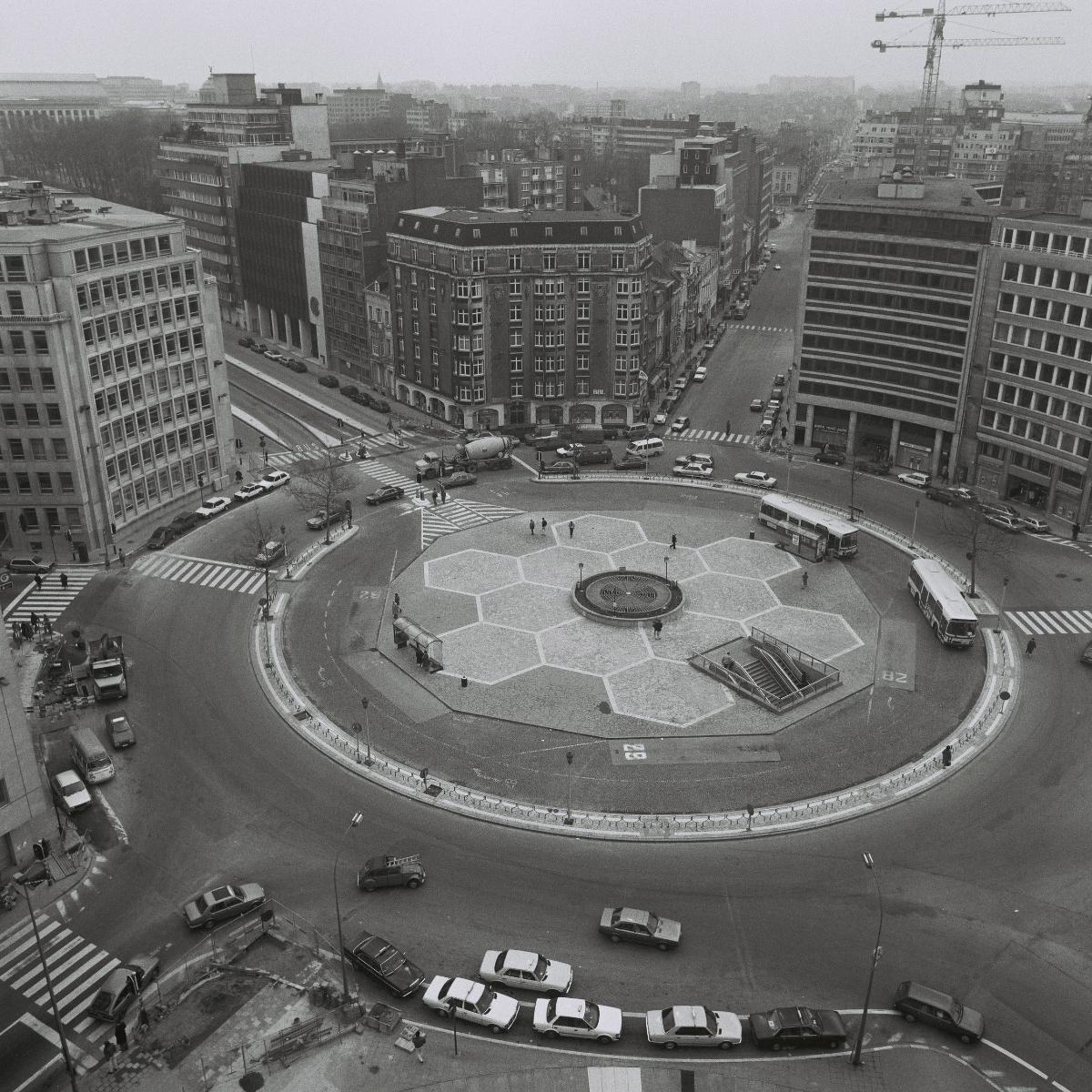
Schuman roundabout.
It planned to replace them with a large building, which it hoped to lease to a European institution.
If the area between Schuman Square and the park was ever to become a lively public space, with cafés and terraces, the design of the new building's ground floor would be crucial.
Unfortunately, Axa's 2002 planning application envisaged an impenetrable ground floor occupied entirely by offices.
Shops and cafés were out of the question, the company argued, because no European institution would accept them beneath its offices.
Our residents' committee put this claim to European Commission President Romano Prodi. He firmly denied that it reflected Commission policy and instead expressed strong support for anything that would make Schuman Square feel more like a piazza.
That helped.
At a meeting on July 3, 2003, Axa's architect, the residents' committee and a Brussels planning official reached an agreement: permission would be granted provided the ground floor included space for cafés, restaurants, shops and a small supermarket.
The old buildings were demolished in 2006 and the replacement completed in 2009. The European External Action Service (EEAS), the EU’s foreign service, moved there in February 2012, by which time the ground-floor premises had already been let on long-term leases.
The possibility of creating a lively piazza, with terraces stretching towards the park, had been preserved.
From amphitheatre to canopy to nothing
But what of Schuman Square itself?
In 2009, while the future EEAS headquarters was under construction and the road tunnel beneath Avenue de Cortenbergh was still planned, an international competition was launched to redesign the square.
A proposal by architect Xaveer De Geyter, featuring an amphitheatre at its centre, was selected in 2011. But it was abandoned in 2014 when the tunnel project was dropped.
A new competition followed in December 2015. This time, the winning design came from the Belgian-Danish consortium COBE-BRUT and featured a large canopy at the centre of the square.
The Brussels government approved the design in December 2017, and planning permission was granted in December 2021.
Work began in November 2023 and was completed in September 2026 – but without the scheme's most distinctive feature. Faced with the Region's dire financial situation, the government decided it could not afford the canopy.
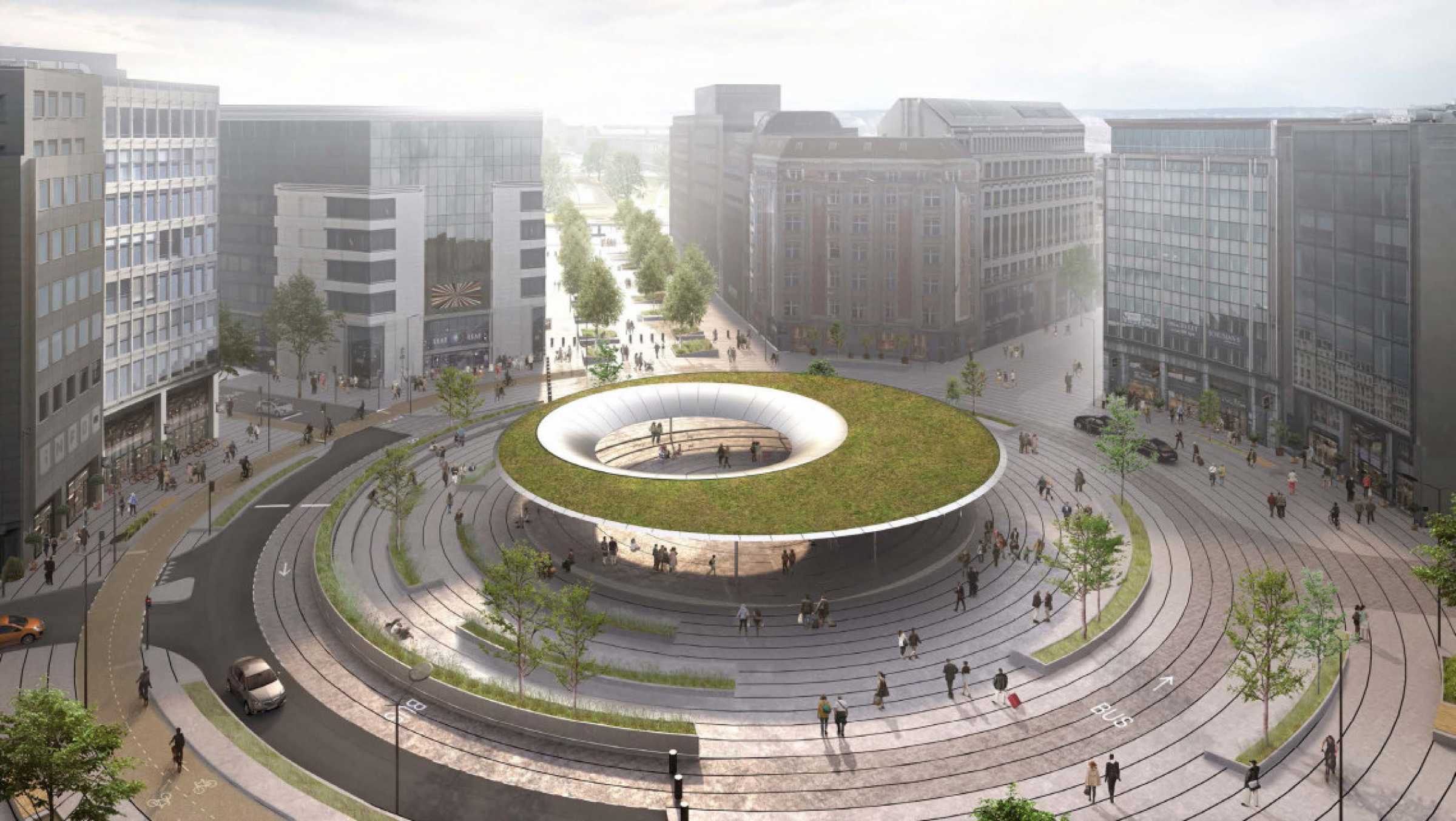
Visualisation of the Schuman roundabout with the canopy.
It is unlikely ever to be built. Nevertheless, the main work has been done.
Schuman Square is now as free of cars as it can reasonably be without the Cortenbergh tunnel. It is better suited to demonstrations and other public gatherings. Those taking part – or simply enjoying the experience of being at the heart of the European Union – can rest on the many sturdy, if not especially comfortable, bench-like structures dotted around the square.
A pedestrian zone now stretches from the European Council building to Cinquantenaire Park, without creating new traffic jams or diverting cars into residential streets.
Some residents regret that they can no longer drive from one side of the square to the other. But their convenience cannot take precedence over the design of the European Union's most symbolic public space.
Taking care of Europe's capital
Much, however, remains to be done.
After an exceptionally hot summer, the demand for more greenery is stronger than ever. Planting trees above a maze of road, railway and metro tunnels, cables and pipes is hardly straightforward. But the remarkable greening of the city centre's pedestrian zone suggests it should not be impossible.
On July 16, 2026, the Brussels government adopted a plan canopée. Despite its name, this is not an attempt to revive the abandoned canopy, but a plan to create a green canopy over various public spaces, including Schuman Square.
Nor should it be beyond our means, now or in the future, to give the centre of the square a striking landmark worthy of its symbolic importance.
Perhaps it is time for the EU to recognise that it is no longer merely an international organisation that happens to have based most of its administration in Brussels, as NATO has done in Evere.
It is now a democratic political entity with a genuine capital.
That gives the EU certain rights in our city, but also obligations – not least to contribute financially to the quality of the neighbourhood in which it has established such a substantial presence.
In June 2026, the Brussels regional government attempted, perhaps somewhat clumsily, to enlist the European institutions' support. So far, without success. It should try again.
There is another possibility worth considering.
In May 2014, as the plan to divert through traffic underground was about to be abandoned on financial grounds, I put forward a suggestion in BxlConnect, the publication that would become The Brussels Times the following year.
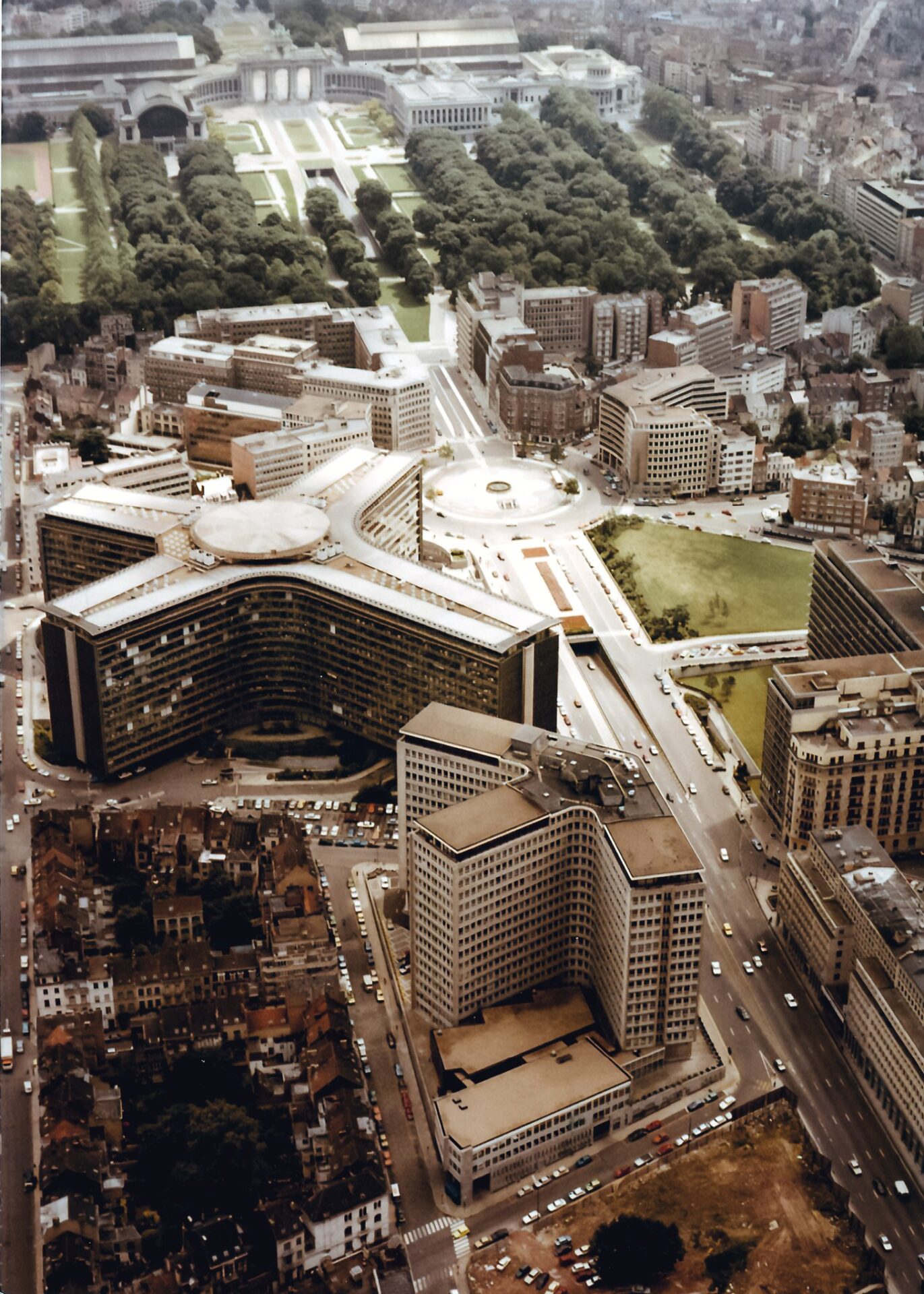
Berlaymont in 1978.
It drew inspiration from Brussels a century earlier, when its wealthier residents paid no income tax. Nevertheless, they helped finance improvements to the city, including monumental fountains, through voluntary public subscriptions.
Affluent citizens considered it their duty to devote some of their wealth to public spaces that everyone could enjoy and take pride in.
Today, many Brussels residents – EU officials, diplomats and others – are in a comparable position. They are comfortably off, yet pay no income tax to local, regional or federal authorities.
I know several who feel uneasy about this. They might welcome the chance to contribute to an ambitious crowdfunding initiative – a modern equivalent of those public subscriptions.
Rather than simply complain about what has not been done, they could help make it happen.
And in doing so, they would help improve a square whose transformation they may not fully appreciate, but which is already immeasurably better than the traffic-choked junction that occupied the heart of Europe's capital at the beginning of this century.
The Schuman debacle in dates
2001: First plan to send through traffic under Schuman roundabout
2003: Car lanes on Rue de la Loi cut from five to four lanes; first two cycle lanes
2003: Plan approved for the EEAS building on condition that ground floor can house cafés and shops
2008: Start of building of the railway tunnel under Avenue de Cortenbergh
2009: Completion of the EEAS building, with cafés and shops
2010: Plan approved for a car tunnel above the railway tunnel taking the cars from the E40 all the way to Rue de la Loi
2011: Approval of a design for Schuman Square (with an amphitheatre)
2012: Bus accident in a Swiss tunnel killing over 20 Belgian children
2014: Tunnel project and first Schuman Square redesign abandoned
2017: New design approved for Schuman Square (with a canopy)
2020: Car lanes on Rue de la Loi reduced from four to three; two more cycle lanes
2023: Schuman Square works start
2026: Schuman Square works completed (without the canopy)
