
The European Union last accepted a new member country in 2013. Enlargement remains a tricky and politically-charged business but the race is still on to be the 28th member.
It has been 13 years since a country joined the European Union, the longest enlargement gap that the bloc has experienced since it first started accepting new members in 1973 when Denmark, Ireland and the United Kingdom joined.
Since Croatia’s name was added to the list, the Union has actually shrunk from 28 to 27 members following the UK’s 2016 decision to leave. The lack of further growth has not been due to lack of interested parties.
Indeed, there are nine official candidates – Albania, Bosnia and Herzegovina, Georgia, Moldova, Montenegro, North Macedonia, Serbia, Türkiye and Ukraine – and one potential candidate, Kosovo.
Of those 10, it is safe to assume that Bosnia and Herzegovina, Georgia, Serbia and Türkiye will not be gracing the halls of the EU anytime soon, given the diverse political obstacles that exist in each of those countries.
Kosovo’s lack of universal recognition within the existing club of EU members – Cyprus, Greece, Romania, Slovakia, and Spain maintain their policy of non-recognition – also means that its future for the time-being is not within the club.
Moldova and Ukraine are the newest candidate countries and are poised to make fast progress in the accession process. This month, the European Commission will propose opening the first membership ‘chapters’ for both countries.
Moldova wants to join the EU in 2028 and has even suggested that it would consider unifying with Romania if that timetable is not respected. Ukraine also wants to be an EU member as quickly as possible.
Germany has suggested granting Ukraine so-called associated membership, which would give Kyiv access to certain funding programmes, decision-making bodies and security guarantees, without voting rights. The plan has not been received well.
Both membership bids are closely tied together and their ultimate fates are largely dependent on what happens with Russia and whether any territorial resolutions can be brokered in the coming years.
Like NATO, the EU will not import disputes and conflicts into the club.
Albania and North Macedonia’s membership aspirations are also linked, as both were granted candidate status at the same time. North Macedonia even officially changed the name of the country to placate Greece, so their commitment cannot be doubted.
But both still need to make serious reforms and count on diplomatic solutions going their way if they want to even dream of membership before 2030. A lot of work still needs to be done.
That means that Montenegro, out of the official candidate nations, is in pole position to join. EU membership is popular in the Adriatic nation, the government is firmly committed to the plan and reforms are proceeding quickly.
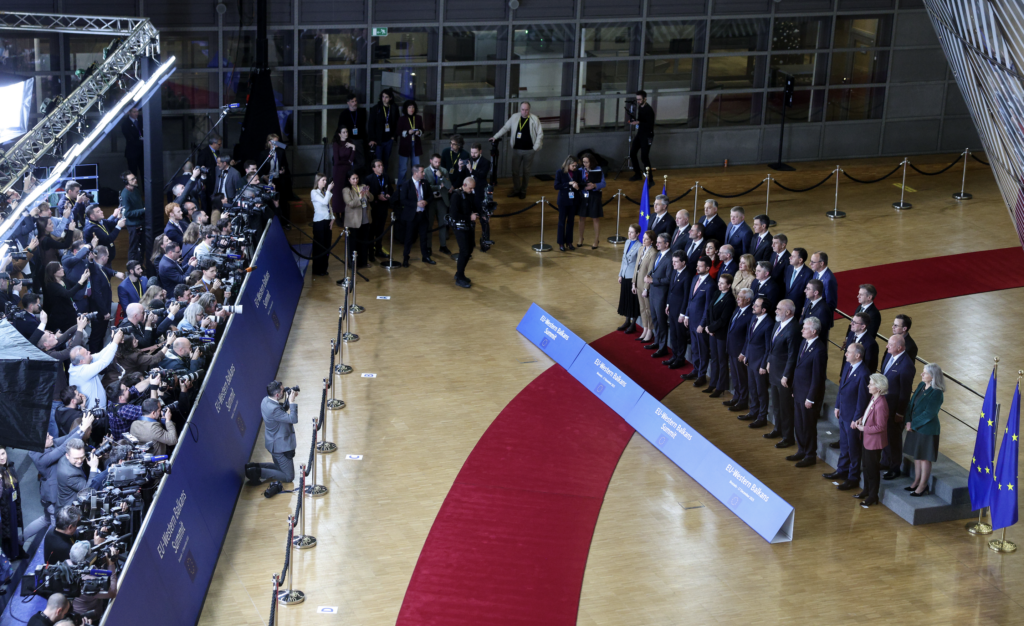
Tomorrow, the latest edition of the EU-Western Balkans summit is being held on Montenegro’s coast in the town of Tivat, a powerful nod to the fact that the country is at the front of the enlargement queue.
Diplomats are even starting to draw up the accession treaty that Montenegro would eventually have to sign before joining, so things are without doubt getting serious.
There are a number of reasons why Montenegro makes sense as the 28th member. The country is small, just 600,000 people, so the balance of power in the EU would not be unduly affected. Funding programmes would also not be overly diluted.
Montenegro also flirts with being in Russia’s orbit, thanks to political and propaganda influence. Accepting Montenegro would therefore be a huge diplomatic win for the EU and potentially help neuter Moscow’s influence in the region.
Finally enlarging and choosing a relatively low-risk option like Montenegro also shows the other candidate countries that EU membership is not an empty promise, that if the right reforms are made, you will be accepted.
Without it, Russia and other actors like China and the United States could destabilise the EU’s backyard by pointing to the fact that Brussels does not live up to its word.
Beyond the official candidates though, it might not be Montenegro that steps over the EU threshold first. Iceland, Norway and even the United Kingdom might beat Podgorica to the punch.
Russia and the United States’ continuing upending of the established world order and the vagaries of geopolitics have made people in those countries think that just maybe it would be better to be inside among friends than outside in the cold.
Iceland is holding a referendum in August. Depending on the result, EU talks could well move quickly as the country is largely aligned with the norms and principles expected of members.
Norwegians are also coming around to the idea. Pro-EU sentiment is on the rise, although no clear majority either way exists. As things stand, the government is unlikely to pull the trigger on a membership bid but there is
And then there’s the UK. Ten years on from the Brexit vote, there is a consensus building that it was a bad idea, which has hurt the country from an economic and diplomatic standpoint.
The current Labour government is not seeking anything close to membership talks and has ruled out joining the single market, but Prime Minister Keir Starmer is on the ropes and a change of party leadership could soon happen.
If new leadership softens those red lines and momentum builds behind getting back in the club, then serious talks will have to be had about what terms a rejoin would happen.
Would a euro opt-out be allowed? What about Schengen? Can the British public finally make their peace with free movement? Would the existing EU members even approve of welcoming the Brits back?
At the end of the day, EU membership remains popular and attractive. It is the existing members, those who will ultimately have to all agree on who joins them, that are the real obstacles to expansion.
