
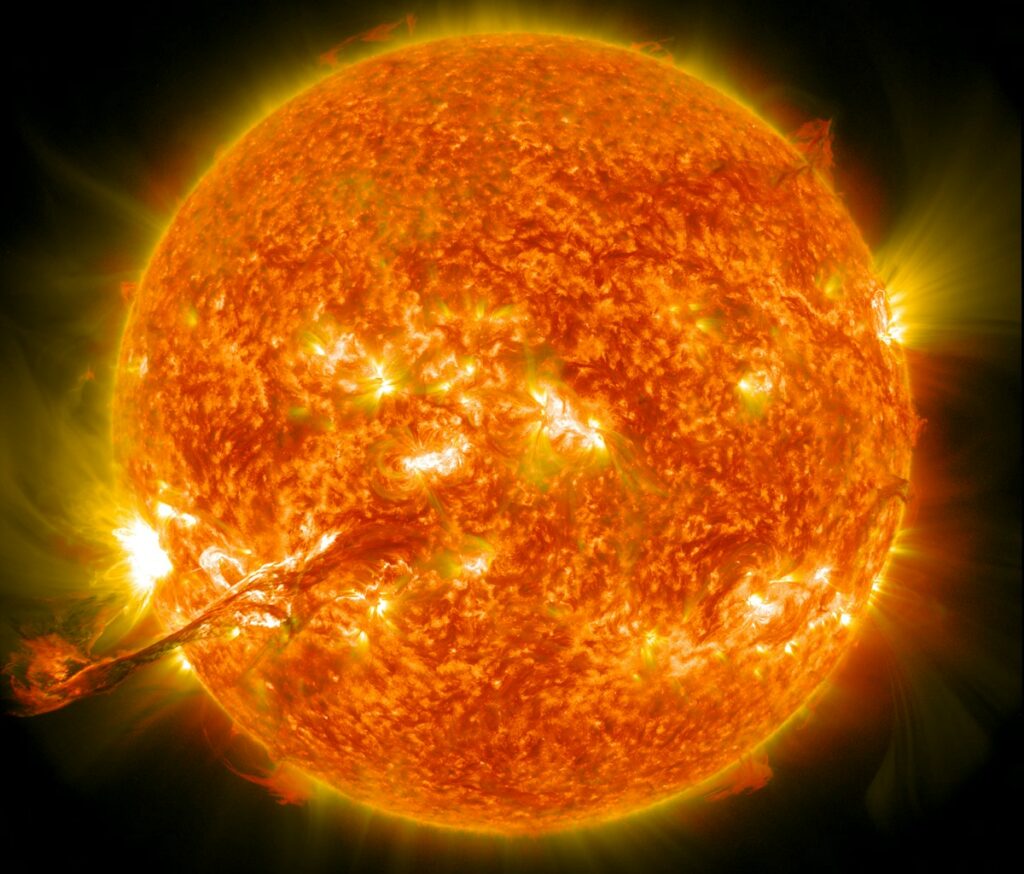
The Earth might not be engulfed by the Sun when it reaches the end of its life cycle in about five billion years, according to new research published in Astronomy & Astrophysics by KU Leuven and France’s CEA Paris-Saclay.
Scientists have long believed the planet would vanish as the Sun expands into a red giant and later an asymptotic giant star, during which it significantly increases in size and loses mass through strong stellar winds.
The study suggests Earth’s fate depends on a balance between two forces. Tidal forces pull the planet closer to the expanding Sun, while the Sun’s mass loss weakens its gravitational pull, allowing Earth’s orbit to shift outwards.
“This delicate equilibrium between these effects is crucial,” explained Mats Esseldeurs, researcher at KU Leuven’s Institute of Astronomy. “If tidal forces dominate, Earth will be consumed by the dying Sun. If mass loss prevails, the planet may escape to a wider orbit.”
Using advanced models, researchers calculated that tidal effects are likely weaker than previously thought, meaning Earth might maintain enough distance during the Sun’s giant phases to avoid engulfment. In such a scenario, Earth would continue orbiting the Sun after it becomes a white dwarf.
“This doesn’t mean Earth will remain habitable,” warned astronomy professor Leen Decin of KU Leuven. “Long before the Sun’s giant phase begins, Earth’s temperatures will rise so drastically that life will become impossible.”
Despite the findings, uncertainty remains. Predicting the exact amount of mass the Sun will lose is challenging, and additional observations of similar stars are needed to refine the models.
