

On 20 October 1996, over 300.000 people gathered in the streets of Brussels to protest the failures in the investigation into the crimes of serial killer Marc Dutroux, in what became known as the 'White March'.
Dutroux had been arrested on 13 August of that year, as a suspect in the disappearance of the 14-year-old Laetitia Delhez. Shortly after his arrest, police discovered Laetitia together with the 12-year-old Sabine Dardenne in Dutroux's basement. Sabine had been missing since May, when Dutroux kidnapped her as she was on her way to school.
Dutroux had held the girls in a hidden compartment in his basement, with police failing to discover the secret door leading to the cellar.
In the weeks after his arrest, Dutroux revealed the locations of the bodies of several more missing girls. Julie Lejeune, 8, Mélissa Russo, 8, An Marchal, 17, and Eefje Lambrecks, 19, had been missing for a year when their bodies were discovered buried in the gardens of various houses owned by Dutroux.
Related News
- Father of Dutroux victim speaks out: 'Still a great deal of work to be done to protect children'
- The infamous Dutroux case, 30 years on: Why Belgian police failed to catch a killer
- The infamous Dutroux case, 30 years on: How 'Le Monstre' dragged Belgium into darkness
The case ignited widespread anger within Belgium. Initially, this anger was directed at Dutroux himself, but it quickly spread to the apparatus meant to stop him.
In the search for the missing girls, police had made several severe mistakes. Dutroux, who had been convicted of sexually assaulting several underage girls in 1988, had been a suspect since the early stages of the first disappearances, but local, federal and military police failed to share intelligence. At some point, local police officers were tipped off to Dutroux's plans of building a hidden cellar to hold young girls prisoner, but failed to discover it when searching his house.
Betrayed innocence
The White March happened in the direct aftermath of the Spaghetti Ruling, when the Belgian Court of Cassation removed judge Jean-Marc Connerotte from the investigation of the Dutroux case. Connerotte was removed after attending a fundraiser for the family of Dutroux victims. By eating a plate of spaghetti and accepting a pen as a gift, Connerotte had proven to no longer be impartial, the Court ruled.
Following the arrest, protesters gathered at several courthouses throughout the country, outraged at what they saw as a cover-up. Connerotte was given credit for saving the lives of Laetitia and Sabine, and many hoped he would have been able to uncover the full extent of the Dutroux case. His removal broke what little trust Belgians had left in its judicial system.
The families of Dutroux's victims and several other missing children sent out a statement, calling for people to come to Brussels on 20 October and protest against the failures of the judicial system, for an independent investigation into the Dutroux case and to better protect children.
"We want this march to take place without banners or political slogans. White will be our symbol – the symbol of our injured and murdered children, of betrayed innocence," the statement read.
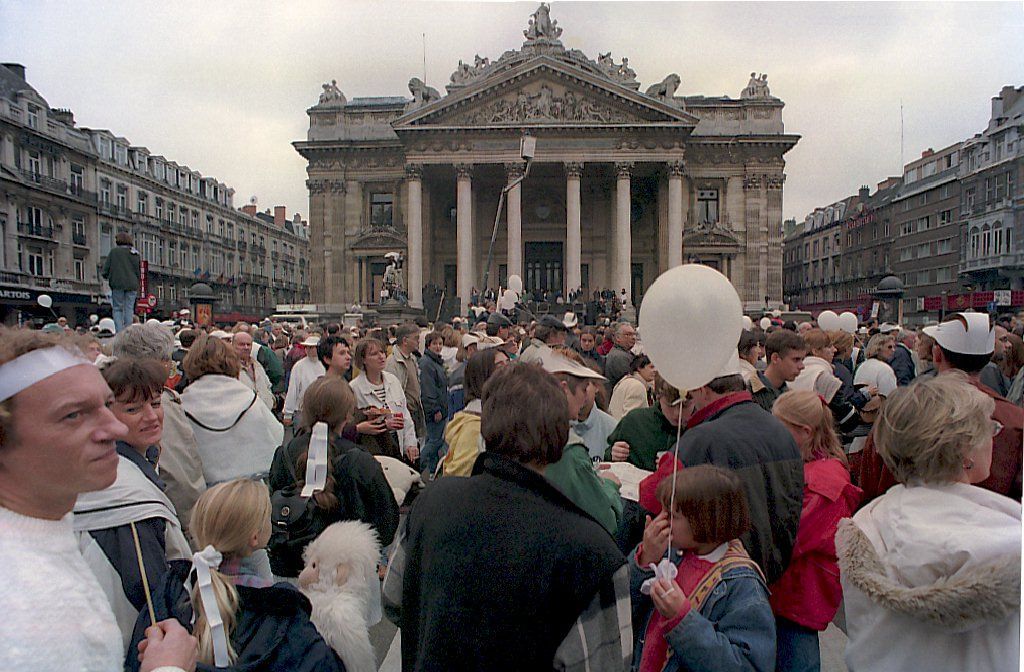
Demonstrators passing in front of Brussels' stock exchange. Credit: Belga photo
The White March passed through Brussels in complete silence, occasionally interrupted by applause when the parents of the victims passed. Protesters asked for reforms in Belgium to better protect children and raised awareness of several missing children cases that had not been resolved.
Following the march, many gathered in so-called White Committees to commemorate the march and simultaneously pressure the Belgian political system into implementing the changes it had asked for.
While the impact of the White March on Belgian society was significant, it initially only had limited results on a political level. Jean-Denis Lejeune, father of Julie, receives support to found Child Focus, an organisation assisting police with the search for missing children. It remains active to this day.
Judicial reform follows in 1998, after Dutroux managed to escape from a court in Neufchâteau. While he was caught after only a couple of hours, Justice Minister Stefaan De Clerck and Minister of the Interior Johan Vande Lanotte stepped down.
The political shock of his escape forces eight parties to find an agreement on a thorough reform of the police, the so-called Octopus agreement.
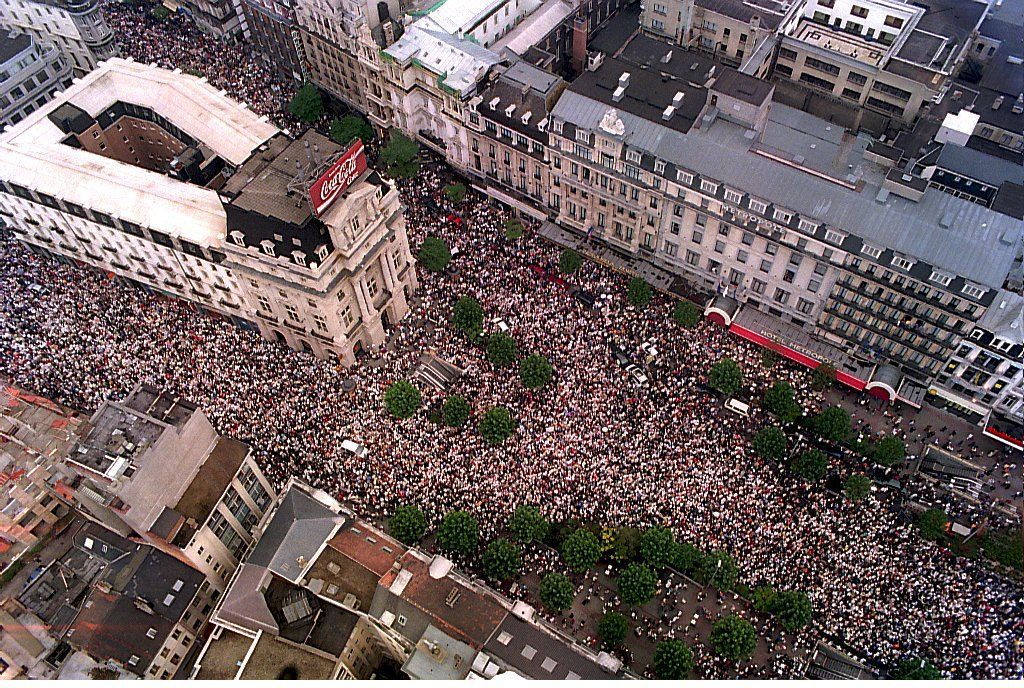
Aerial view of some of the demonstrators at the De Broeckere Square. Credit: Belga photo
