
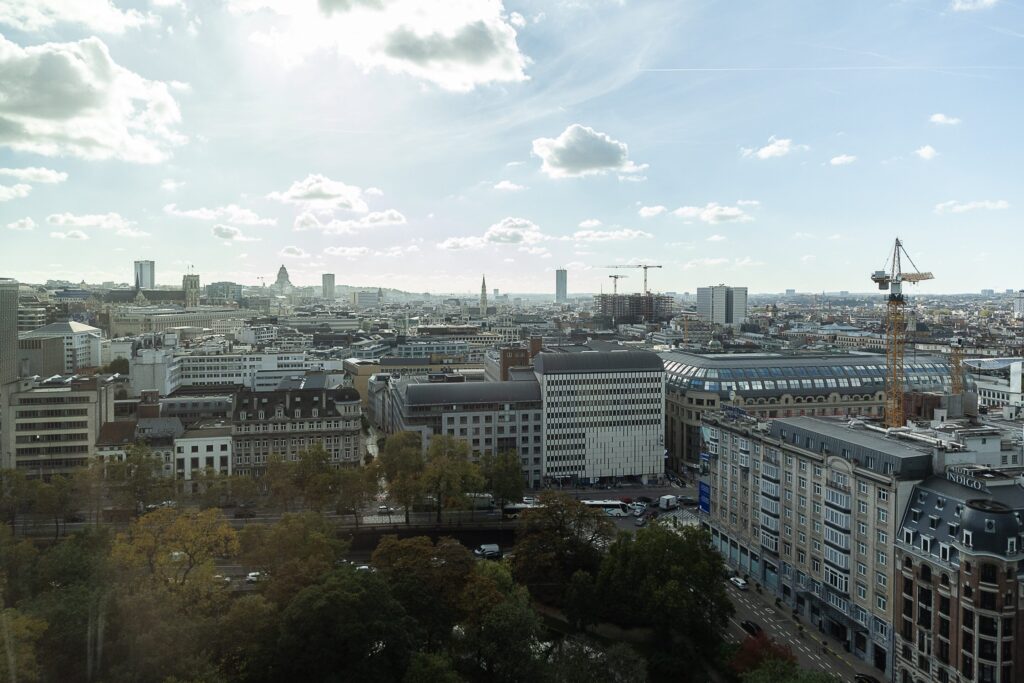
Brussels would not meet the new EU air pollution limits if they were implemented today, according to the Clean Cities City Ranking 2026.
Brussels scores highly on the ranking, as the Capital-Region comes in fifth with a B grade. If the new limits were implemented today, the city would still fail to meet them.
"For Brussels, it shows a straightforward story: the ambitious low-emission zone (LEZ) works," Pierre Dornier, founder of Les Chercheurs d'Air, an organisation dedicated to raising awareness about air pollution in Brussels, told The Brussels Times.
"The numbers back up that the LEZ has improved air quality, but there is still a lot of work to be done," he said.
The EU has revised its pollution limits for both Nitrogen Dioxide (NO₂) and Particulate Matter (PM₂.₅), with stricter limits being implemented by 2030.
The other Belgian cities on the ranking also fall short of the new limits, with Ghent ranking one spot above Brussels at fourth place (B grade) and Antwerp ranking 21st with a C grade.
Across Europe, only three cities are on track to reach the EU air pollution limits: Copenhagen, Stockholm and Helsinki, which were the only cities given grade A.
More than half of public space is for cars
The lowest-ranking cities on the ranking are Zagreb, Bucharest and Athens. All 11 cities given the lowest grades are located in Southern, Central or Eastern Europe.
"It is important to note that the new limits are still above the World Health Organisation (WHO)'s guidelines. And even at those guidelines, there is still a health risk," Dornier warned.
He said that while the full implementation of the LEZ at the current timeline would see Brussels meet the limits by 2030, this would not be enough to reach the WHO guidelines.
Dornier pointed to other measures, like implementing car-free zones around schools and shifting the public space towards being more cycling- and public transport-friendly. "Our research shows that of all the public space in the city, 53% is designated for cars and other private transport. Public transport amounts to 3%, and bicycles only to 1%. Giving more space to these will directly improve air quality."
Clean Cities, a coalition of 150 NGOs and groups focused on sustainable urban mobility and reducing environmental impact, publishes its yearly City Ranking, which ranks 40 major European cities based primarily on air-quality data from the European Environment Agency (EEA).
| Rank | City | Country | Grade | Total score |
|---|---|---|---|---|
| 1 | Copenhagen | Denmark | A | 54.8 |
| 2 | Greater Stockholm | Sweden | A | 50.8 |
| 3 | Greater Helsinki | Finland | A | 48.9 |
| 4 | Ghent | Belgium | B | 42.0 |
| 5 | Brussels-Capital Region | Belgium | B | 40.8 |
| 6 | Bilbao | Spain | B | 40.1 |
| 7 | Munich | Germany | B | 39.4 |
| 8 | Cologne | Germany | C | 38.9 |
| 9 | Vienna | Austria | C | 38.8 |
| 10 | Greater Amsterdam | Netherlands | C | 38.1 |
| … | ||||
| 21 | Antwerp | Belgium | C | 33.1 |
